
BRIEF
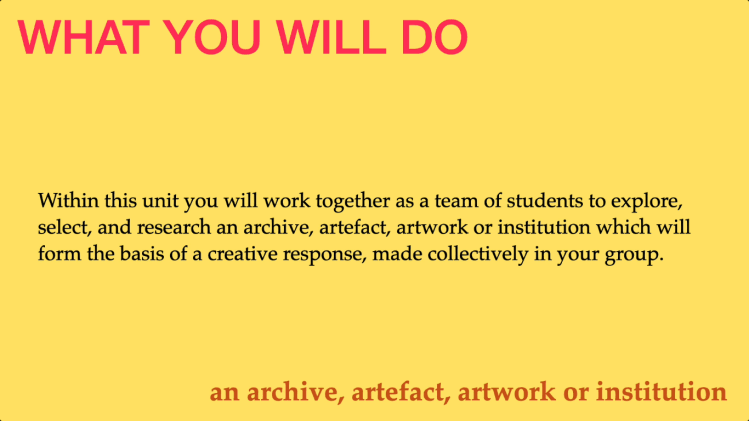
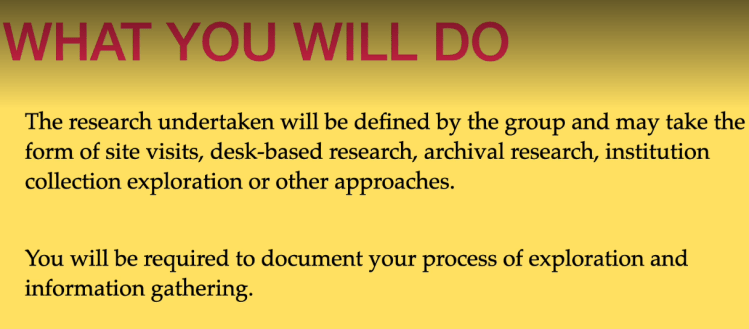
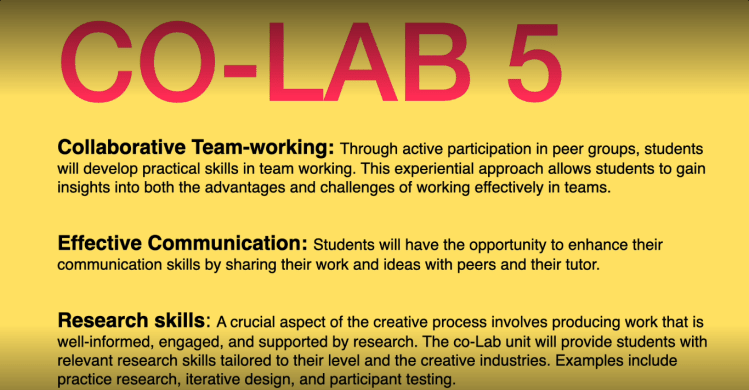
Within this unit you will be carrying out collaborative active research into a relevant collection, institution, object or artifact. The research undertaken will be defined by the group and may take the form of site visits, desk-based research, archival research, institution collection exploration or other approaches. You will be required to document your process of exploration and information gathering.
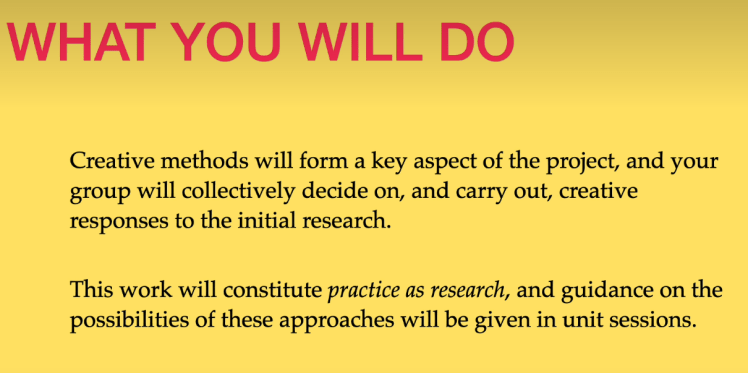
Creative methods will form a key aspect of the project, and your group will collectively decide on, and carry out, creative responses to the initial research. This work will constitute practice as research, and guidance on the possibilities of these approaches will be given in unit sessions.
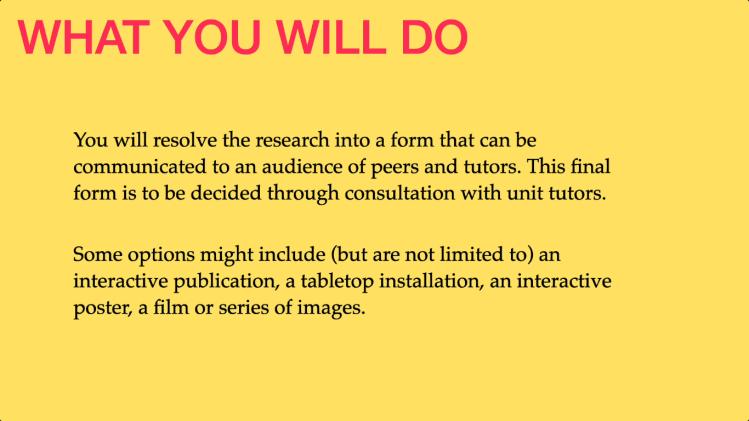
As a group you will collectively resolve the research into a form that can be communicated to an audience of peers and tutors. This final form is to be decided through consultation with unit tutors.
Some options might include (but are not limited to) an interactive publication, a tabletop installation, an interactive poster, a film or series of images.
Presentation of the research and final elements will be shared in a group showcase on the 8th December, where groups will collectively present their work.
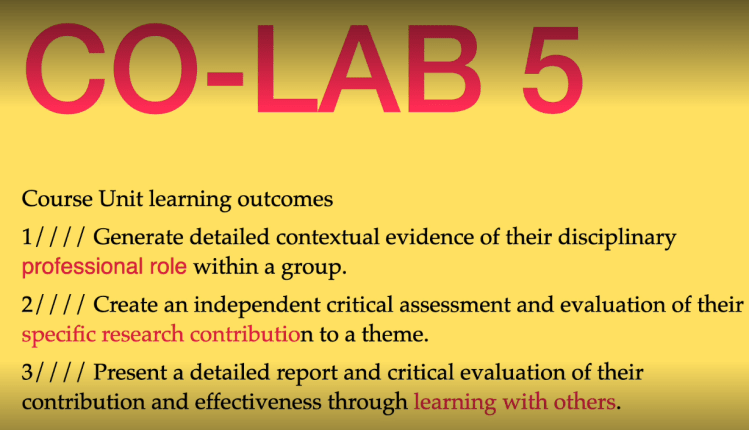
Learning Outcomes
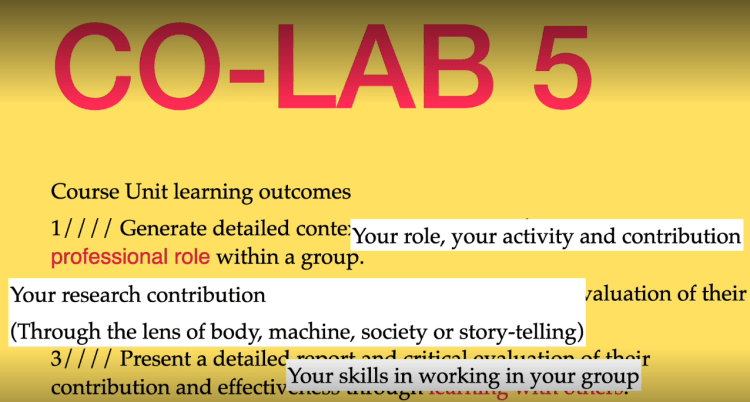
1. Generate detailed contextual evidence of their disciplinary professional role within a group.
2. Create an independent critical assessment and evaluation of their specific research contribution to a theme.
3. Present a detailed report and critical evaluation of their contribution and effectiveness through learning with others.
The assessment comprises
- A group portfolio
- An individual Personal Reflection (700-1000 words)
COLLAB UNIT LAUNCH VIDEO
“Nothing is original. Steal from anywhere that resonates with inspiration or fuels your imagination. Devour old films, new films, music, books, paintings, photographs, poems, dreams, random conversations, architecture, bridges, street signs, trees, clouds, bodies of water, light and shadows. Select only things to steal from that speak directly to your soul. If you do this, your work (and theft) will be authentic. Authenticity is invaluable; originality is non-existent. And don’t bother concealing your thievery – celebrate it if you feel like it. In any case, always remember what Jean-Luc Godard said: “It’s not where you take things from – it’s where you take them to.”
– Jim Jarmusch
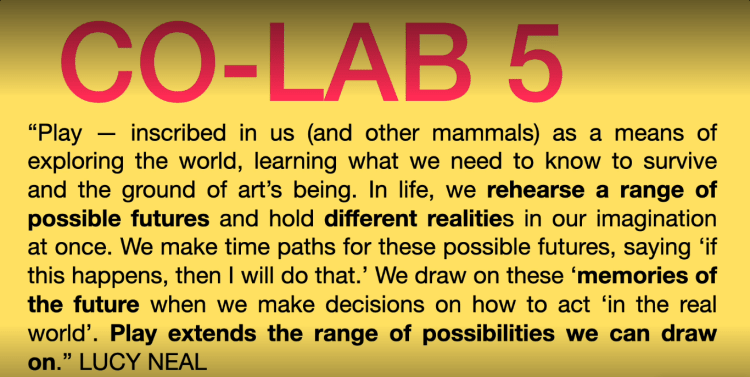
RESPOND TO ONE OF THE PROMPTS
NOTES:
- get familiar with unit handbook
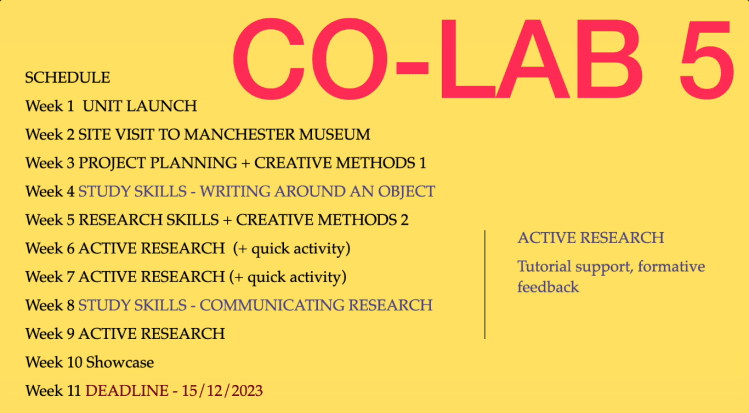
- SHOWCASE 8th of December, submission deadline 15th of December!
- MACHINE: relationship with technology
- REMIX, REFORMULATE!
- play together
- look for crossovers, intersections, they way thing react to each other
- you are not limited to one theme, if you want to explore intersections between two themes, do so!
- active research!
- have a research journal
- examples of INSTITUTIONS to analyse: MMU Special Collections, The Pankhurst Centre, The People’s History Museum, Manchester Museum, John Rylands Research institute and Libraray, Science and industry Museum
- use video data bank
- North West Film Archive
- negotiating access – takes time, challenging, not on last minute
RESEARCH
- Your research could comprise research visits/images/written sources/your own reflections on the research
- The archive, artefact, artwork, institution, or idea, that you are exploring. Find research materials in relation to it – images (yours or others), materials from their website
- Writing/reviews etc. Materials that you have found that has influenced your group’s approach. This could be artworks from the creative methods booklet or other photographers and artists, films, media, and their approaches.
- Academic and written sources that support your ideas. For example, if your work is seeking to interrogate the institution as an idea, you could use the work of Allan Sekula (introduced in week 1). If your work is engaging with ideas of family photography and the vernacular – readings around these themes
- Include readings/engagement around your chosen theme here too.
Talk to unit tutors for support with this aspect if you are struggling for reading for this aspect. We can suggest places to look! - Look to make connections between different aspects of the work.
For example, within the research portfolio can it be seen….
How has the research shaped and affected the decisions the group has made?
Where do the ideas come from – the research, making?
What has the process of making enabled you to learn? PRACTICE AS RESEARCH
How do the creative methods developed link to the themes of the work?
TRIP TO MANCHESTER MUSEUM
I visited the Manchester Museum as a part of research for the unit.
My focus was on the Egyptology department, observing the ways artefacts are displayed, the way the institution presents artefacts, China and Asia collection.
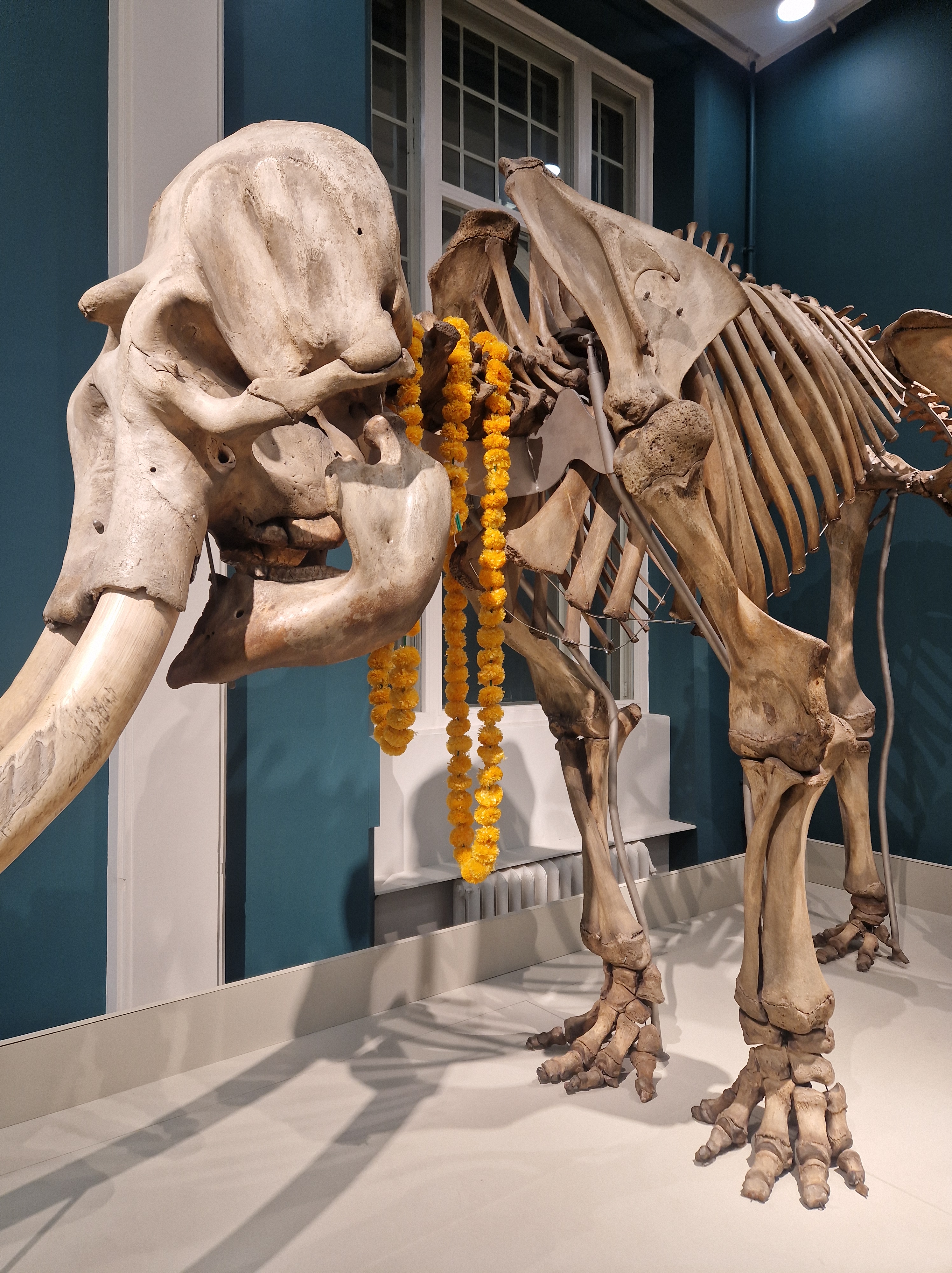
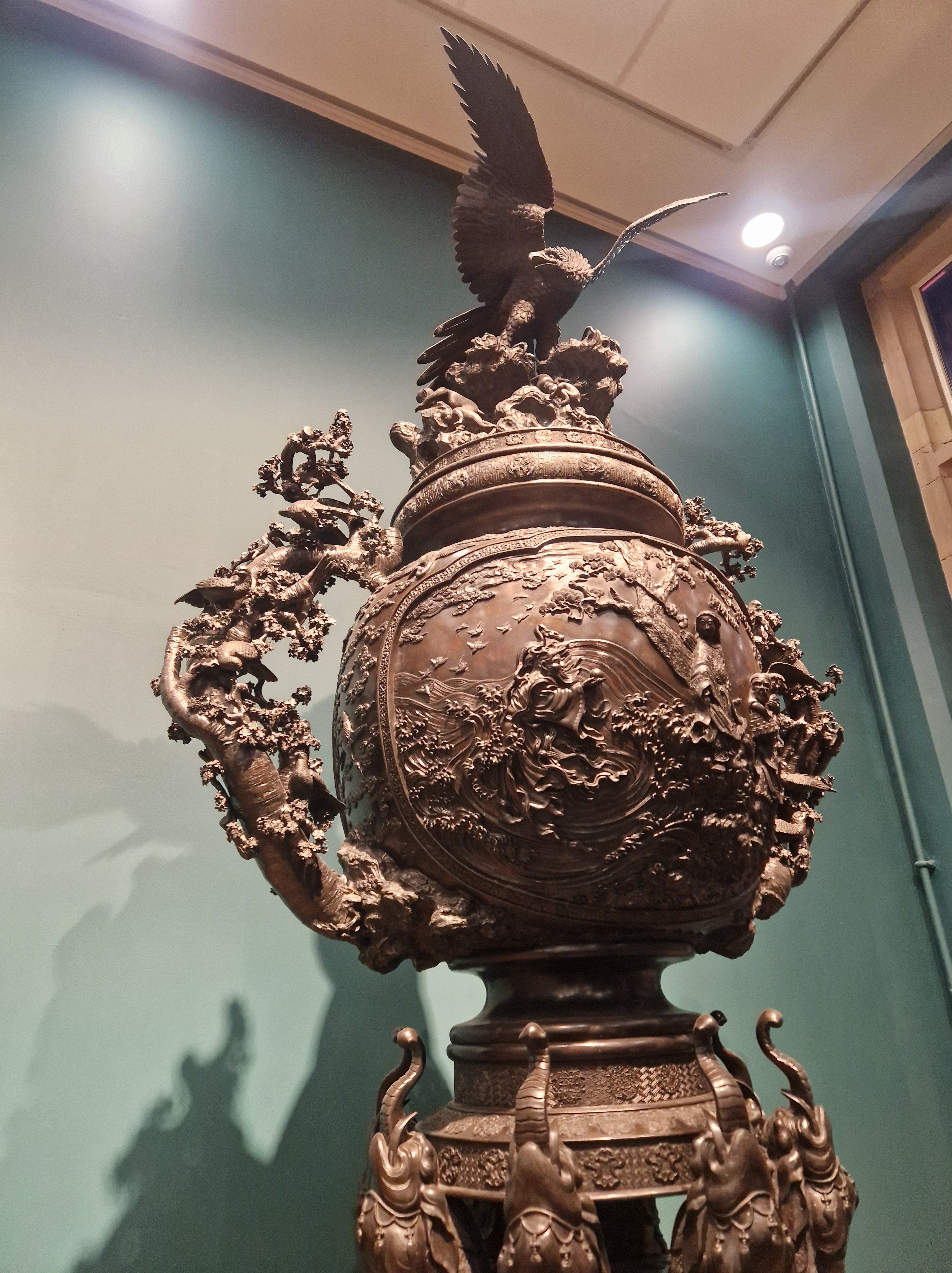
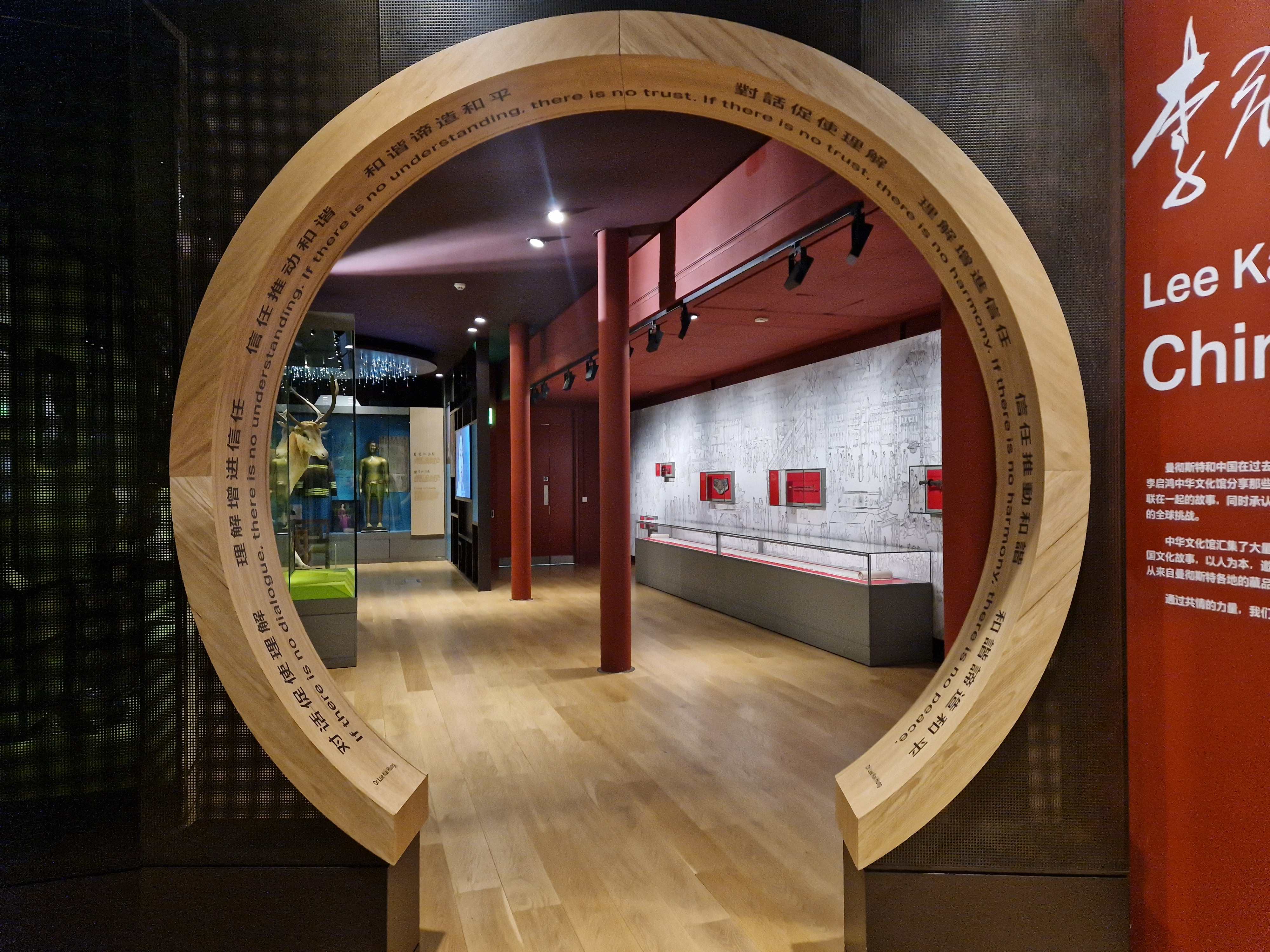
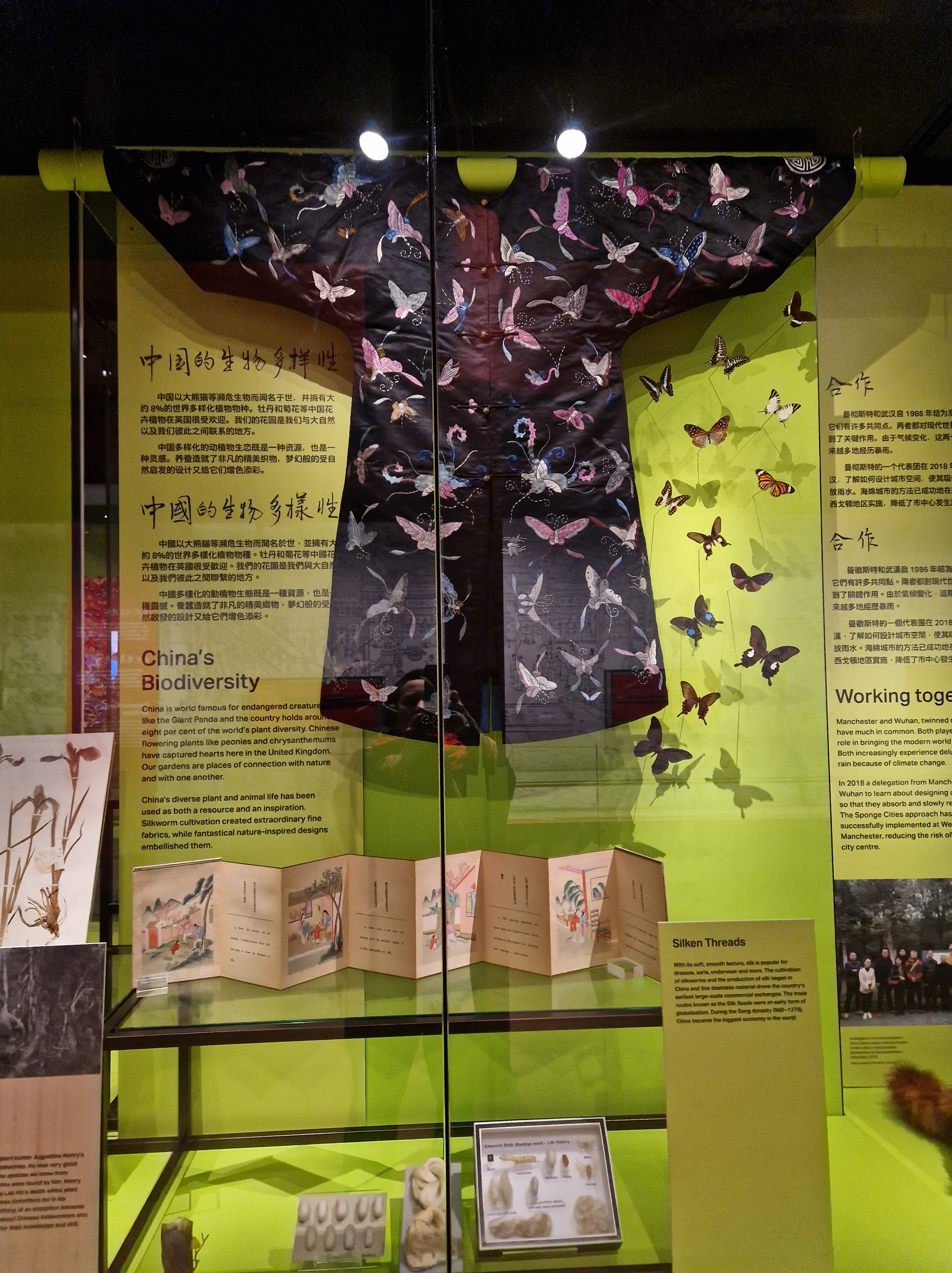
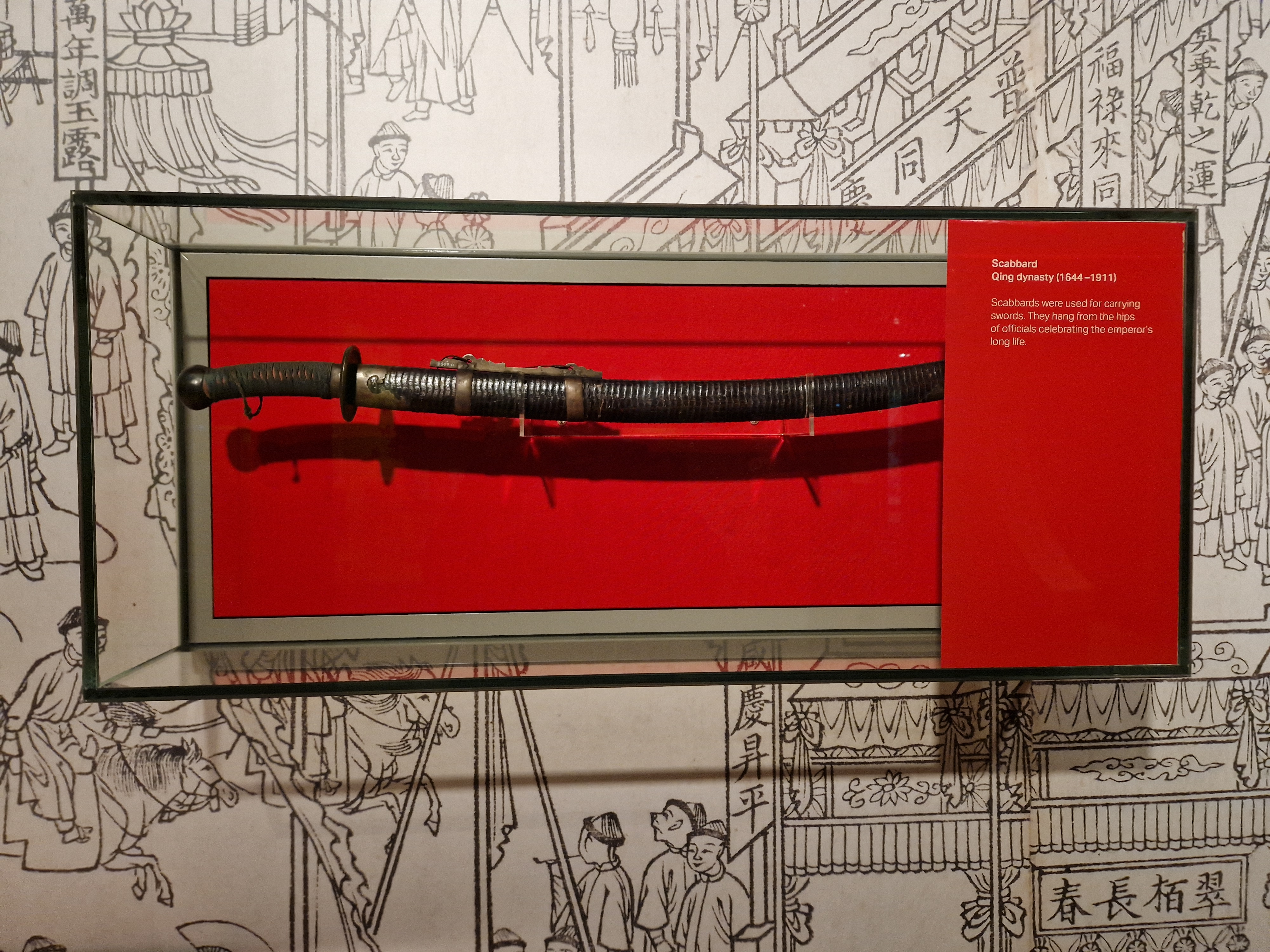
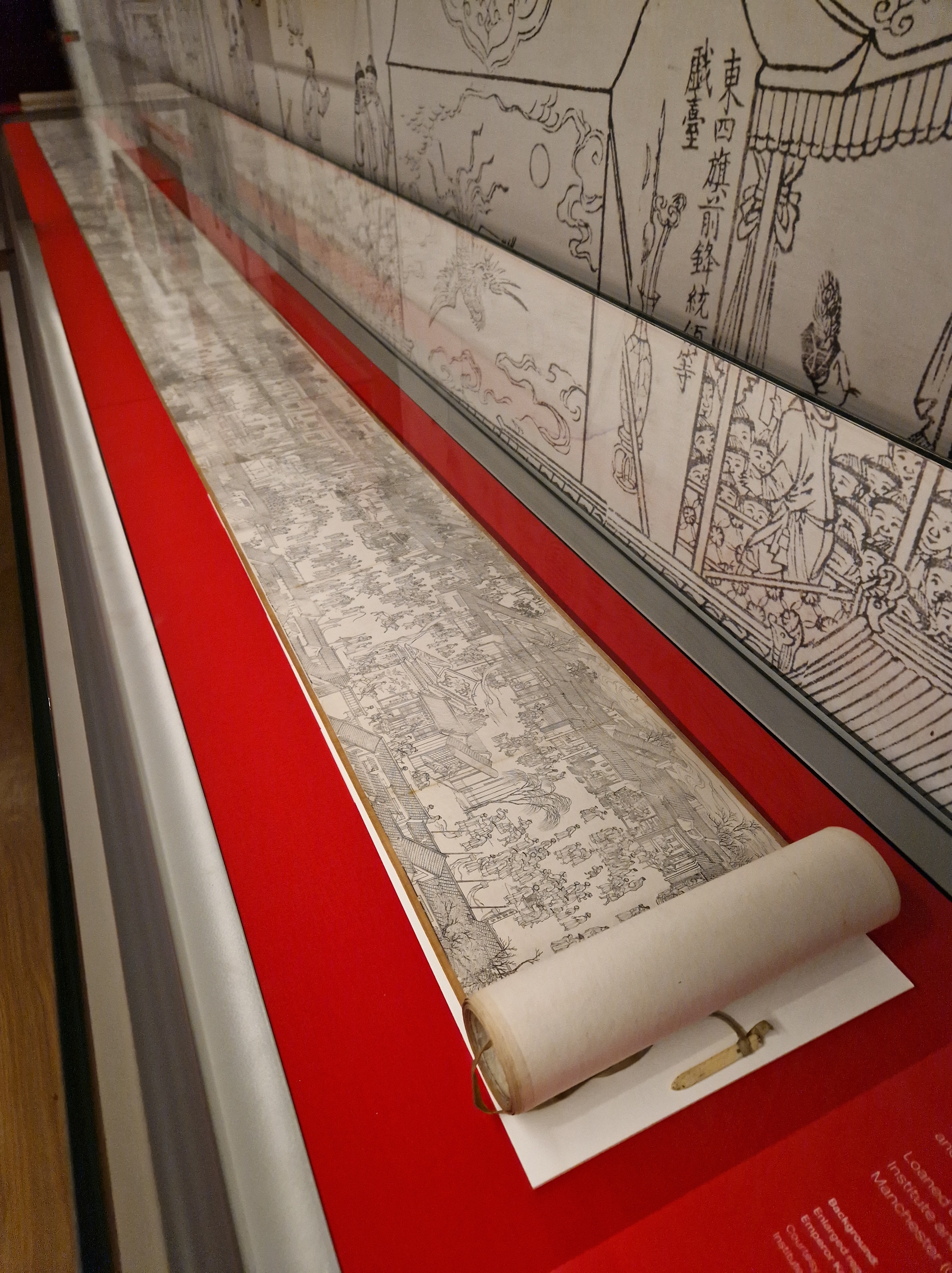
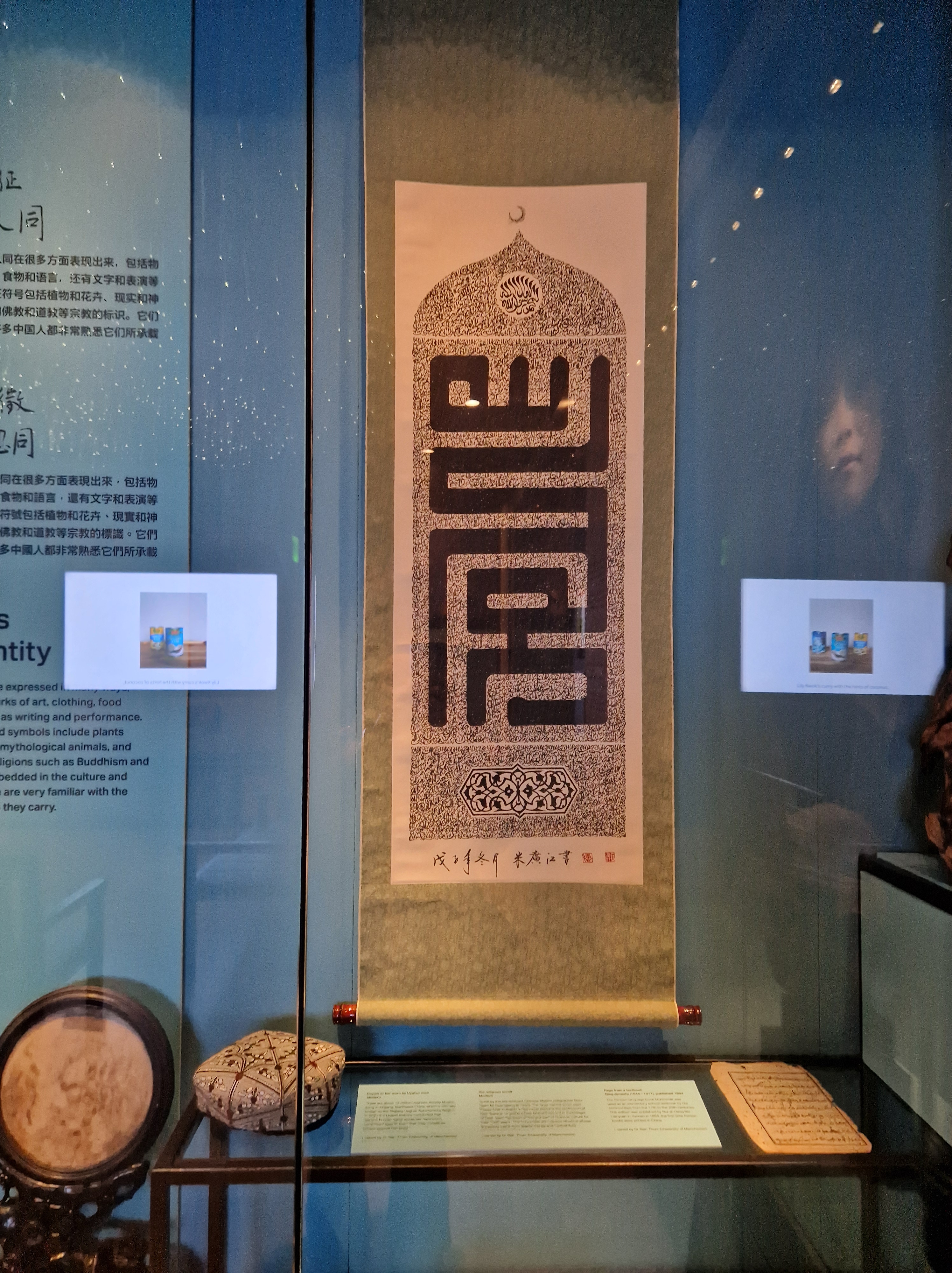
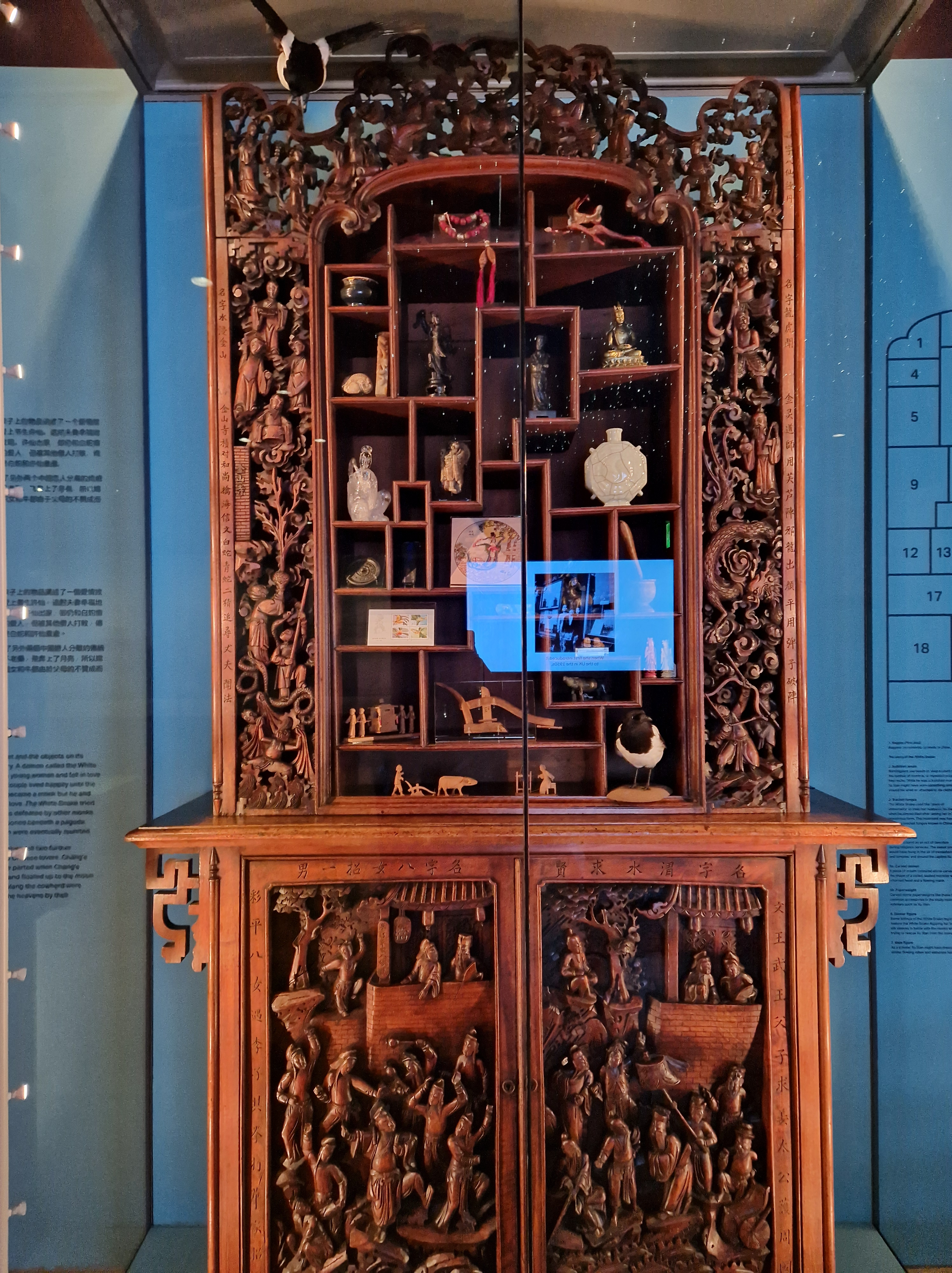
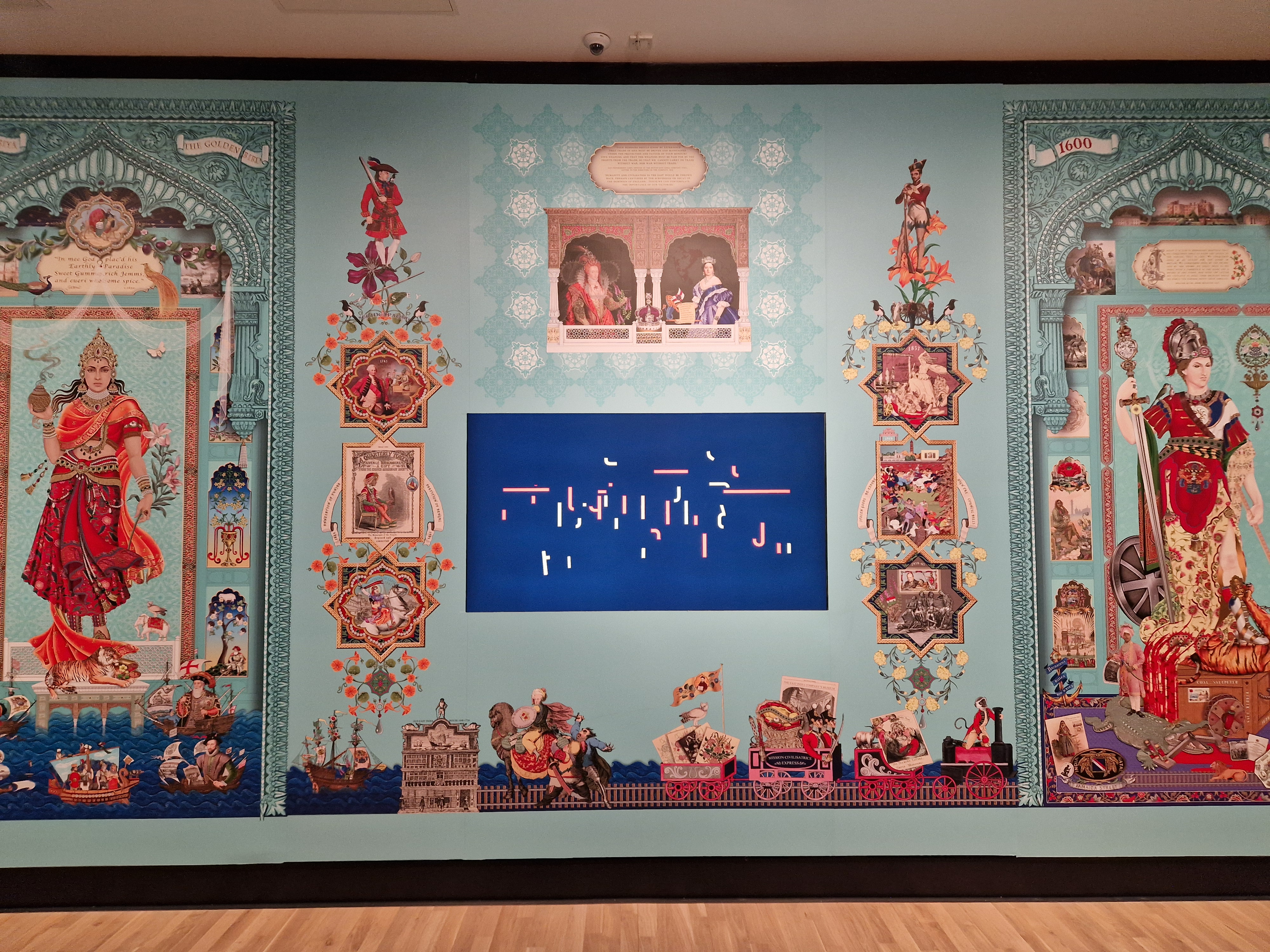
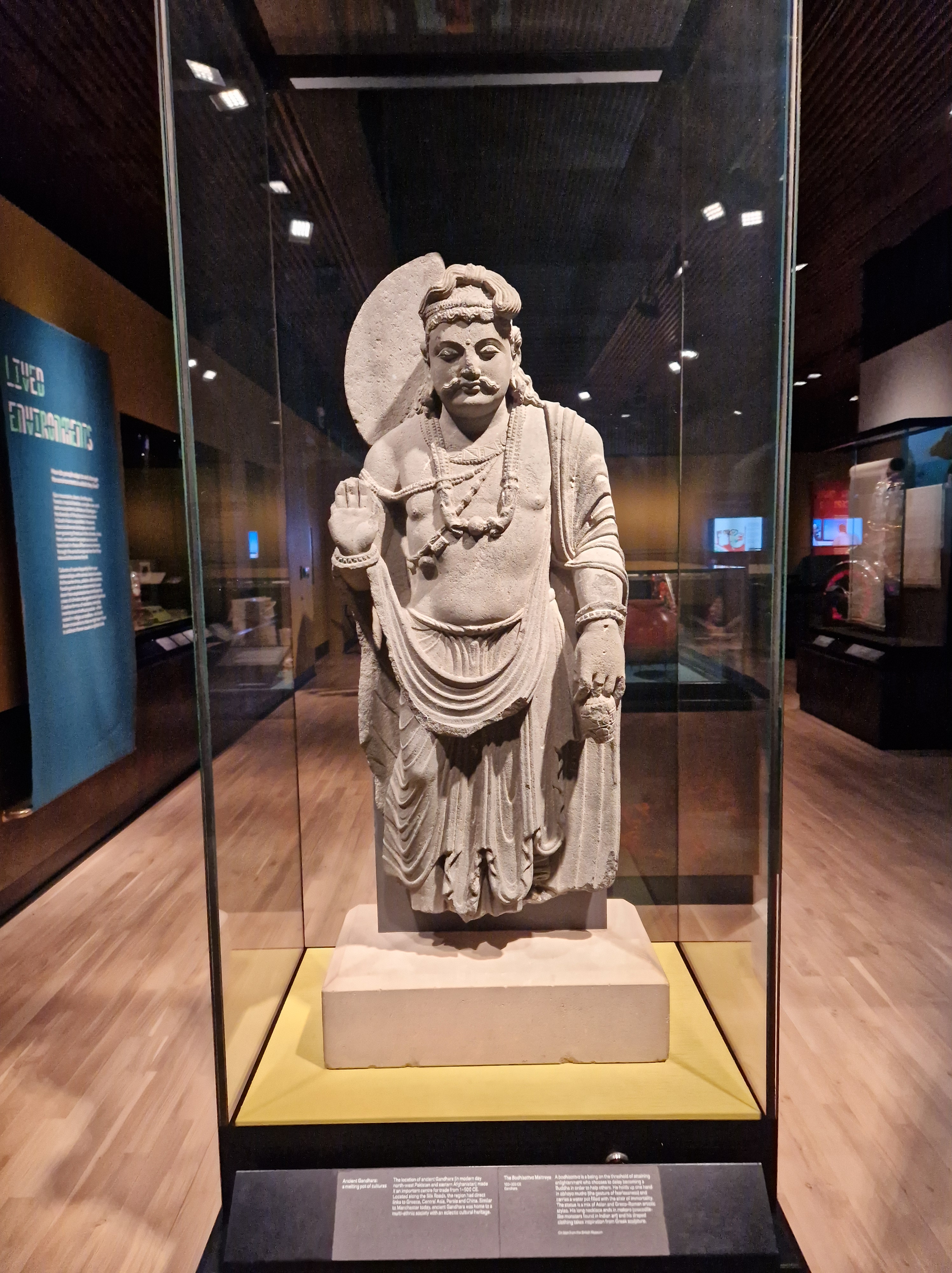
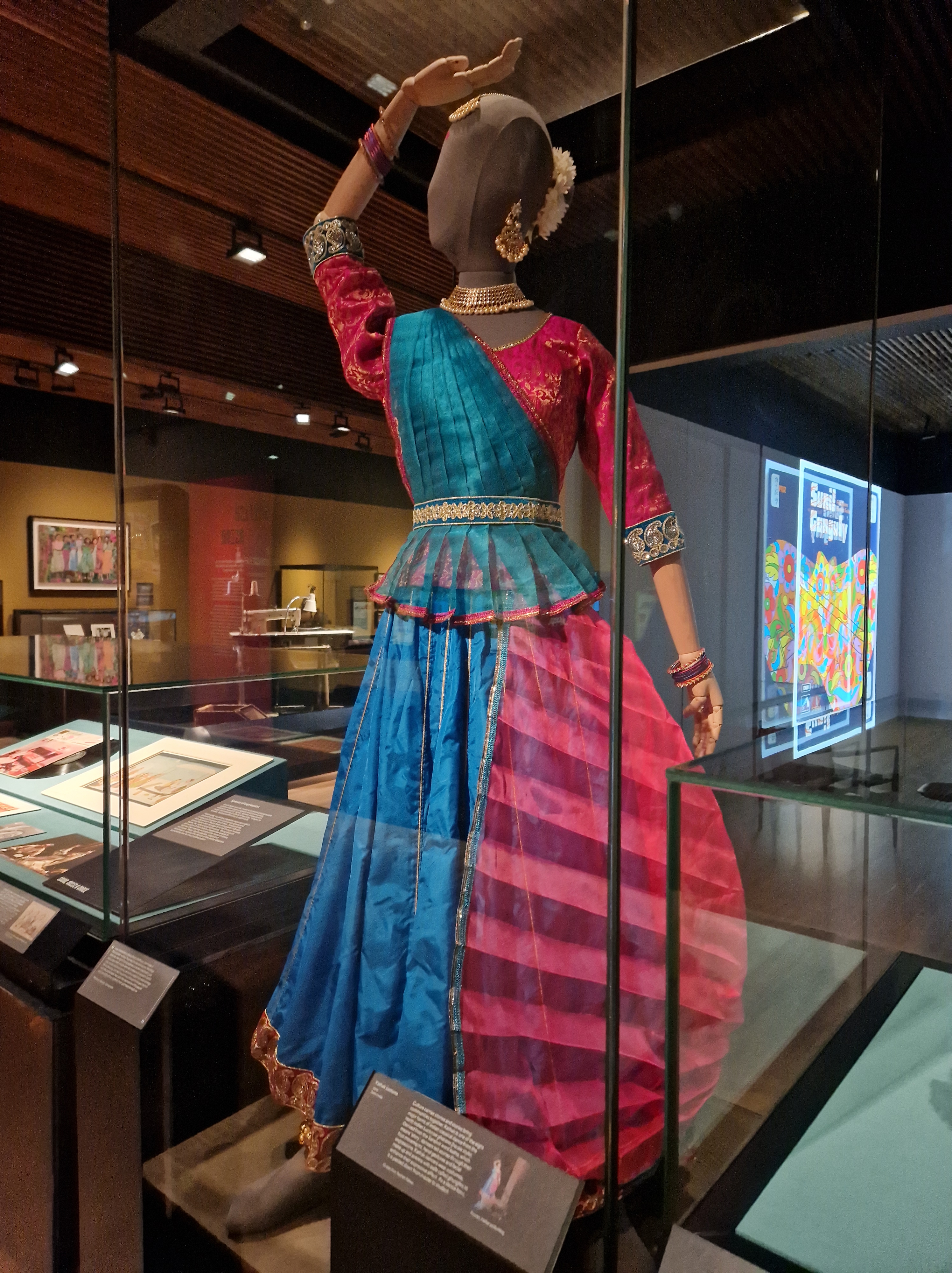
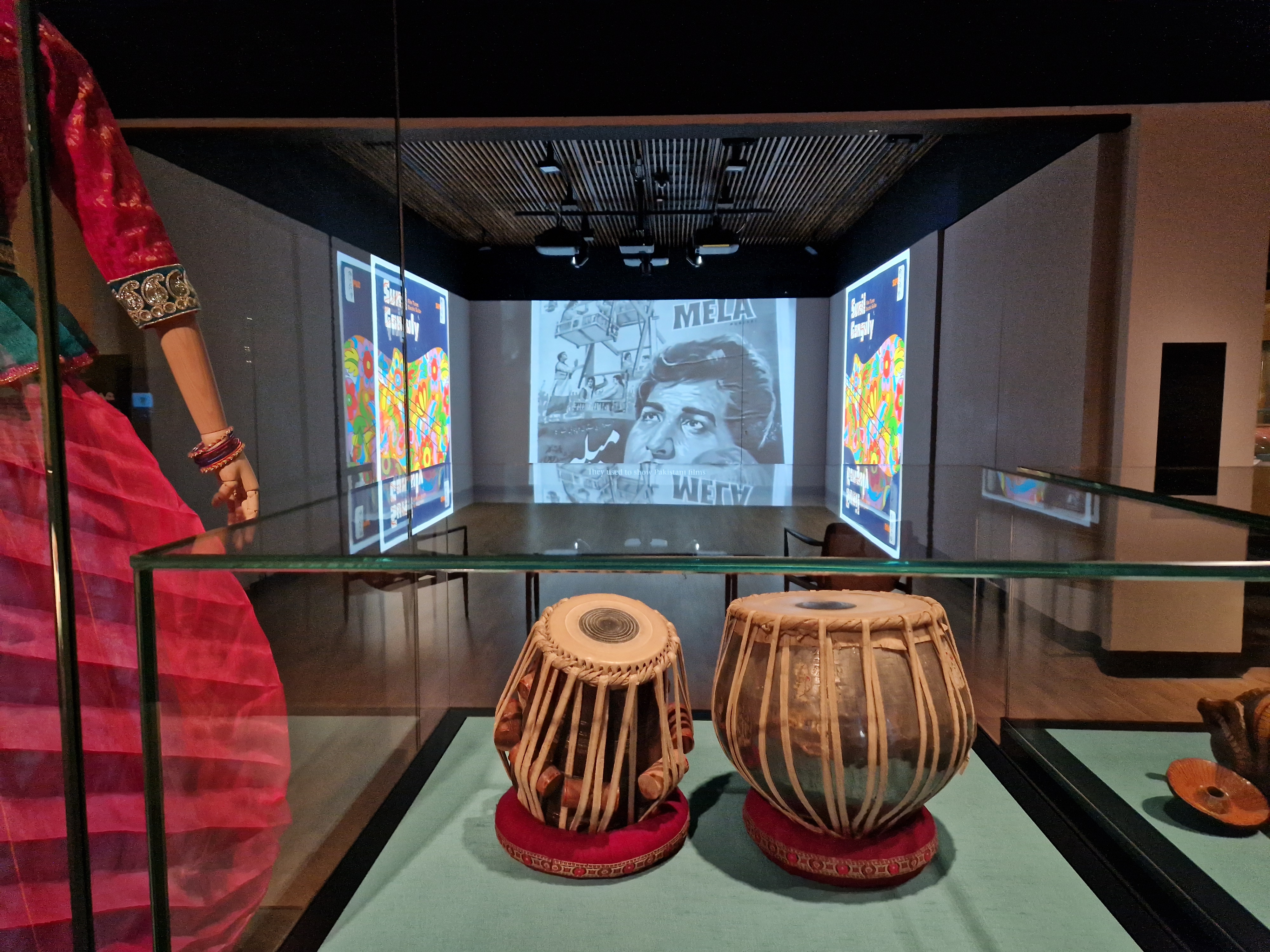
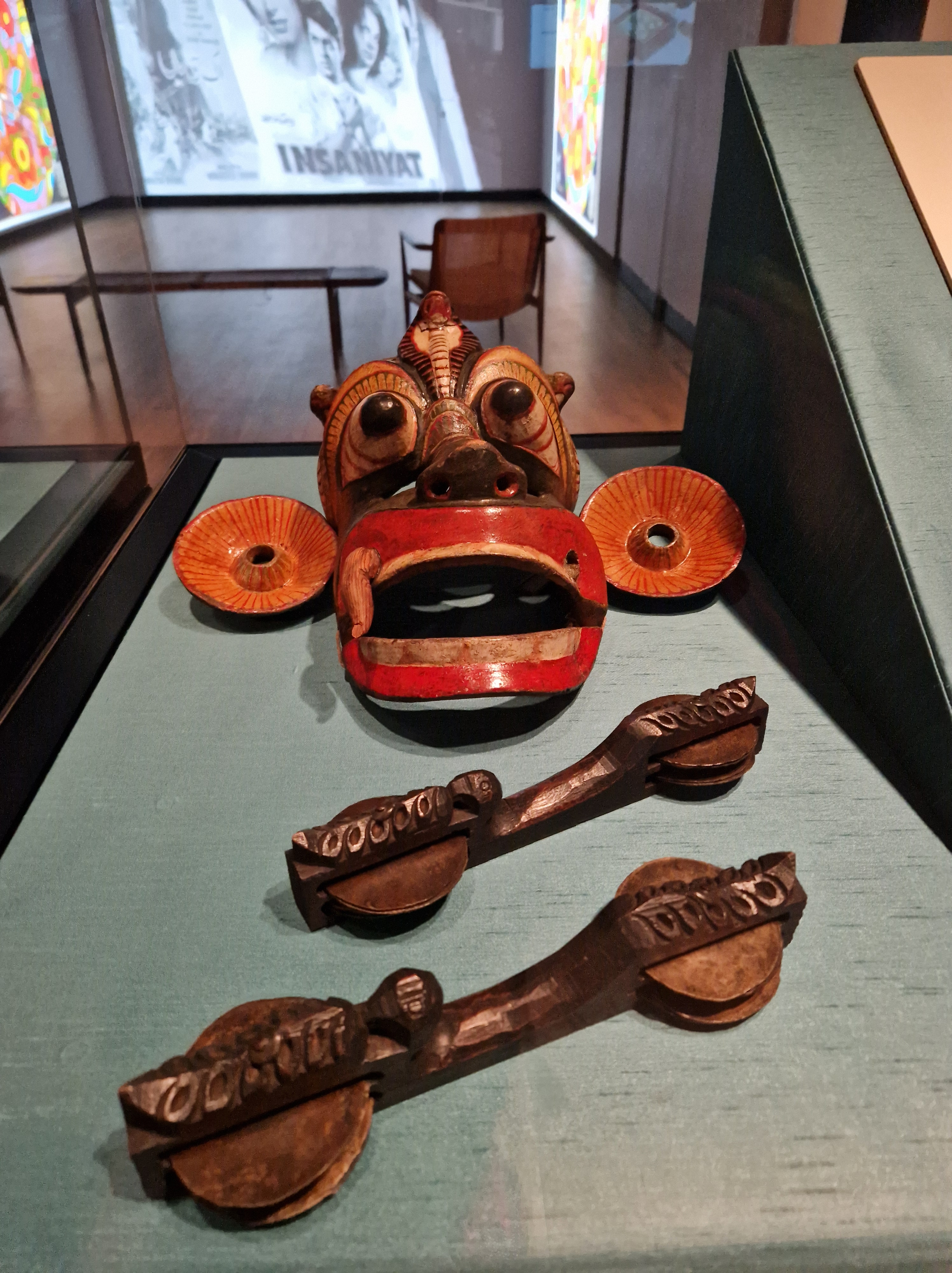
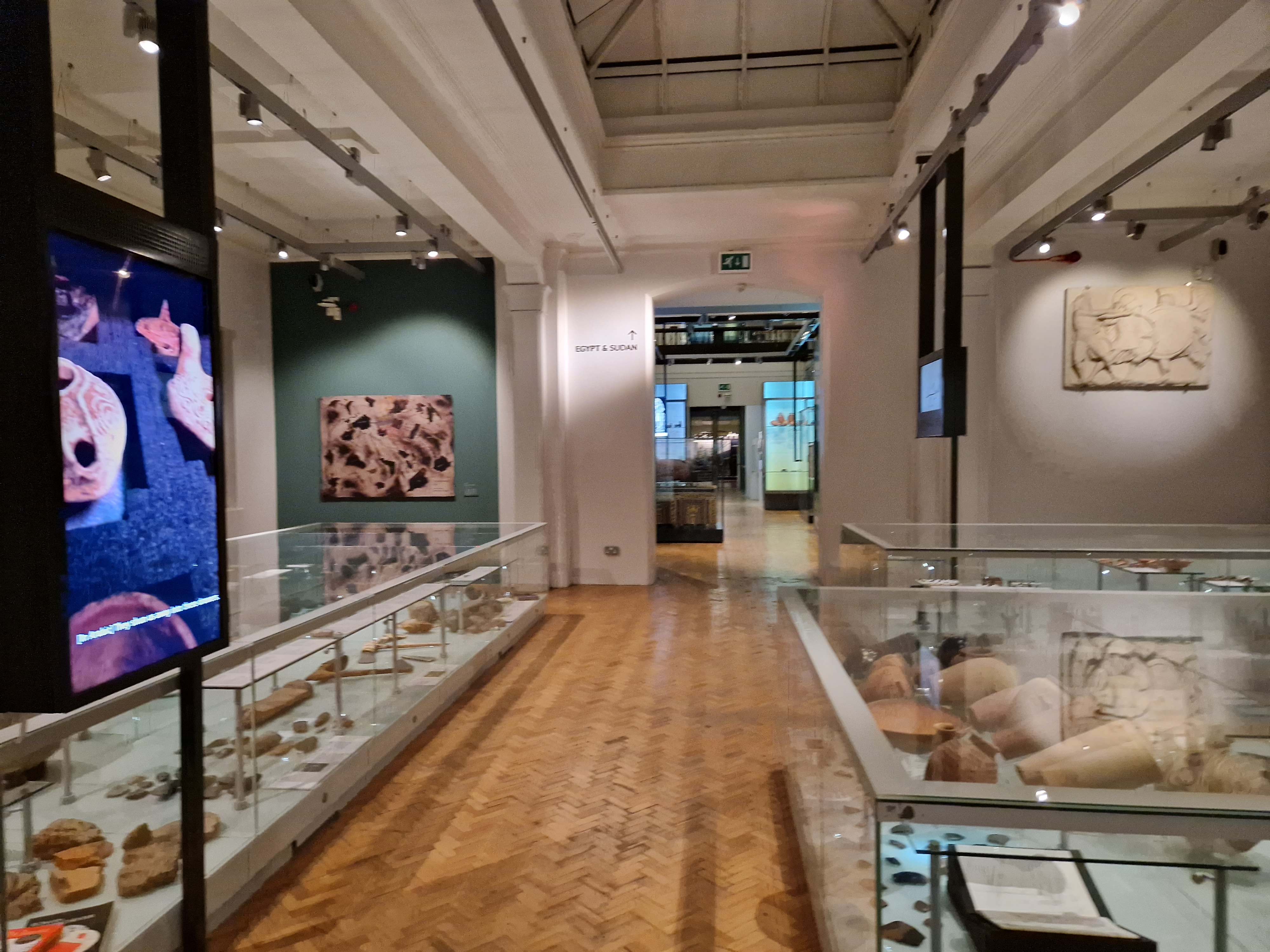
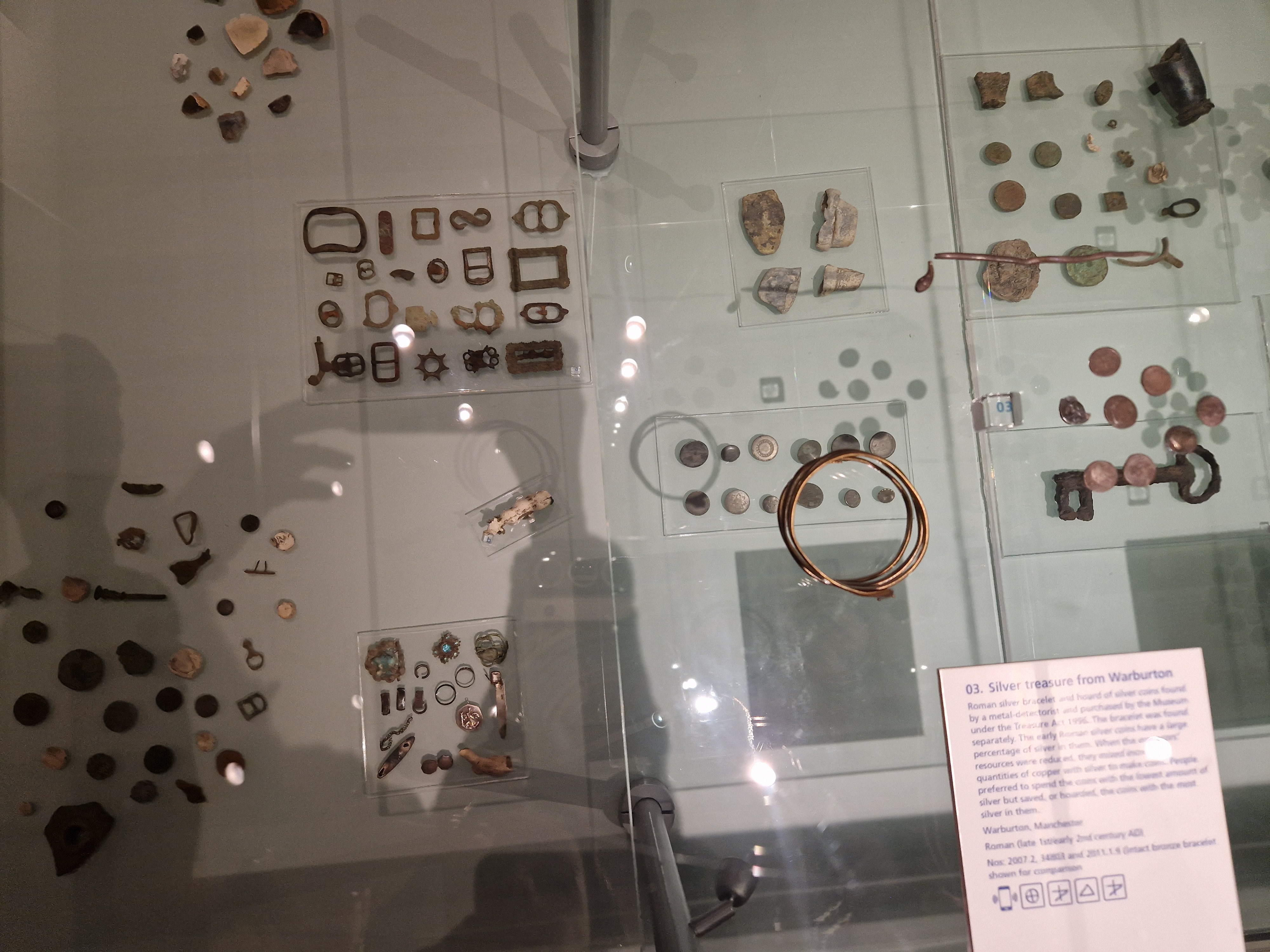
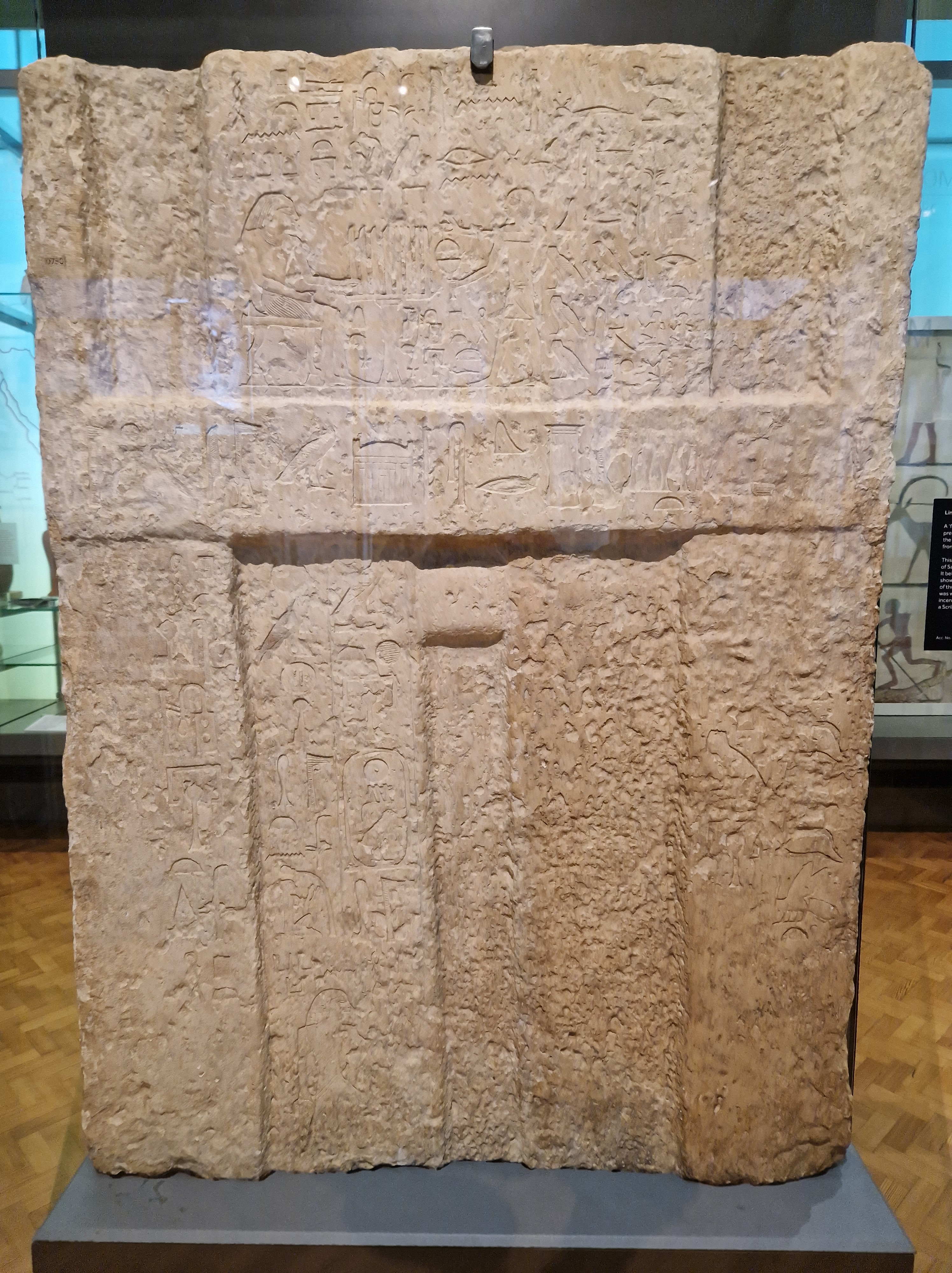
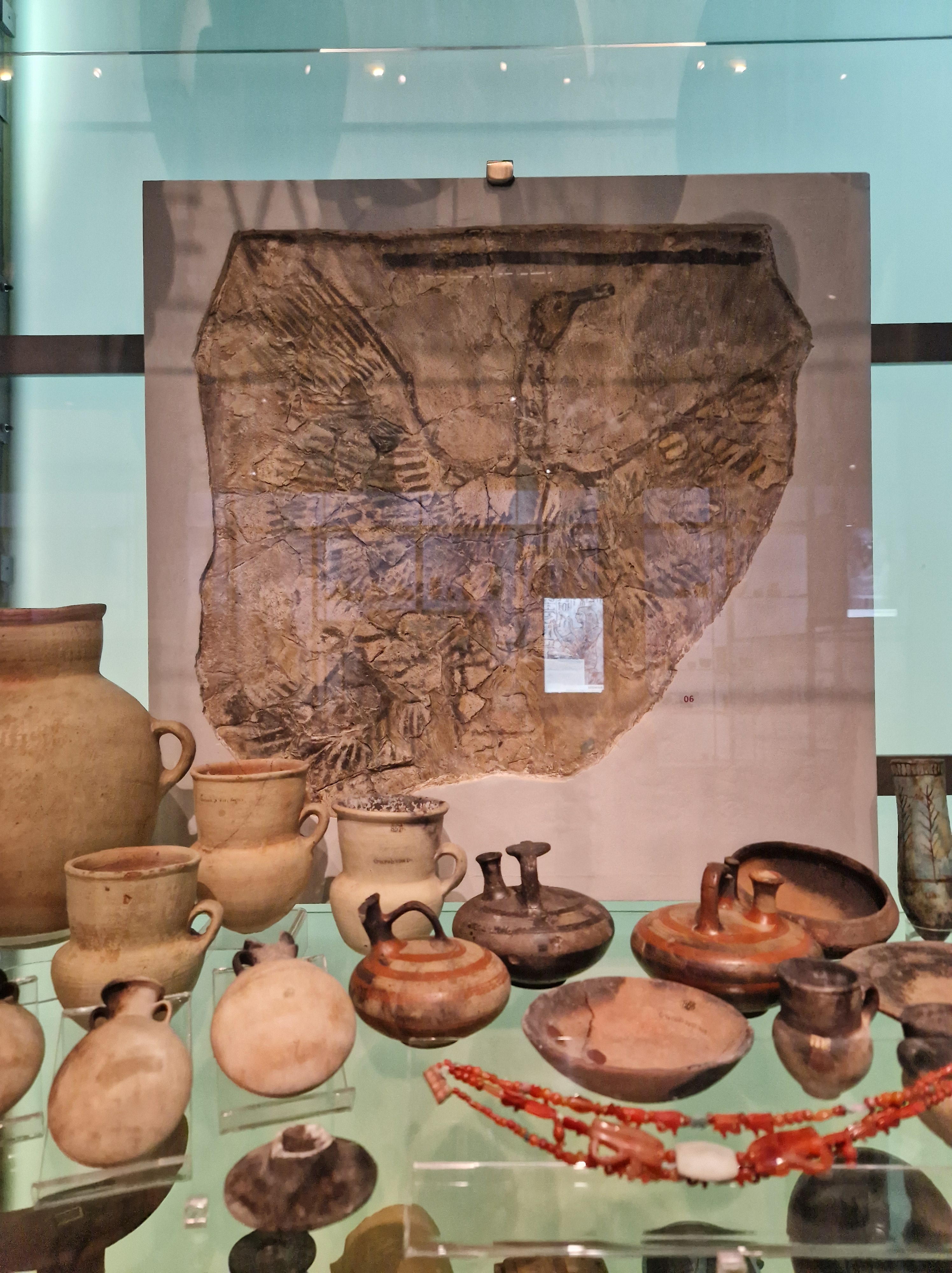
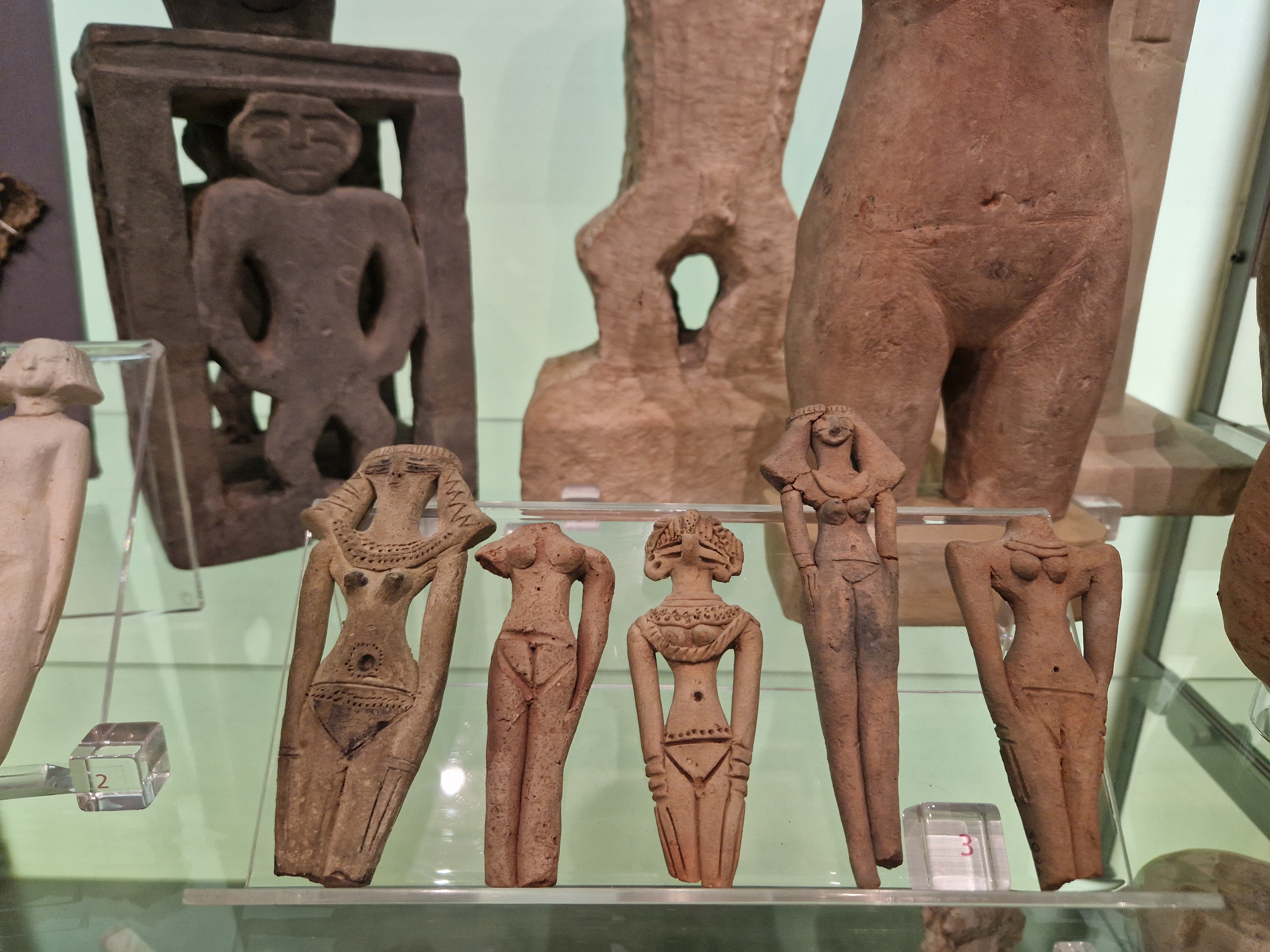
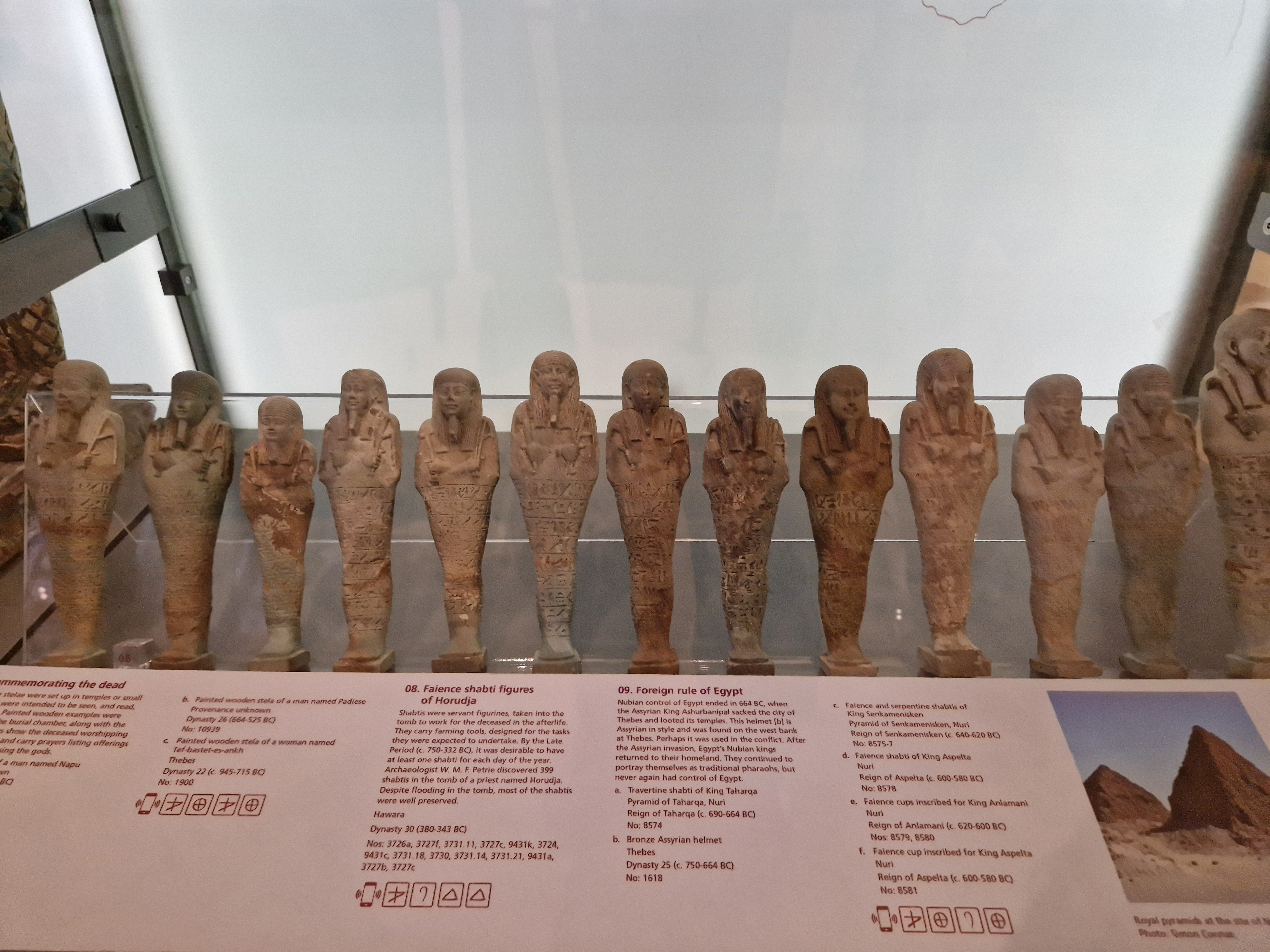
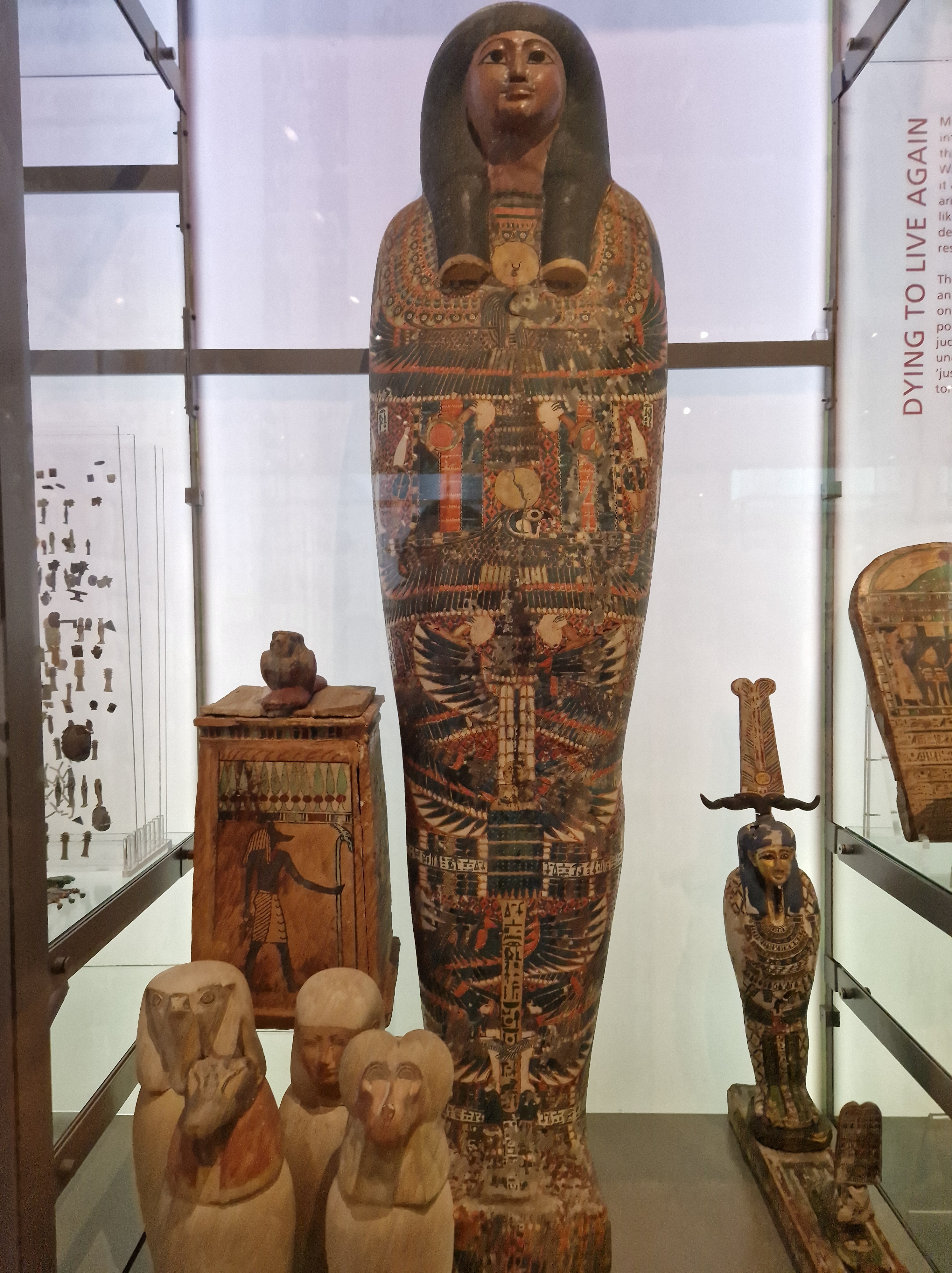
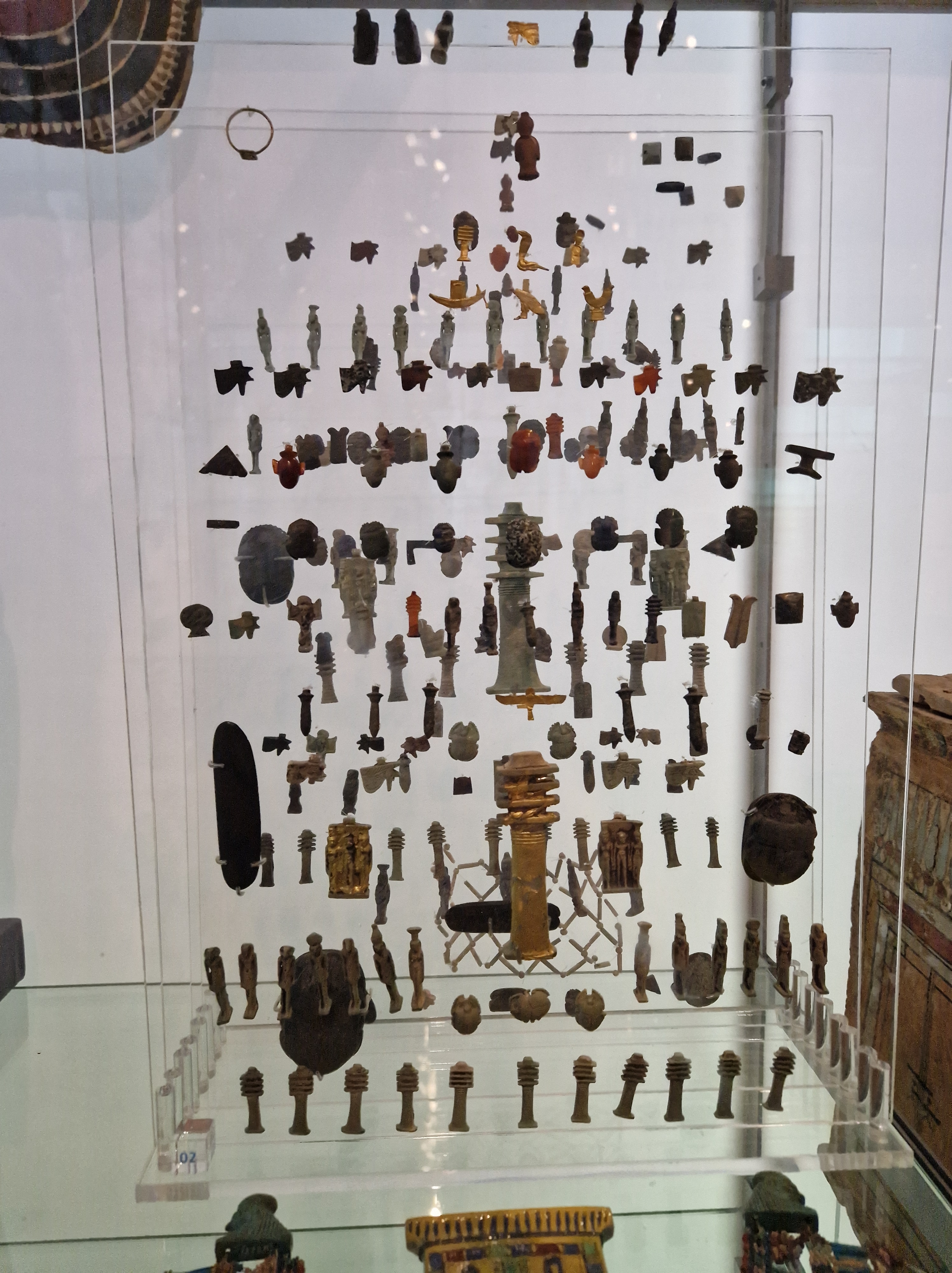
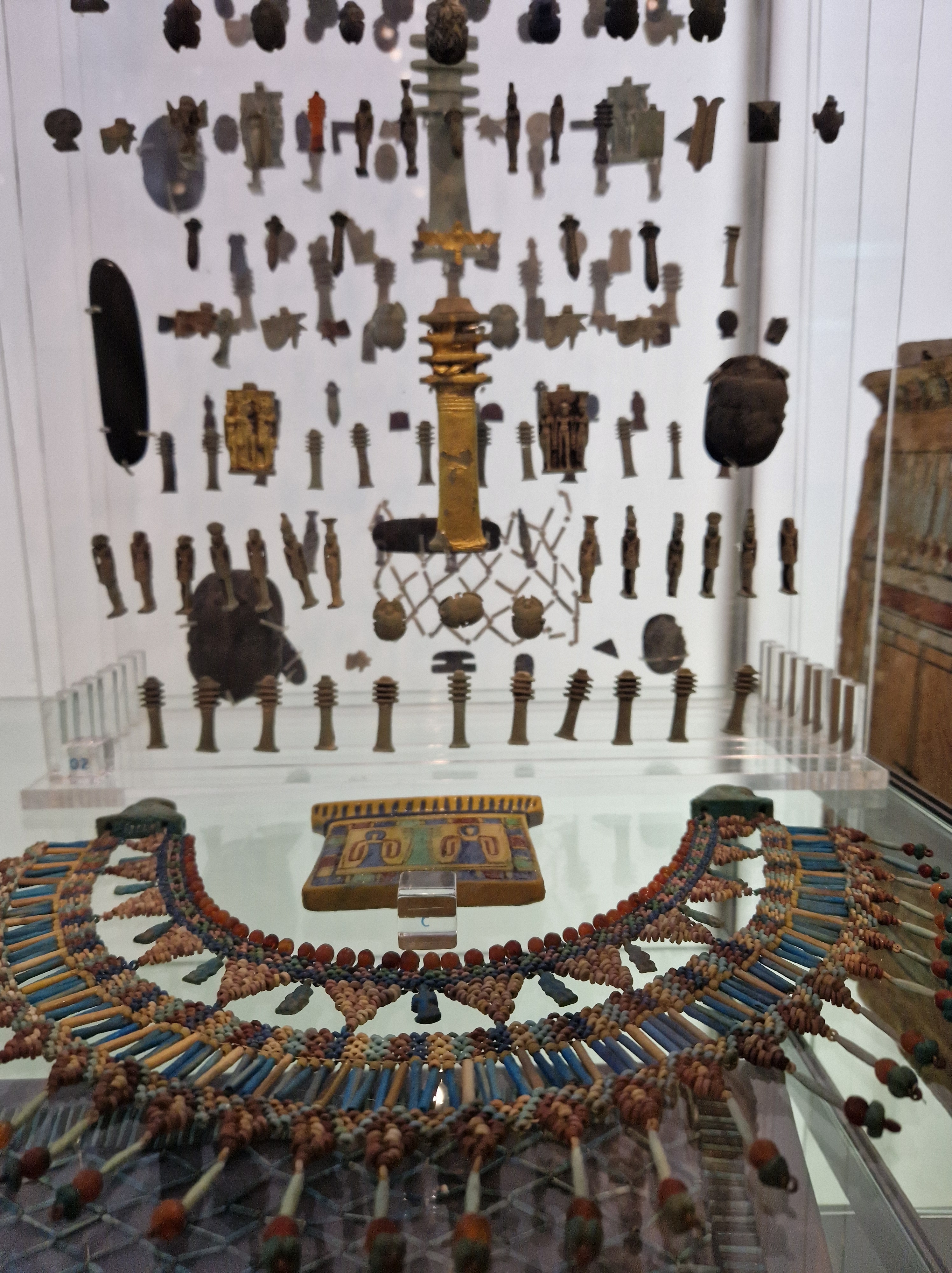
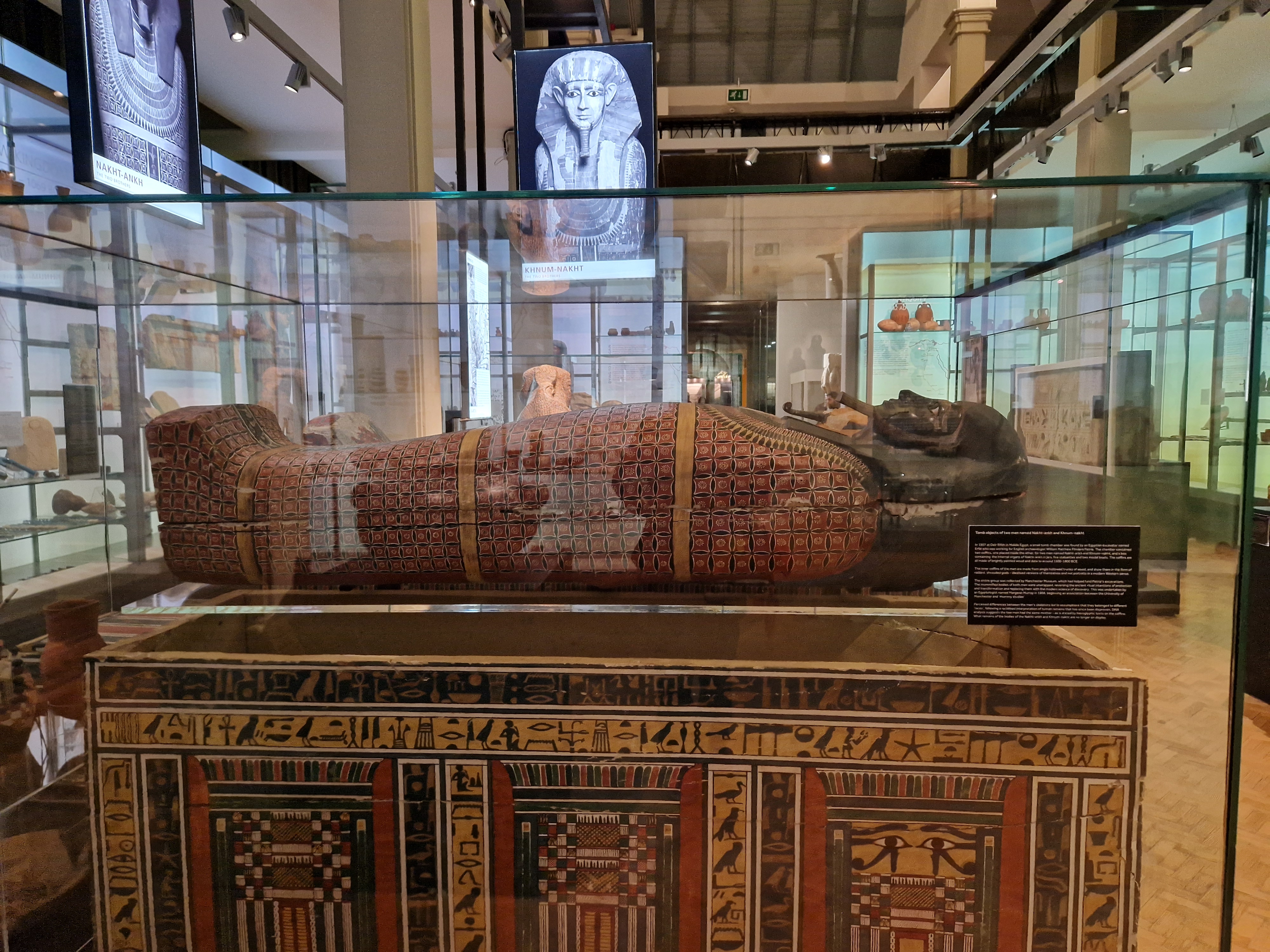
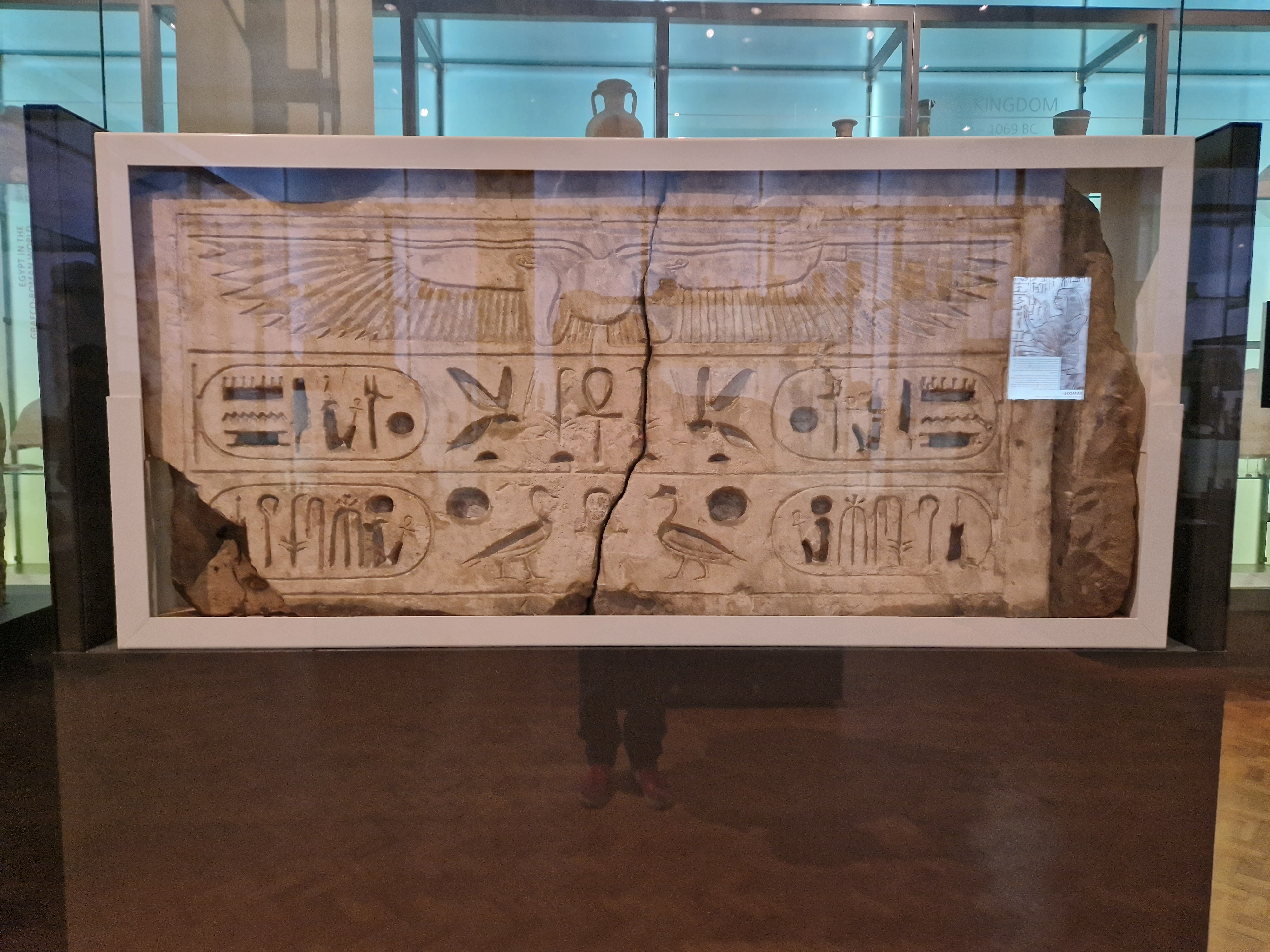
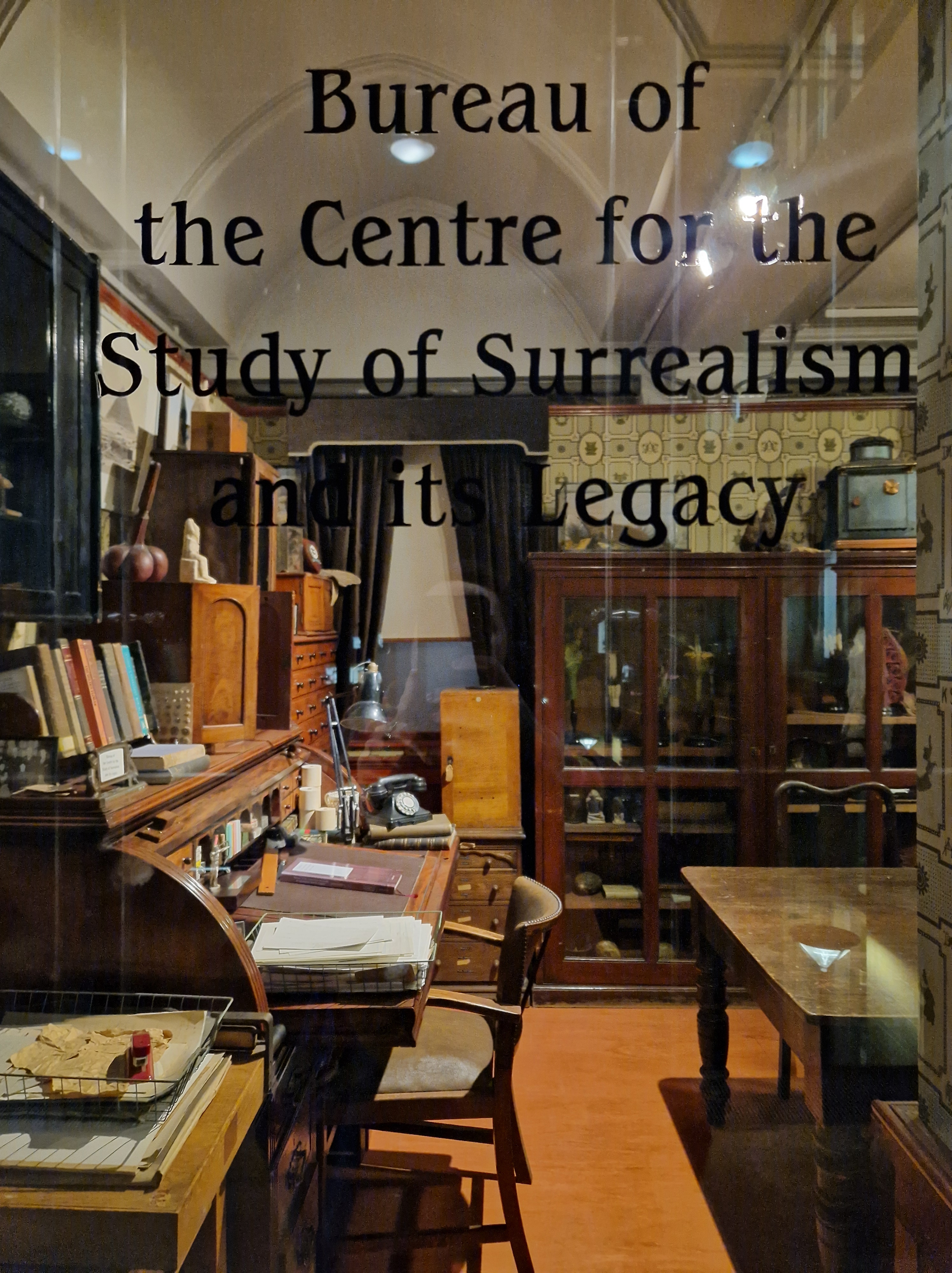
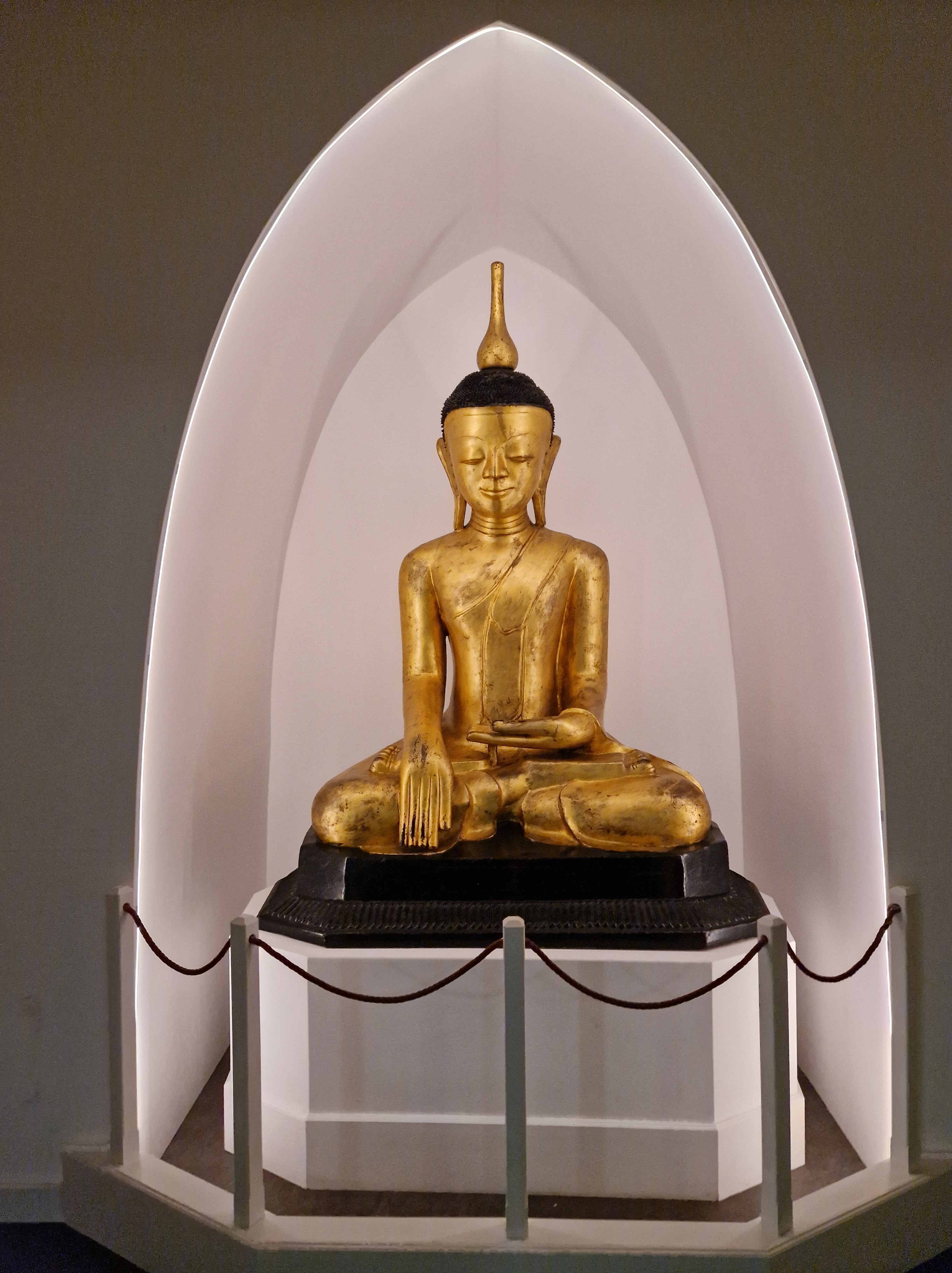
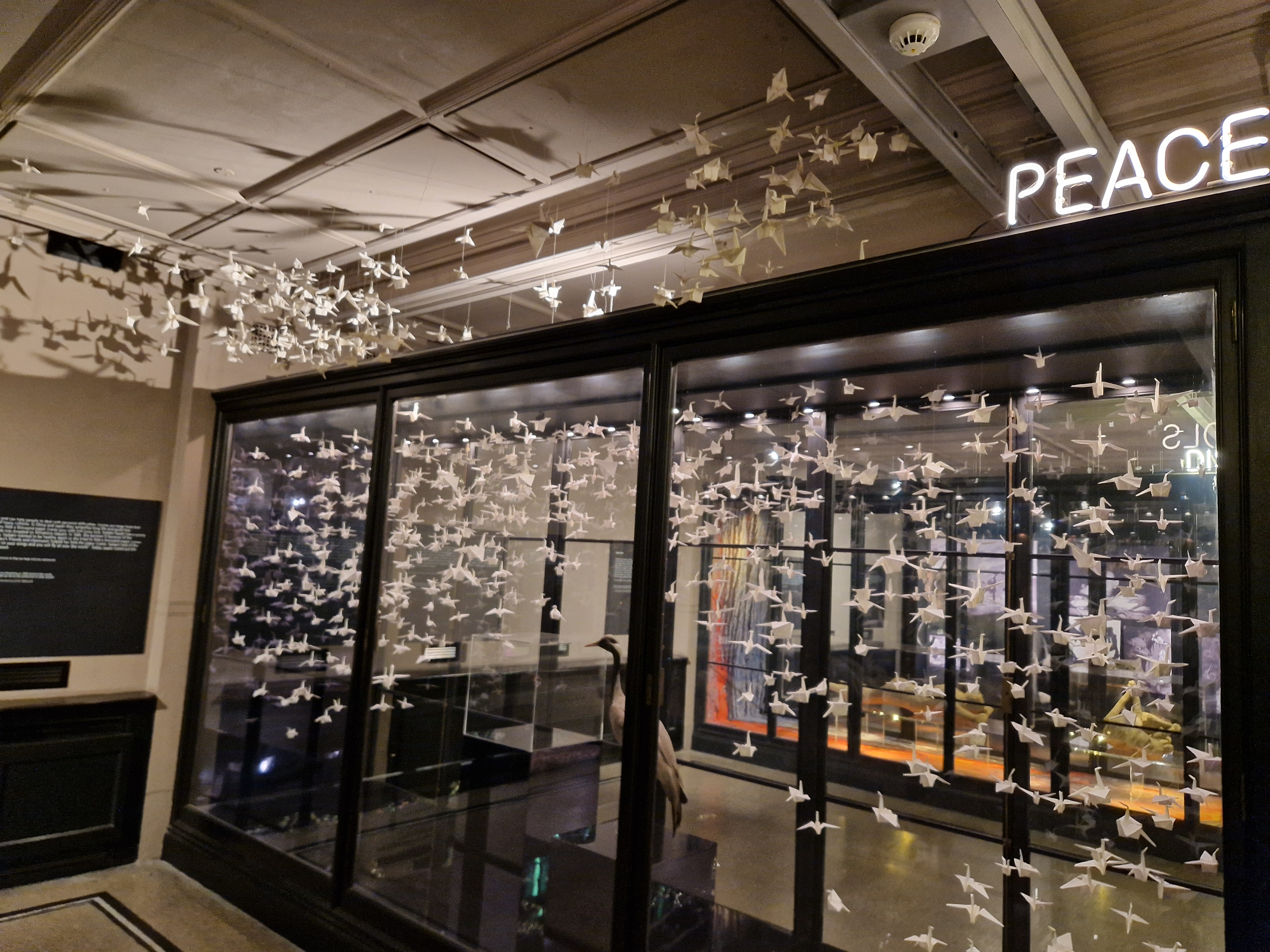
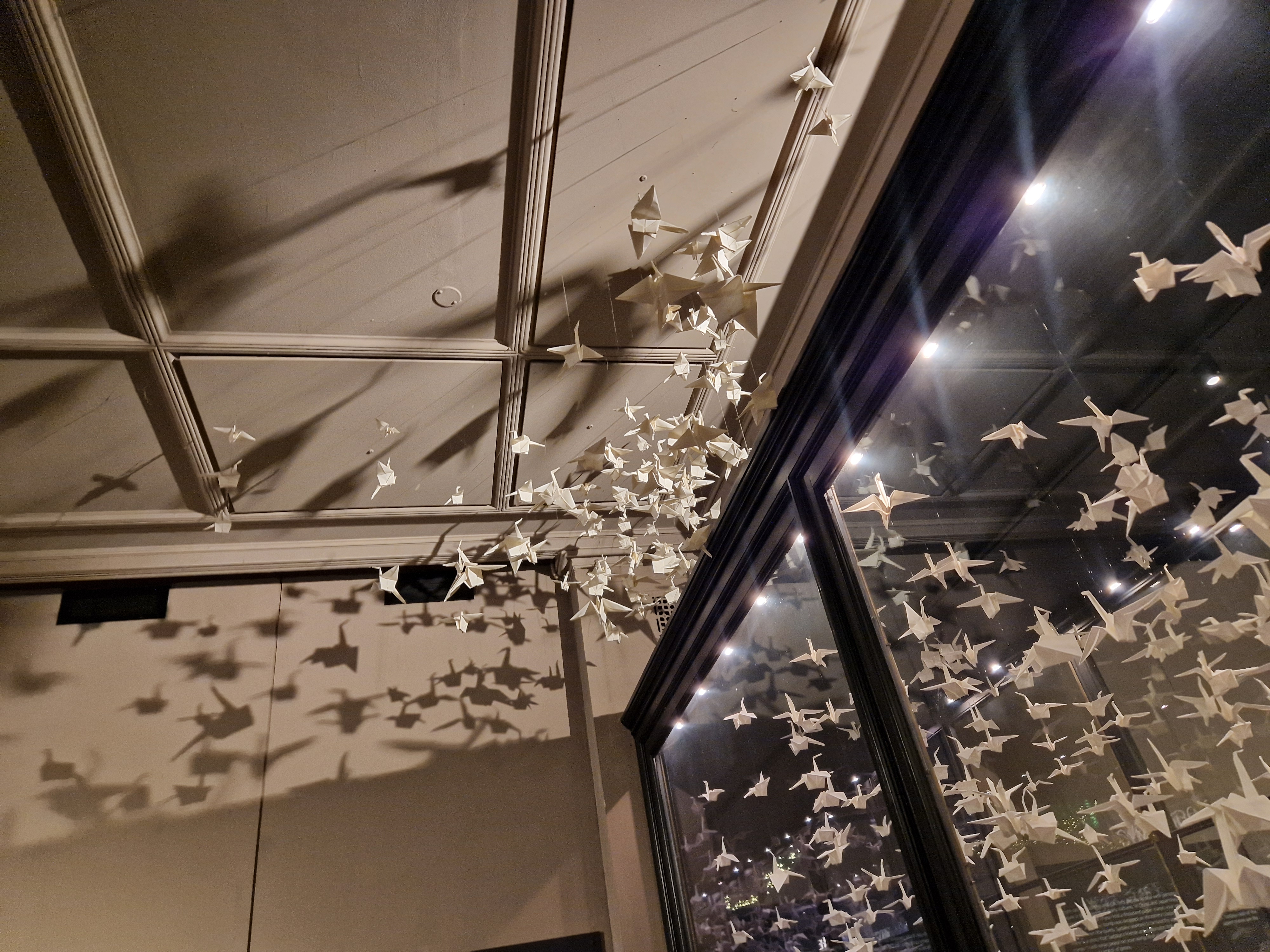
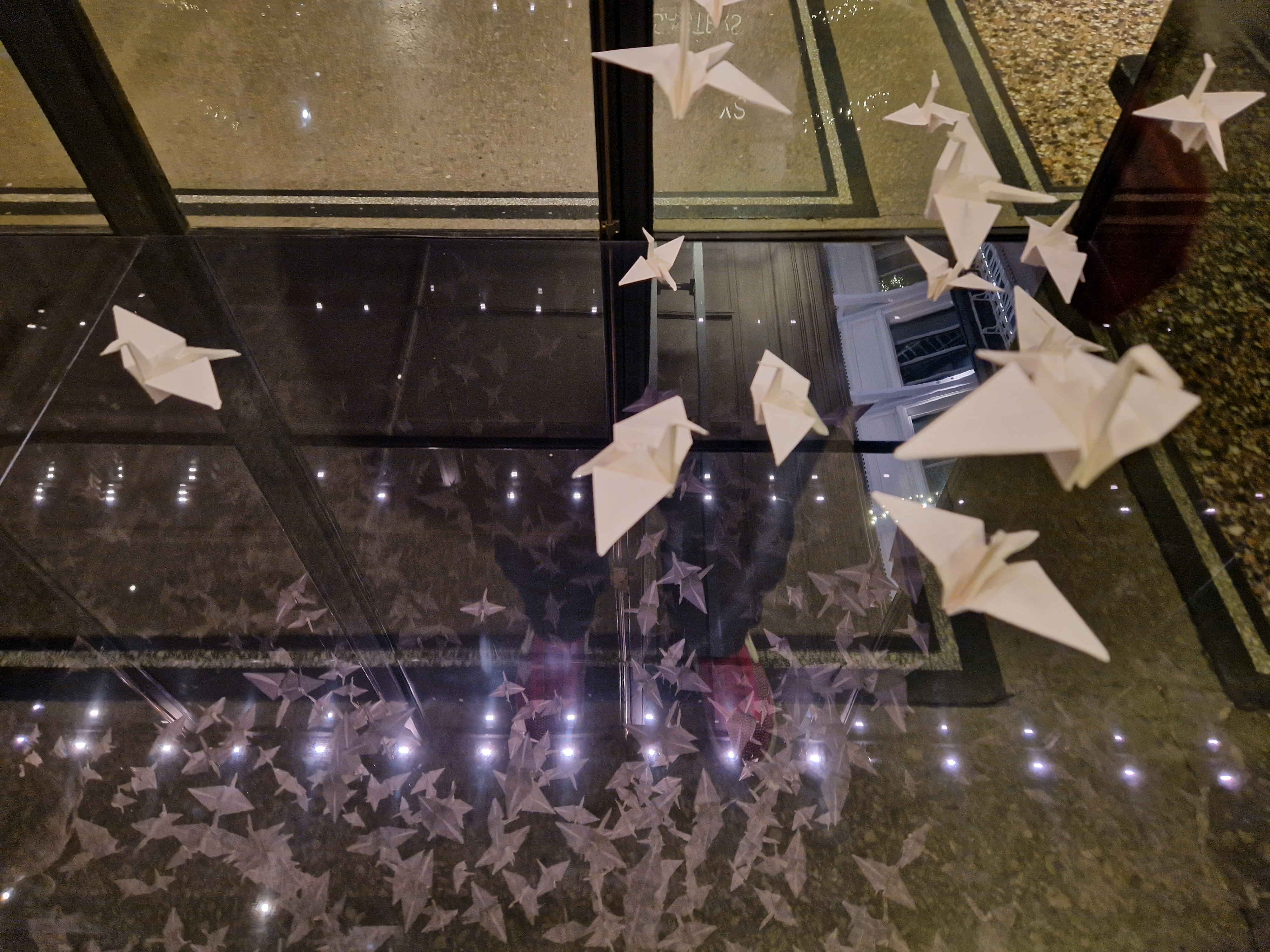
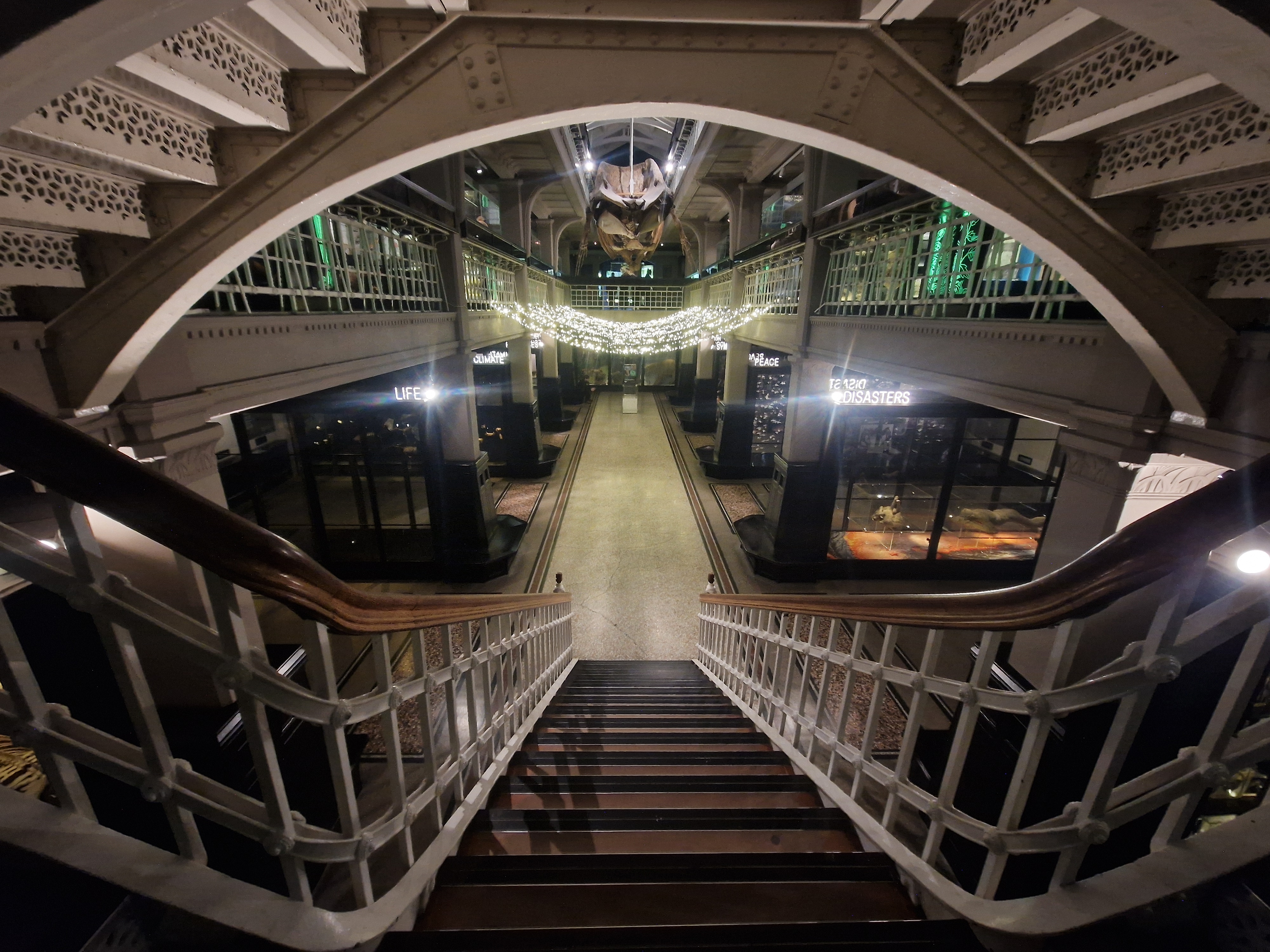
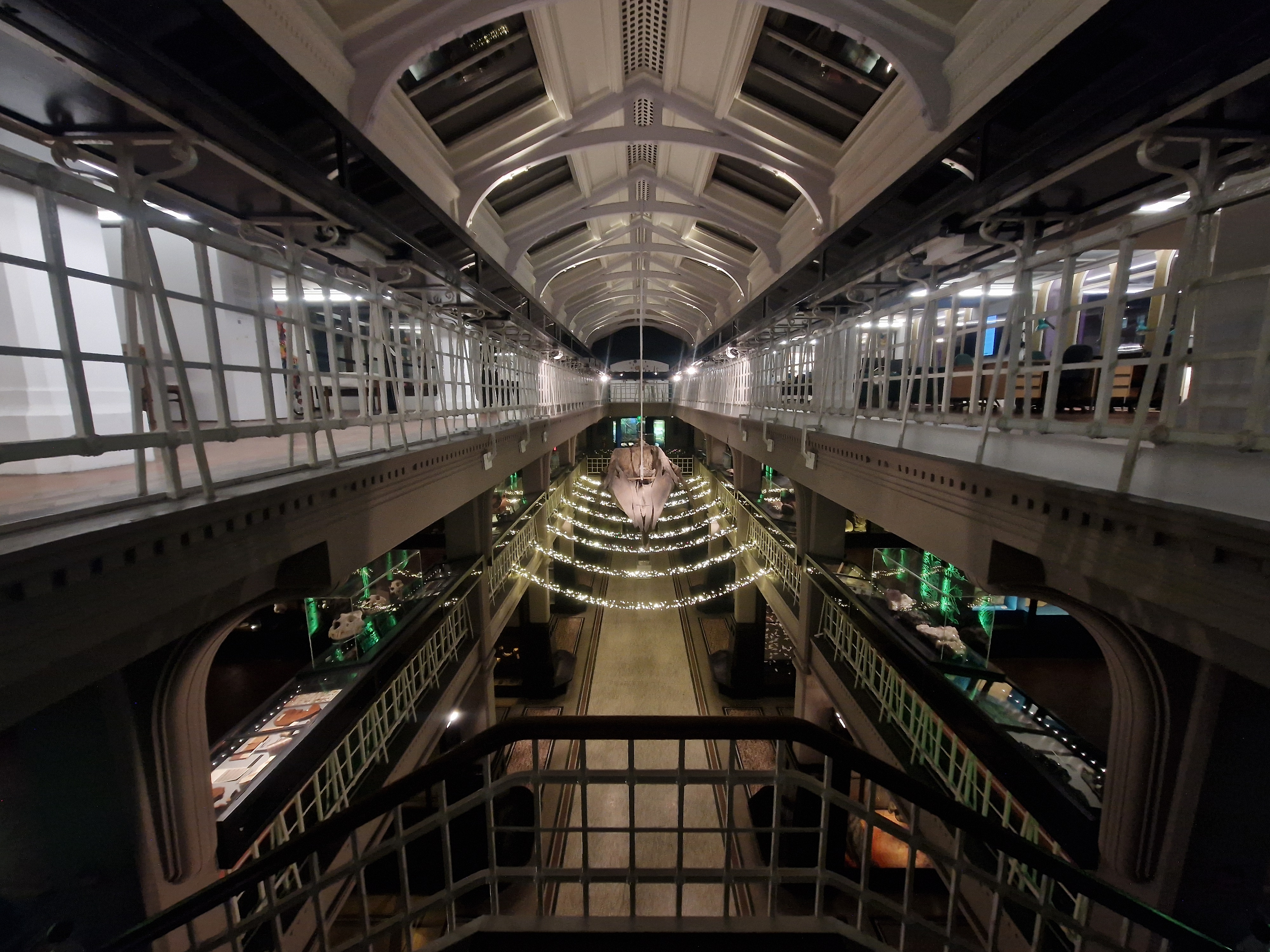
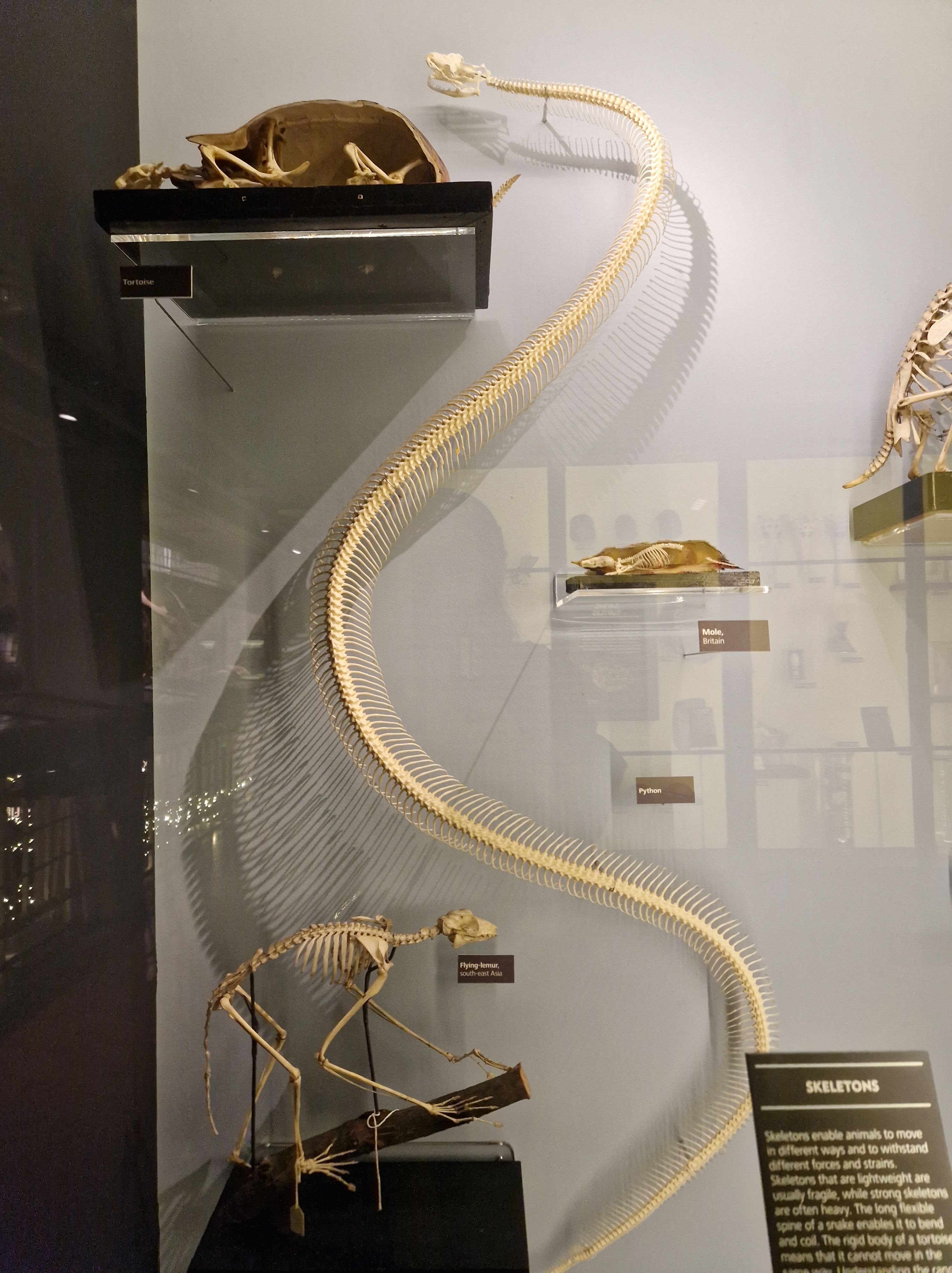
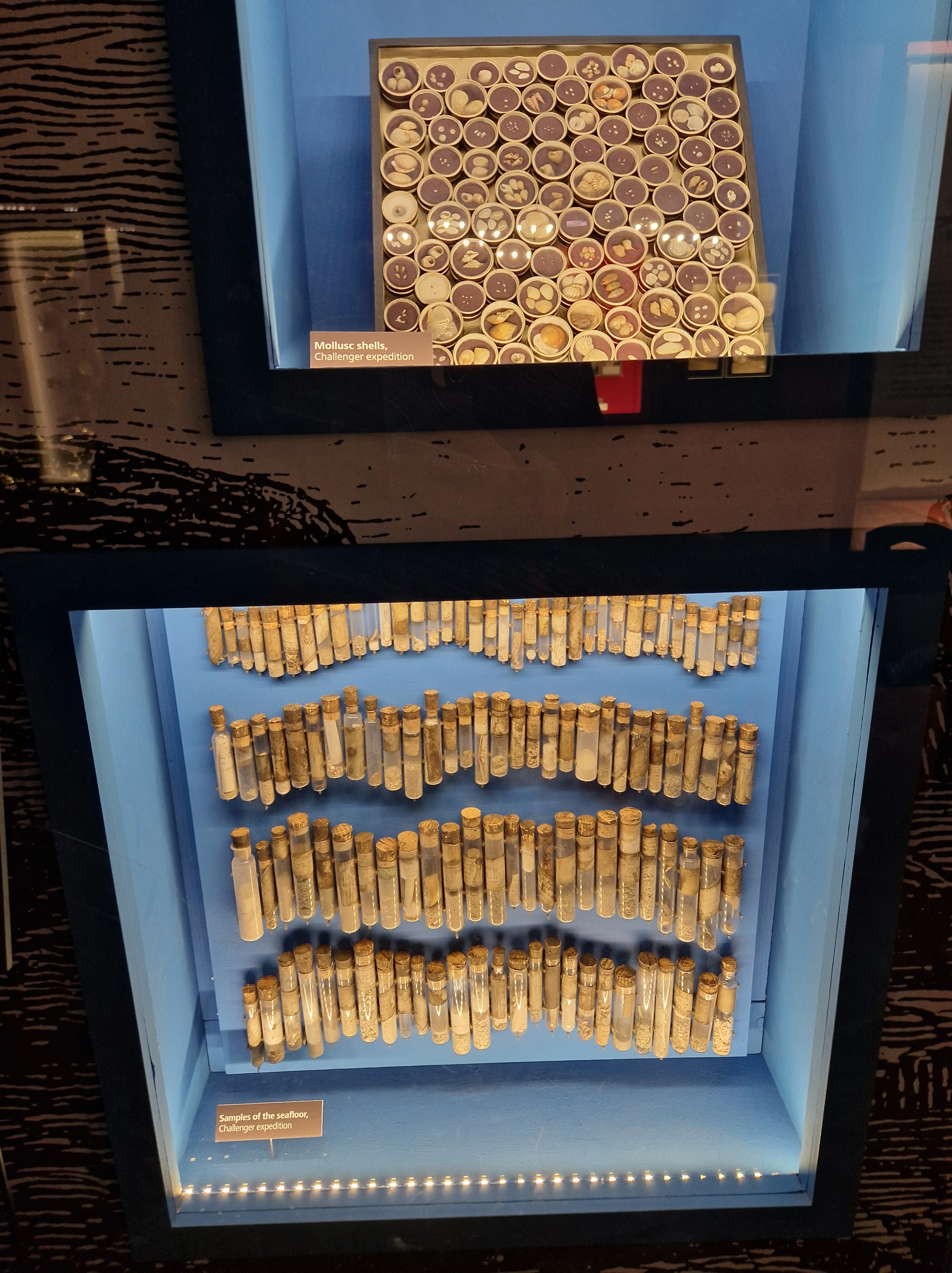
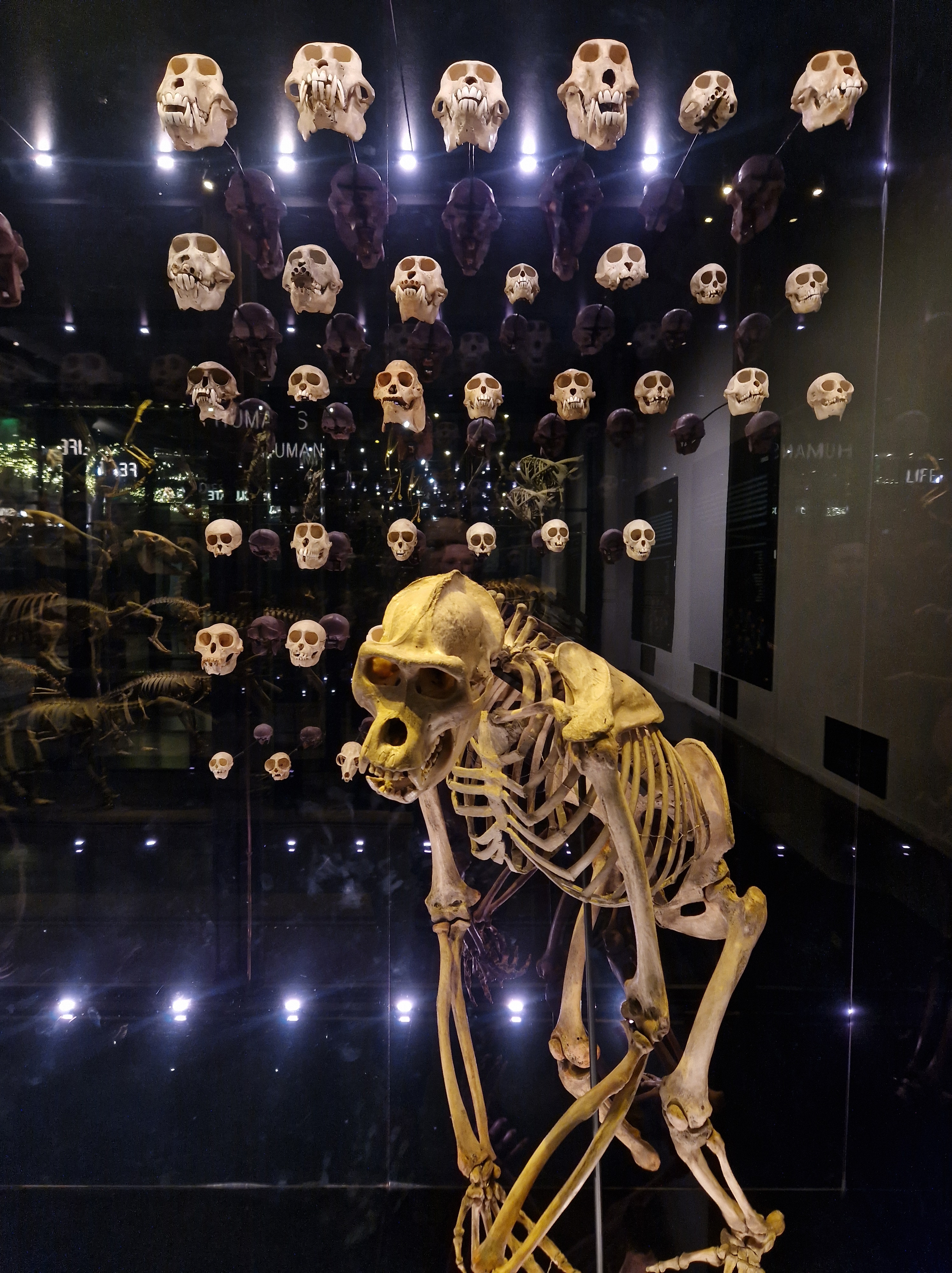
REFLECTIONS: A very valuable trip that made me consider ways to show work, how important colours, background, situating things next to each other, framing, and every little detail is in elevating work and presenting it to its best.

I also observed how the space is presented to the viewer (very impressive), as how I felt in the space affected my interaction with the art. I never thought about it before, but it's so obvious!

It is definitely a revelation to me that I will carry with me forever.
EXPLORING SPECIAL COLLECTIONS AT THE ALL SAINTS LIBRARY
I decided to visit a Special Collections at All Saints Library in order to commence my research into archives.
I think I knew deep down from the beginning that I will be working with archives one way or the other, so it seemed appropriate to start from looking at the ways other artists archive and present their work.
I spoke to the librarian who works there, made an appointment and came back to a table of material she prepared for me based on the information I gave her.
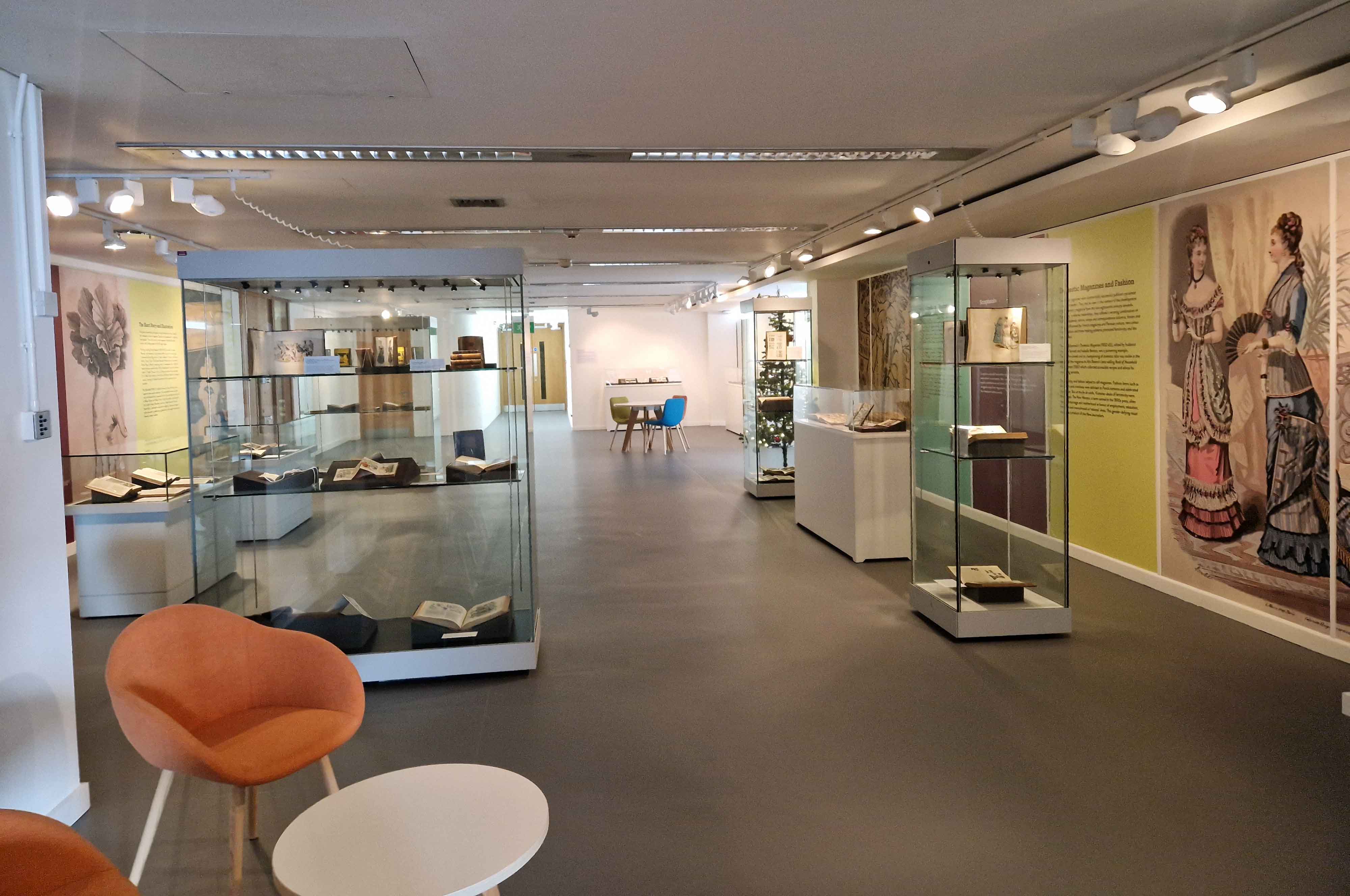
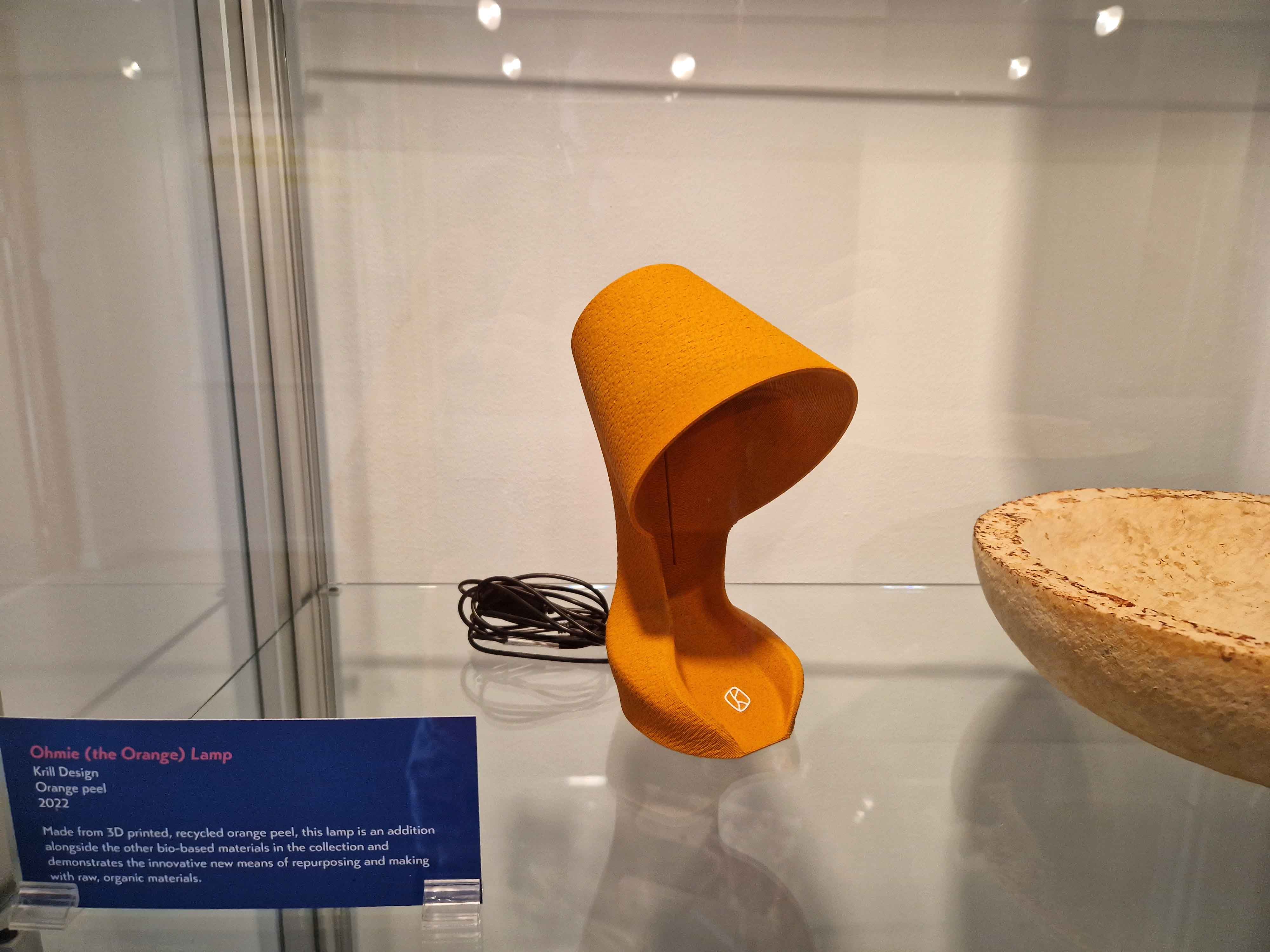
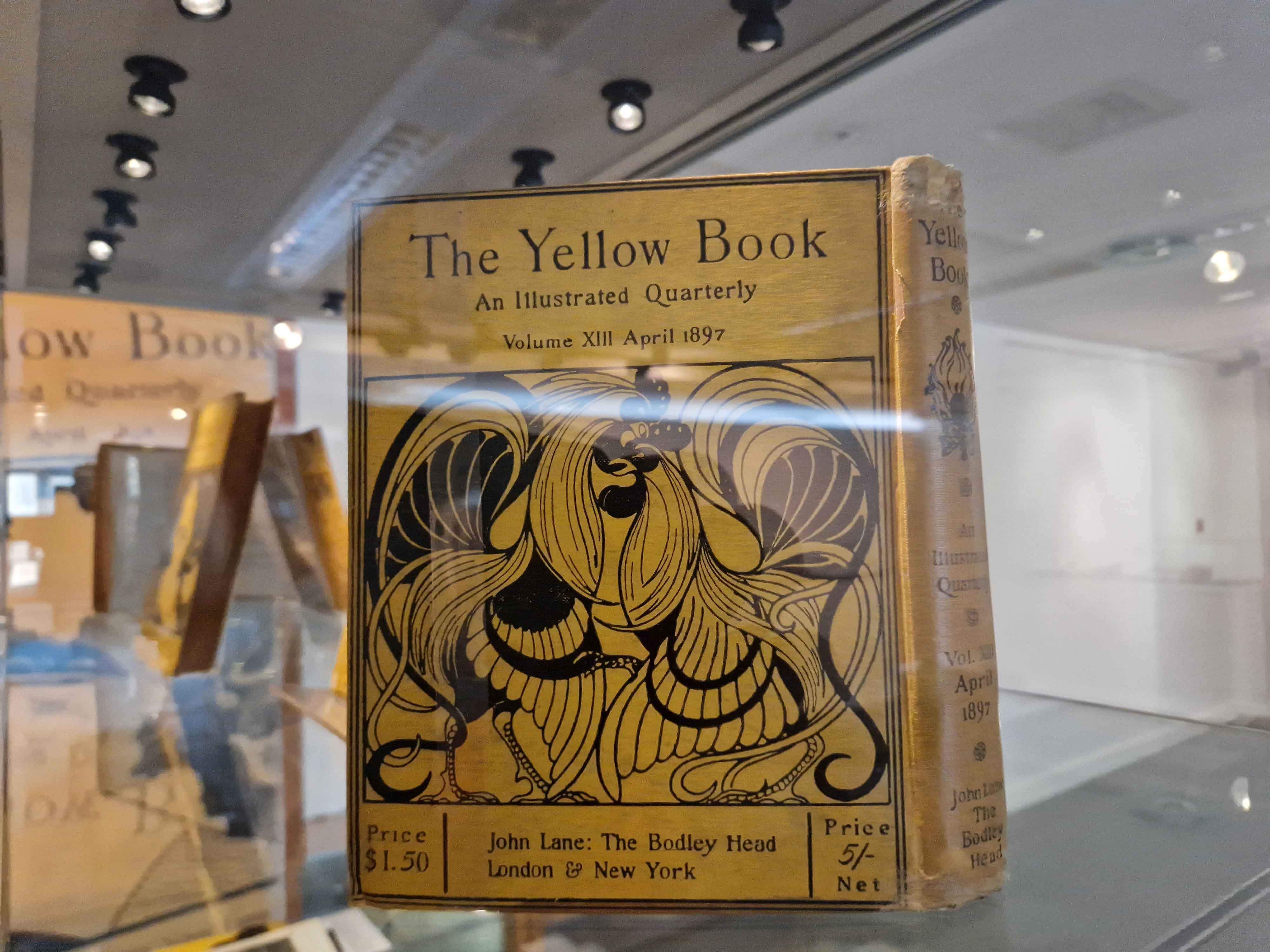
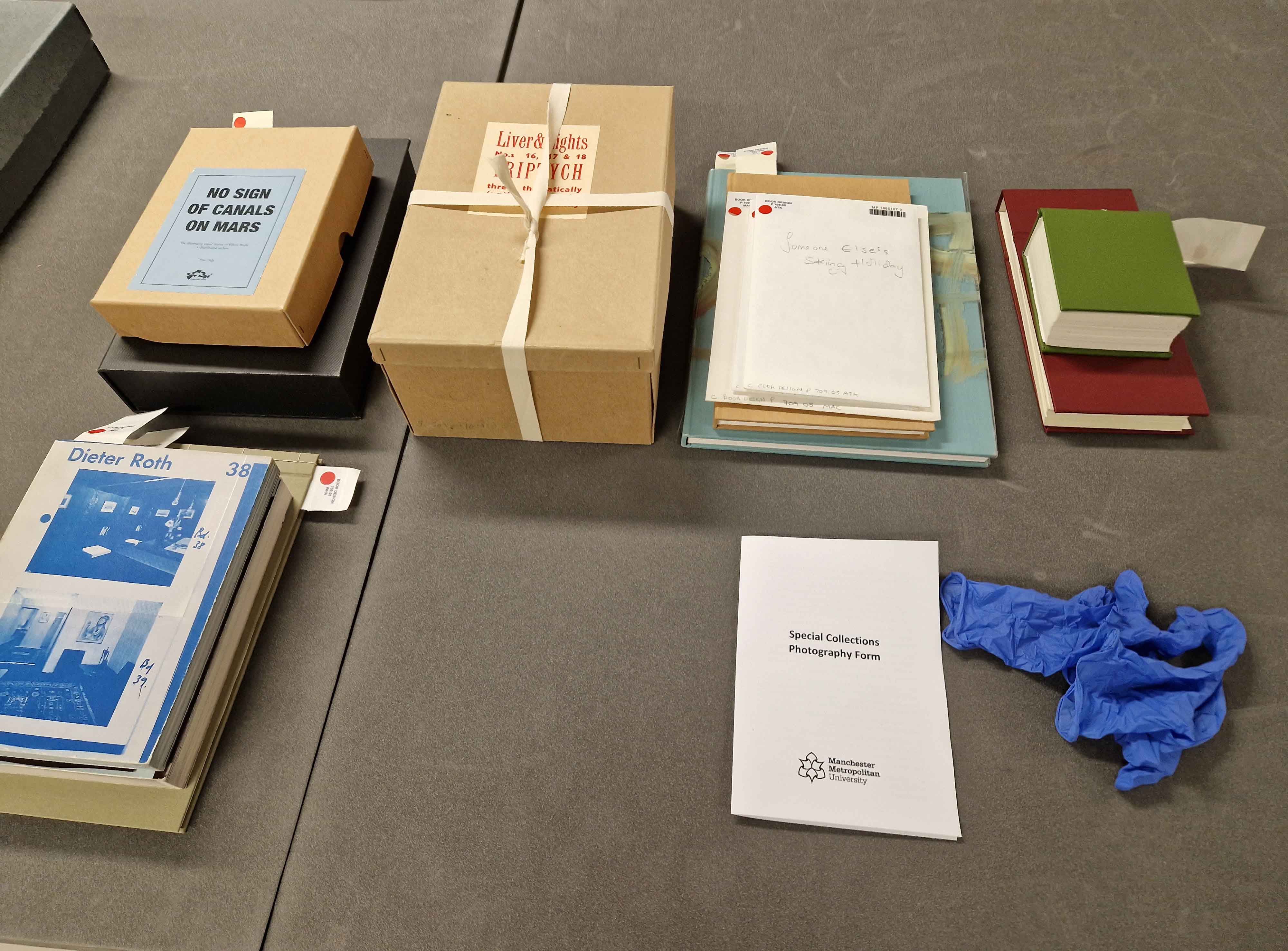
REFLECTIONS: I am very glad that I visited the Special Collections, as it was a very eye-opening experience. I saw work there presented beautifully, originally and like I haven't seen before.
It made me realize the possibilities in which work can be presented, which I find beneficial not only for my collaborative unit but also in my creative practice.
COLLAB SEMINAR FRIDAY 20.10.23
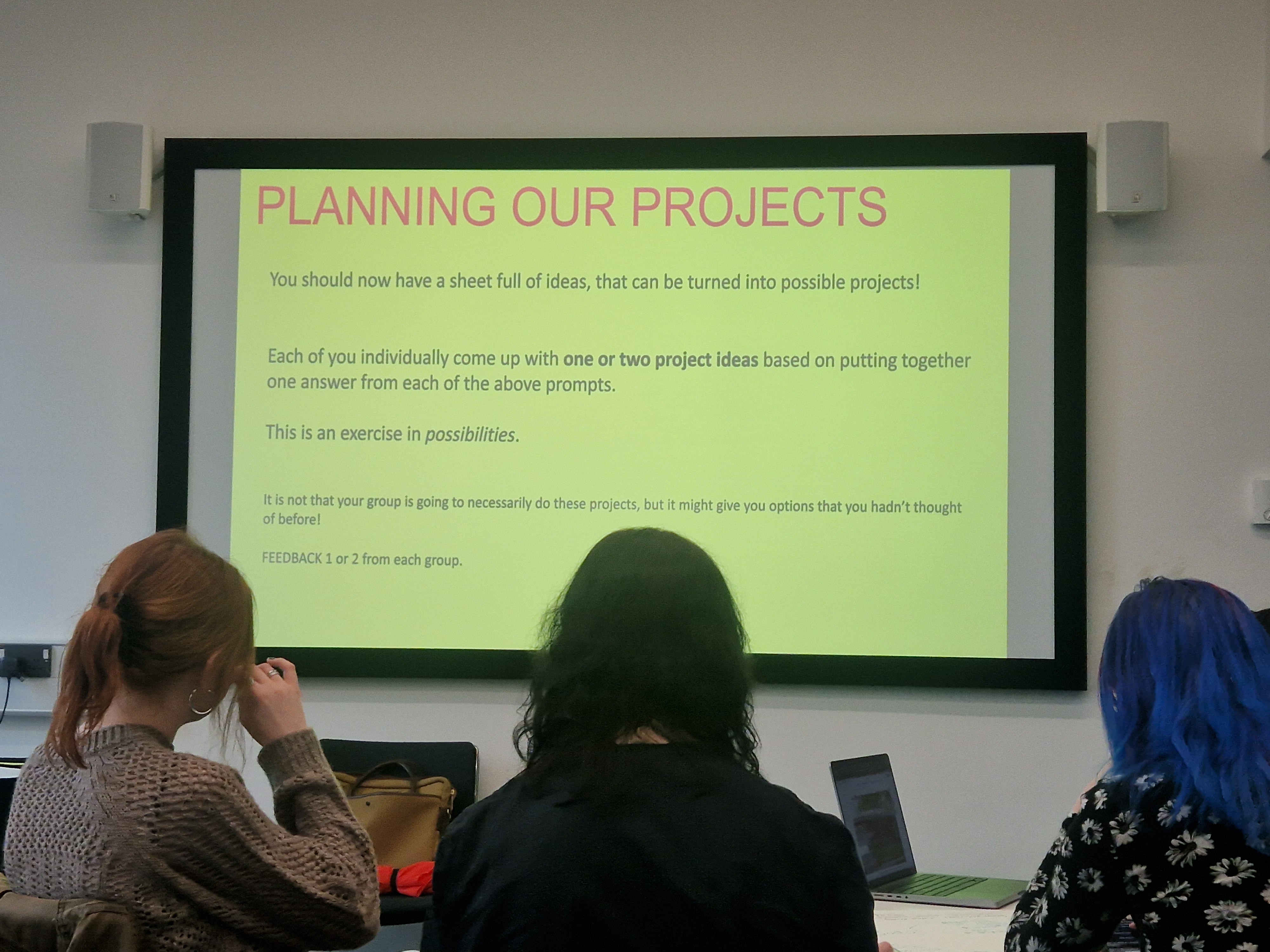
On this day we were prompted to answer a few questions in order to help us shape the project.
My group didn’t show up so I did everything myself, then got in touch with two men I am in the group with sharing my ideas. I asked them for feedback and contribution but received none. I suggested meeting before the next session, but after initially agreeing to meet they both cancelled and not showed up to a session. I suggested we meet next week, but I haven’t received a reply.
I am now doing this project on my own.
CREATIVE METHODS
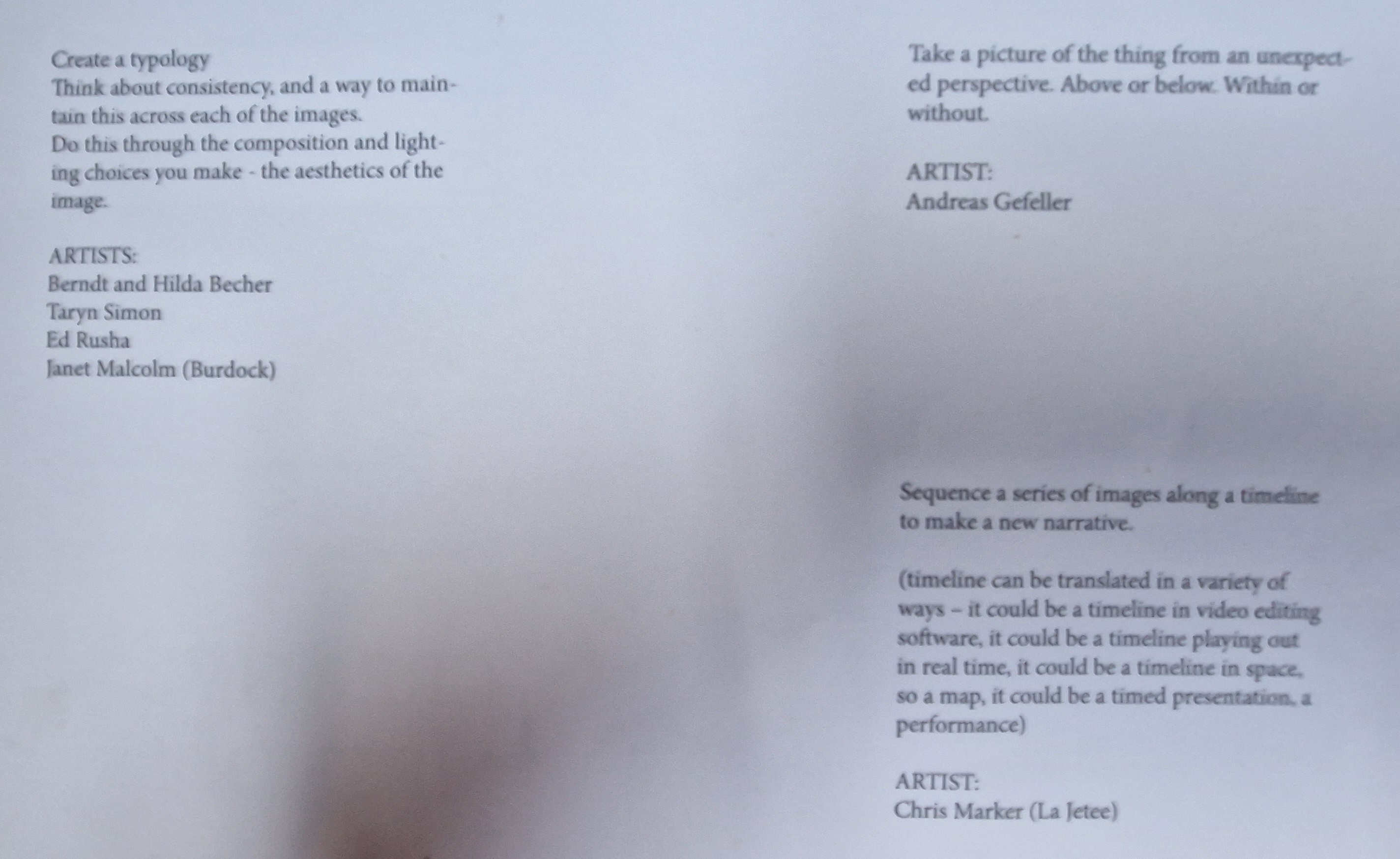
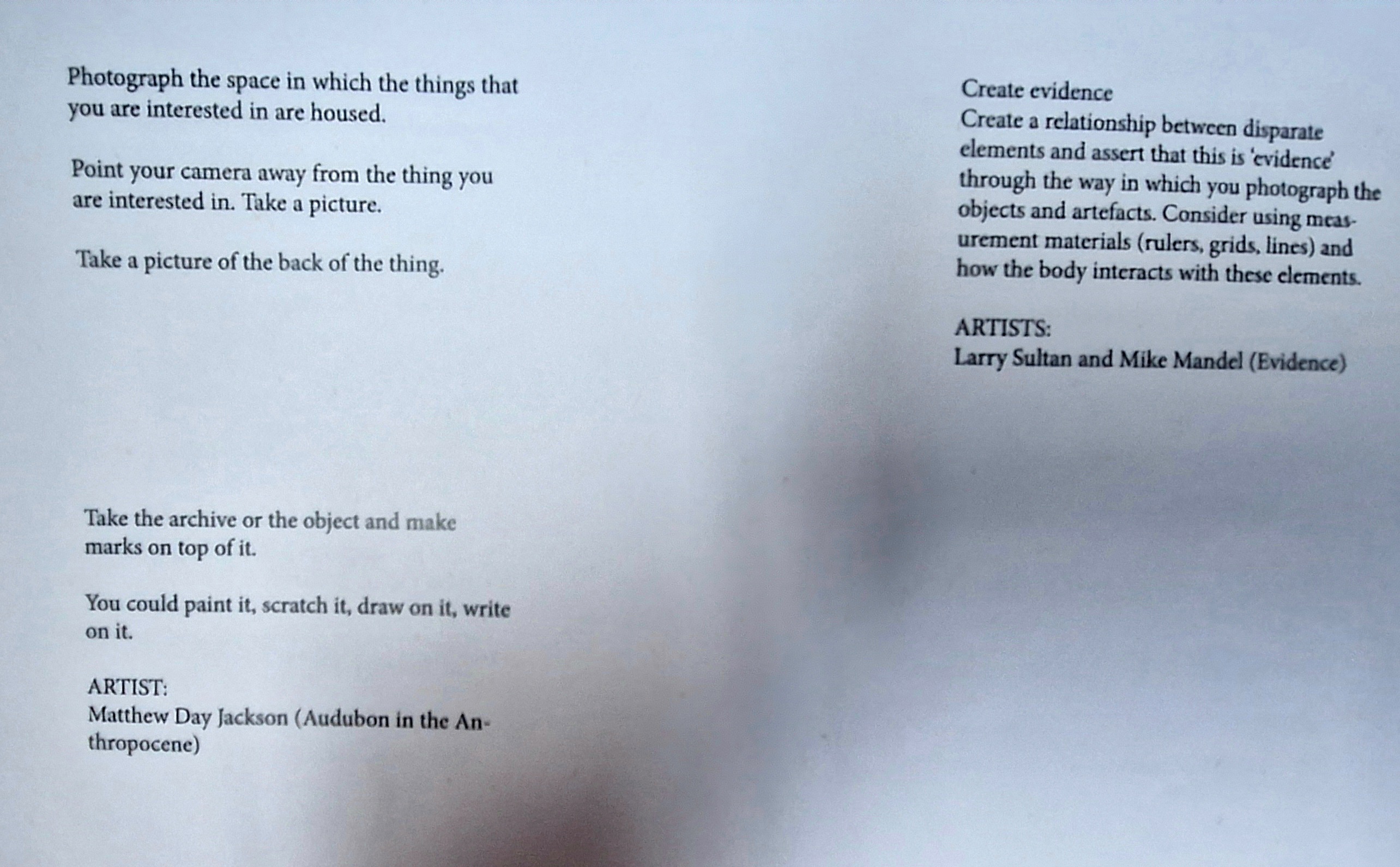
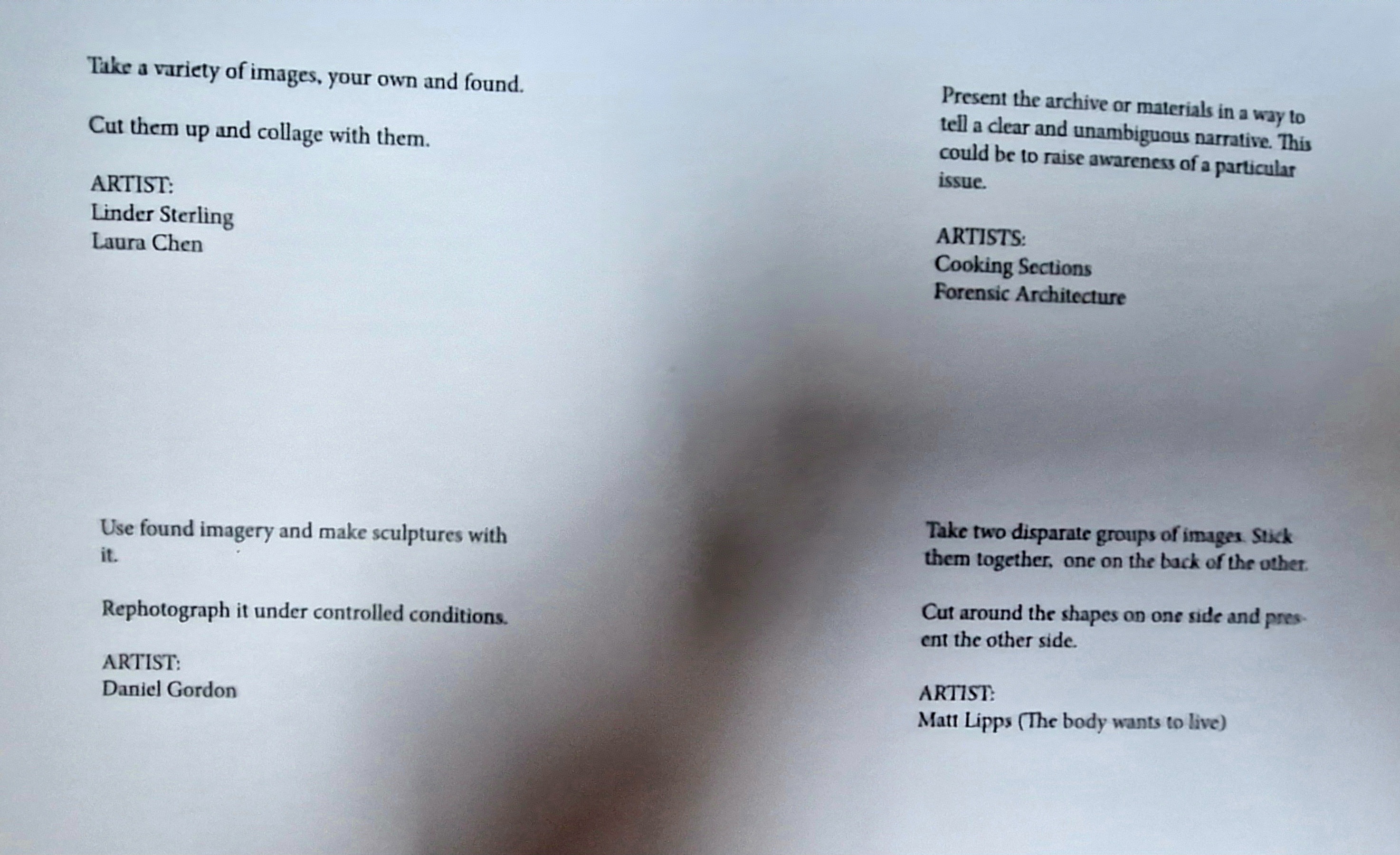
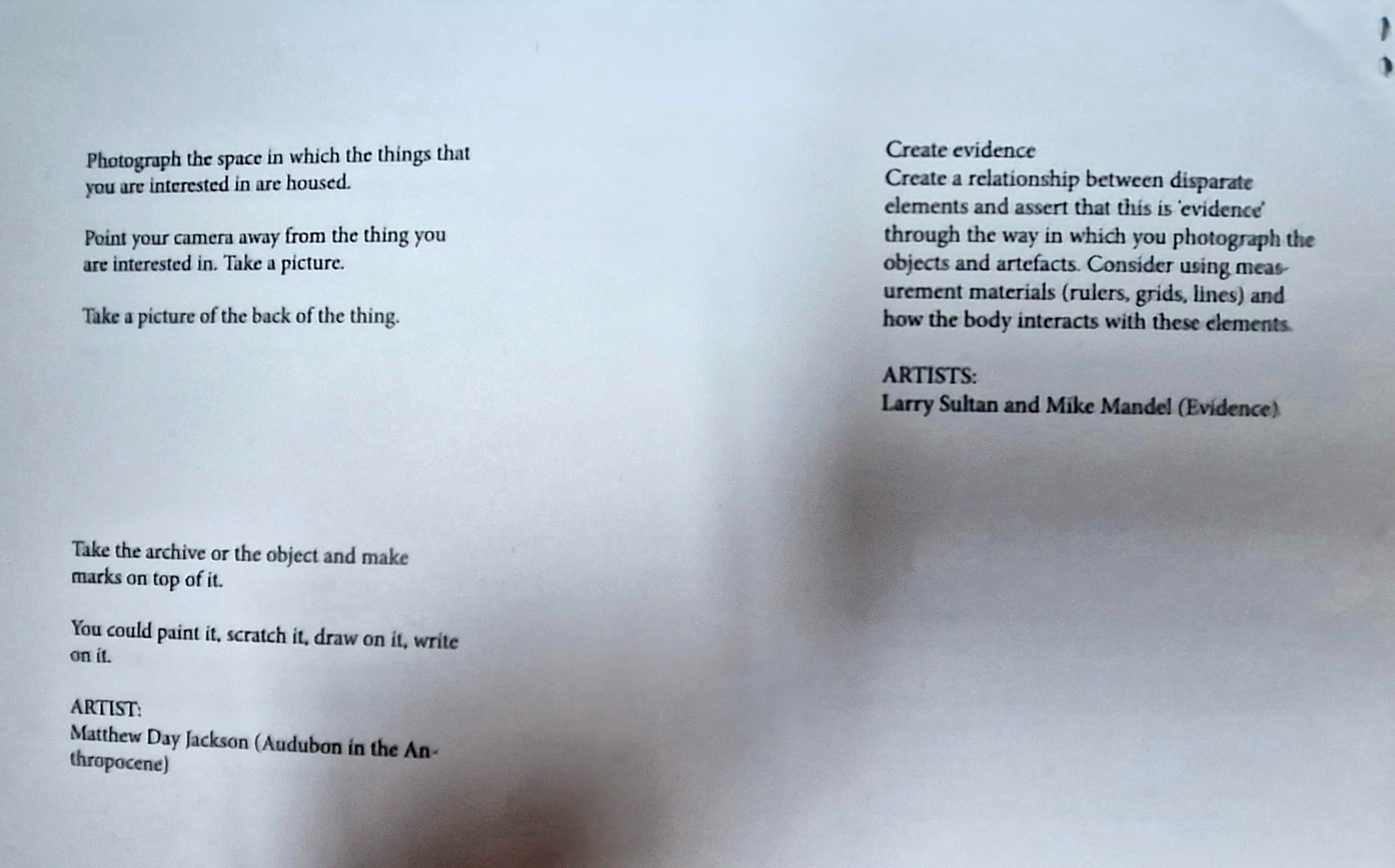
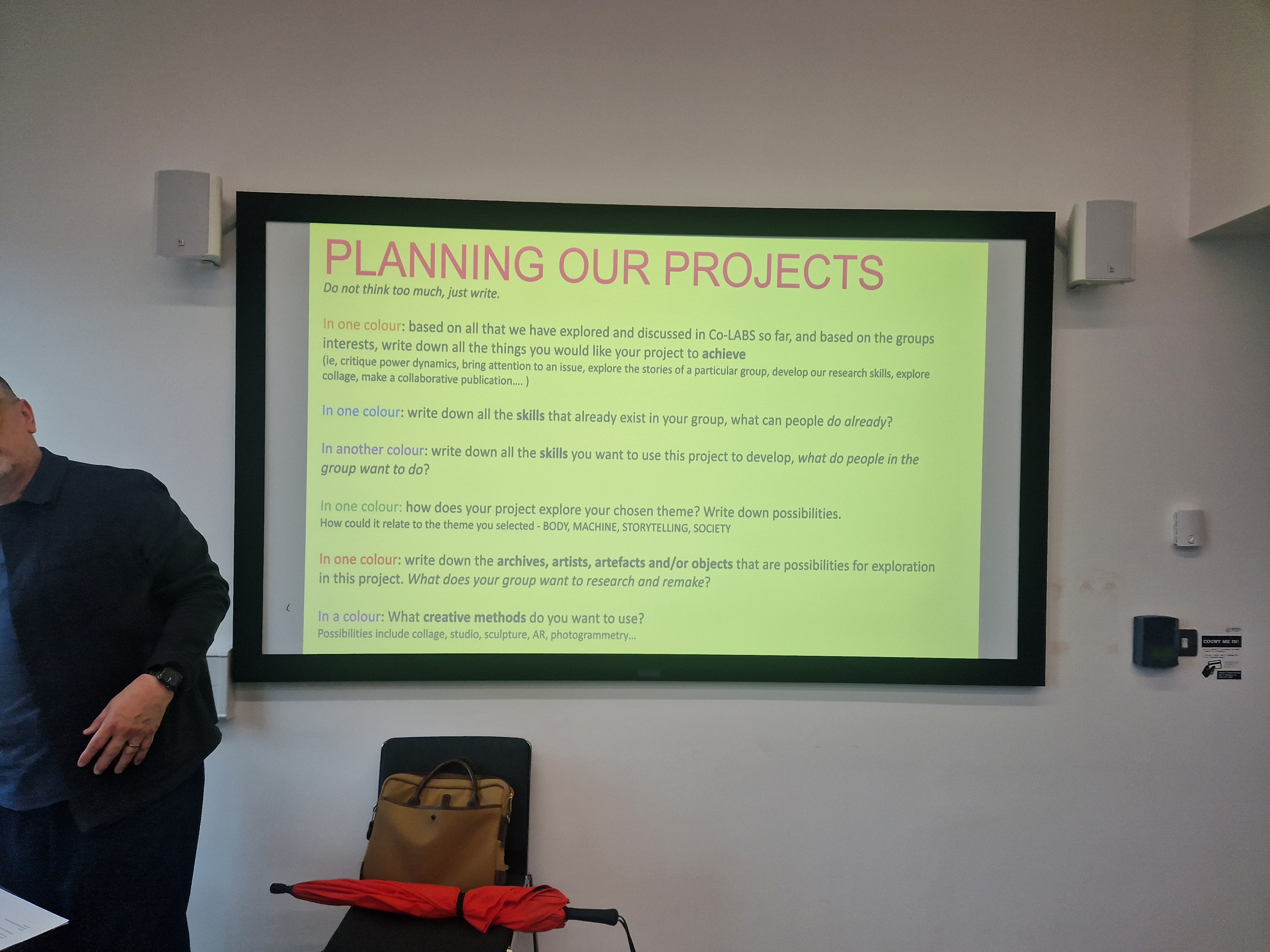
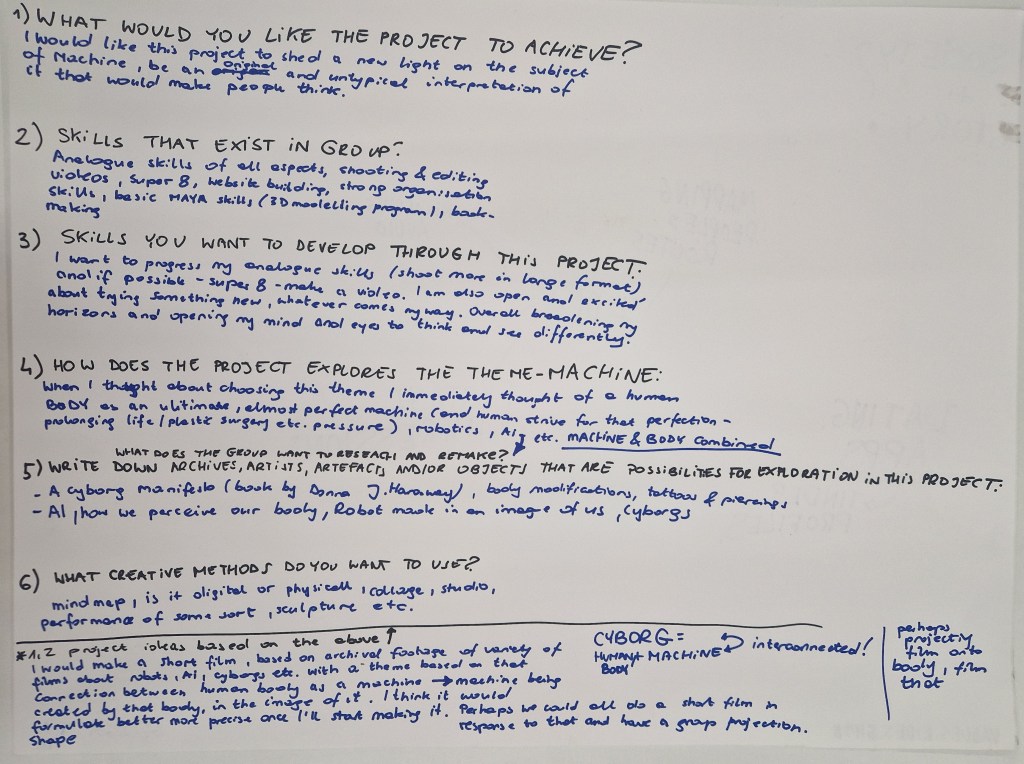
QUESTION: WHAT WOULD YOU LIKE A PROJECT TO ACHIEVE?
I would like this project to shed a new light on the subject of THE MACHINE, to be an original and untypical interpretation of it that would make people think
SKILLS THAT EXIST IN THE GROUP
As I am alone in my group I listed my skills:
- analogue skills of all aspects
- shooting and editing videos
- shooting with Super 8
- website building
- strong organisation skills
- basic MAYA skills (3D modelling program)
- book making skills
SKILLS YOU WANT TO DEVELOP THROUGH THIS PROJECT:
I want to progress my analogue skills (shoot more in large format) and if possible shoot Super 8 – make a video. I am also open and excited about trying something new, whatever comes my way. Overall broadening my horizons and opening my mind and eyes to think and see differently.
QUESTION: HOW DOES THE PROJECT EXPLORE THE THEME OF THE MACHINE?
When I thought about choosing this theme I immediately thought of a human BODY as an ultimate almost perfect machine (and human strive for that perfection – prolonging life, plastic surgery etc.), robotics, cyborg, AI, MACHINE AND BODY COMBINED
WHAT DOES THE GROUP WANT TO RESEARCH AND REMAKE? WRITE DOWN ARCHIVES, ARTISTS, ARTIFACTS AND/OR OBJECTS THAT ARE POSSIBILITIES FOR EXPLORATION IN THIS PROJECT:
- A Cyborg Manifesto book by Donna J. Haraway
- body modifications, tattoos, piercings
- AI
- how we perceive our body – robots made in our image
- CYBORGS!
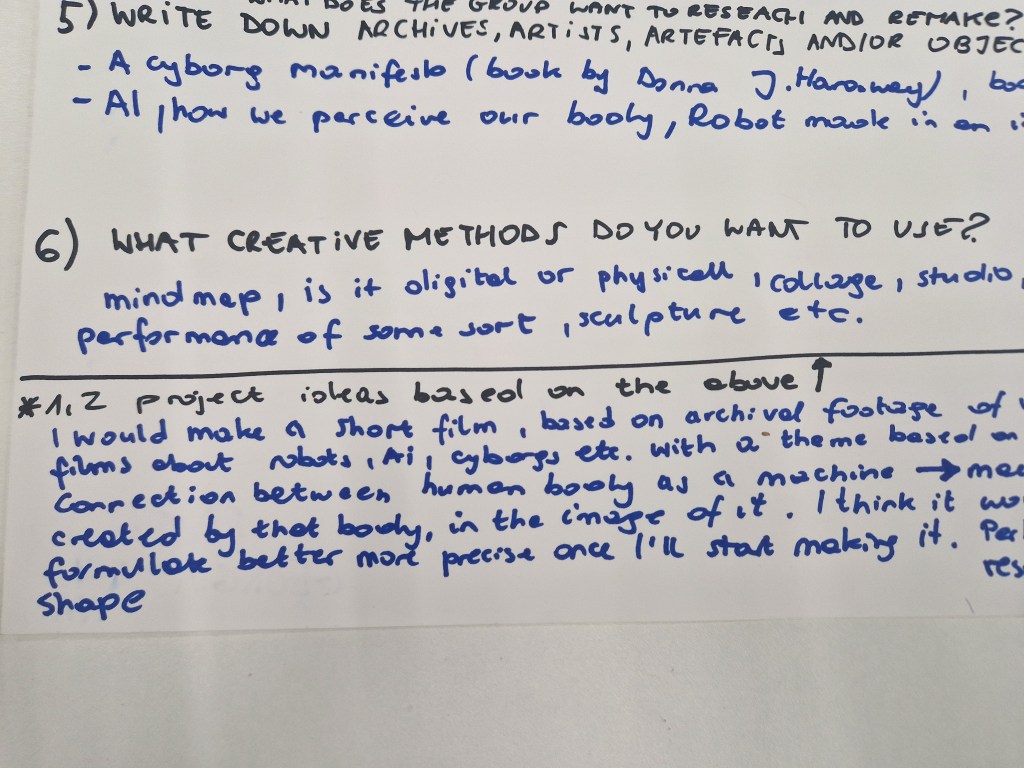
WHAT CREATIVE METHODS DO YOU WANT TO USE?
Mind map, collage, studio work, performance, sculpture, short film
WRITE DOWN 1-2 PROJECT IDEAS BASED ON THE ABOVE:
I would like to make a short film based on archival footage of a variety of films about robots, AI, Cyborgs etc. with a theme based on that connection between the human body as a machine – a machine being created by that body, in its image. I think it would formulate more precisely once I start making it.
Think of a creative way to project the film! Perhaps project it onto a body?
CYBORG = HUMAN+MACHINE = INTERCONNECTED
PROJECT PLAN
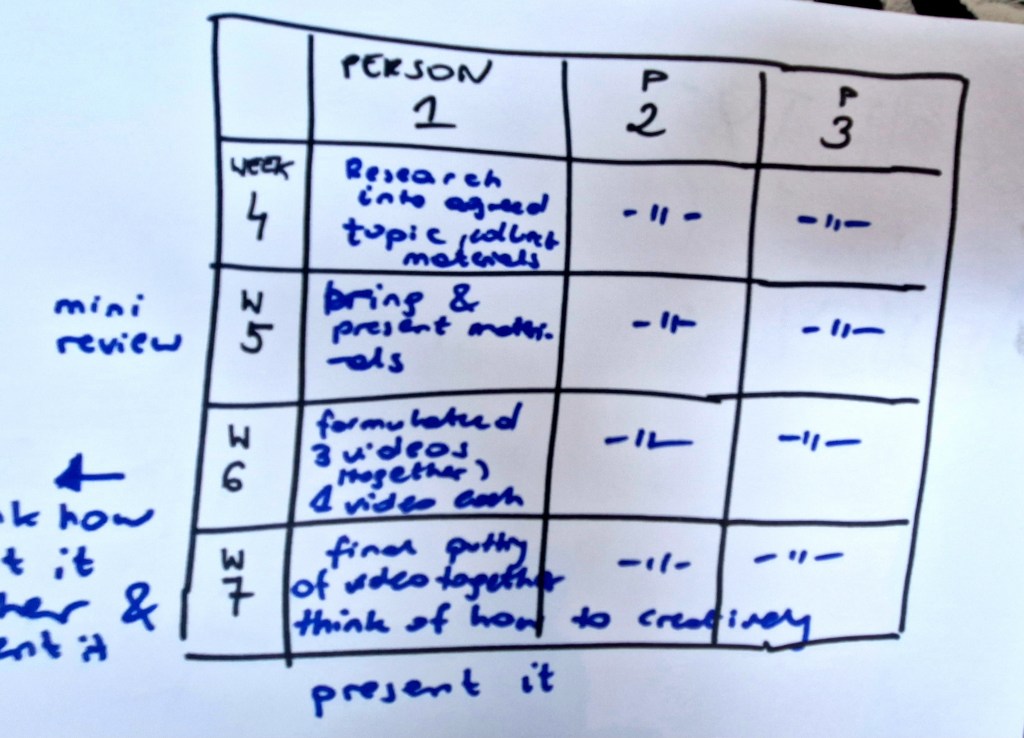
REFLECTIONS: It was an incredibly useful session that helped me identify my strengths, interests and direction for this unit. I learned that if I am stuck for ideas, simply ask myself a series of basic questions. As a consequence of brainstorming, aims and expectations became clear very quickly, which then allowed me more time to realise the project.
COLLAB SEMINAR 27.10.23
WRITING AROUND AN OBJECT with DR Chad McDonald
NOTES:
- practice generating ideas to support reflection
- identify critical questions to use when discussing sources
- exercise in describing each others objects
TASK 2:
Exercise with photographing objects, diffusing and reflecting light
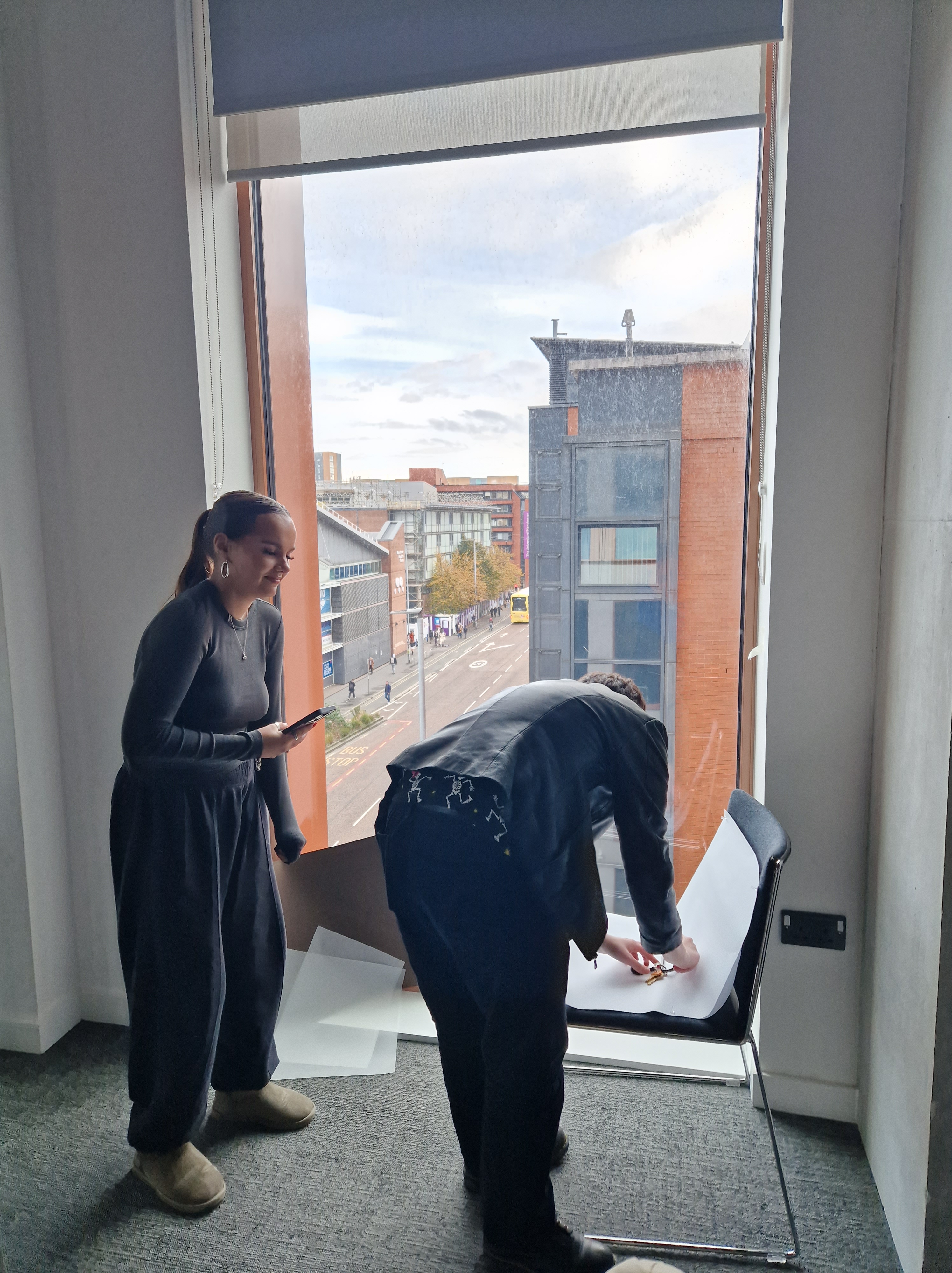
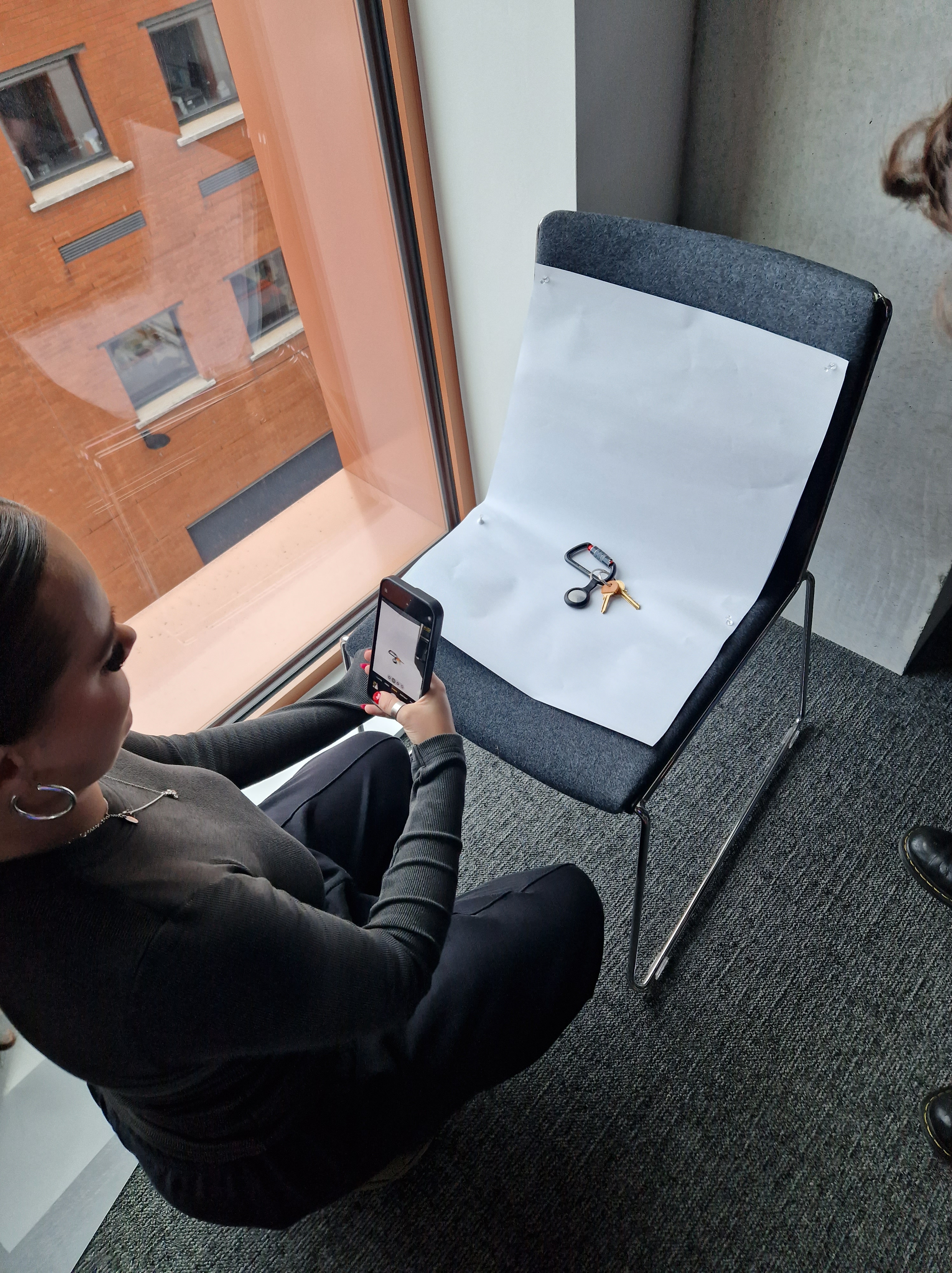
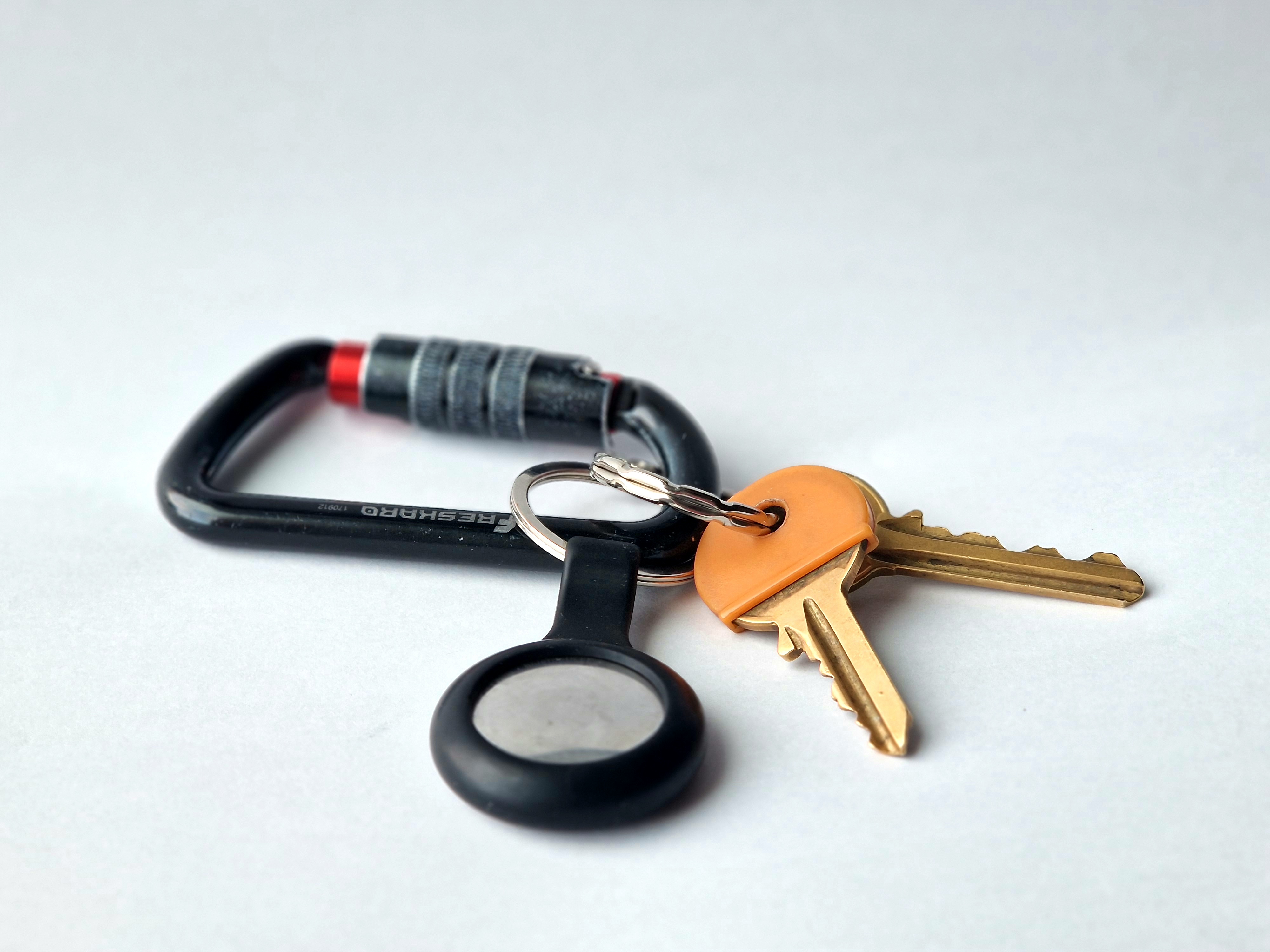
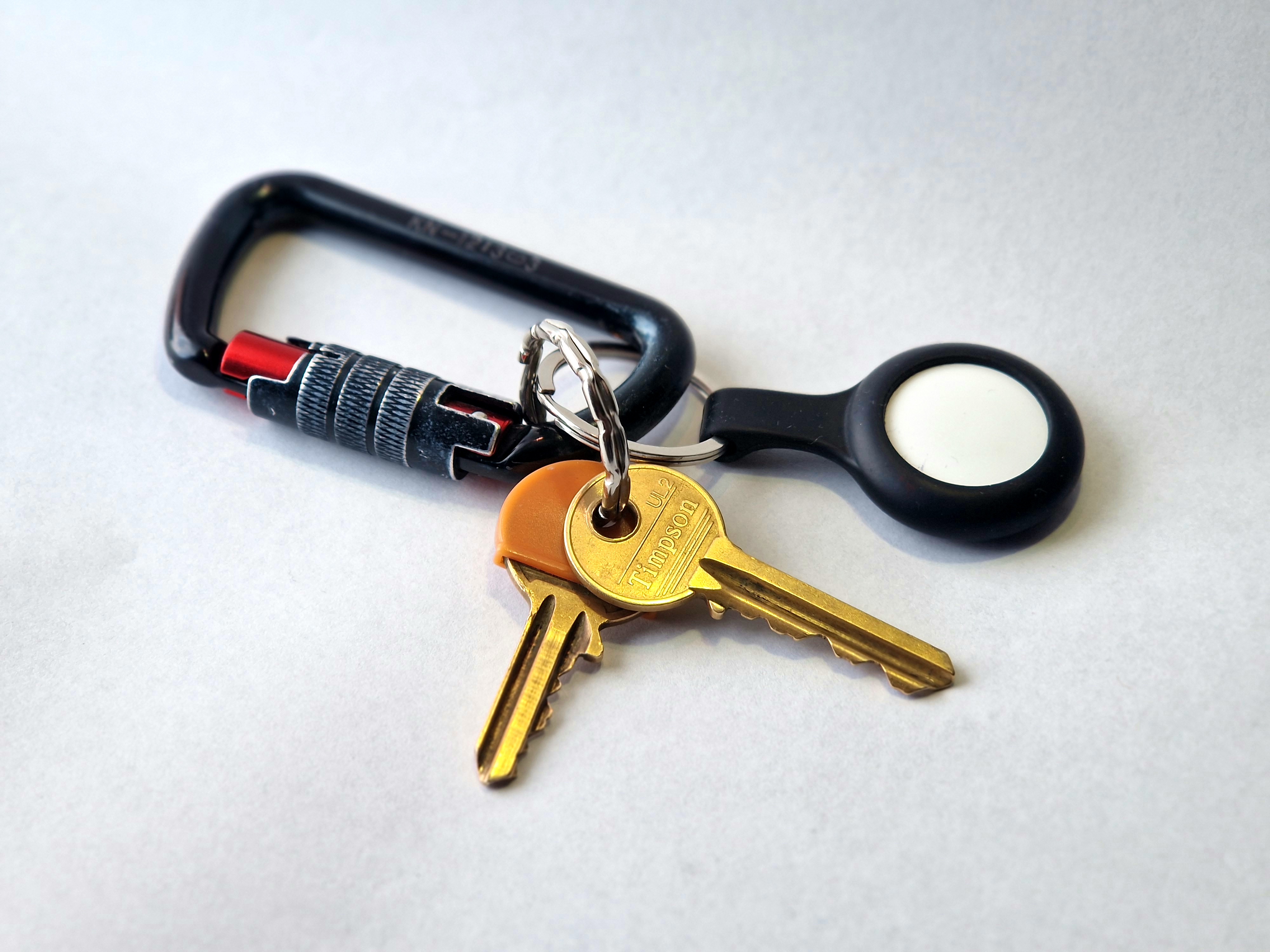
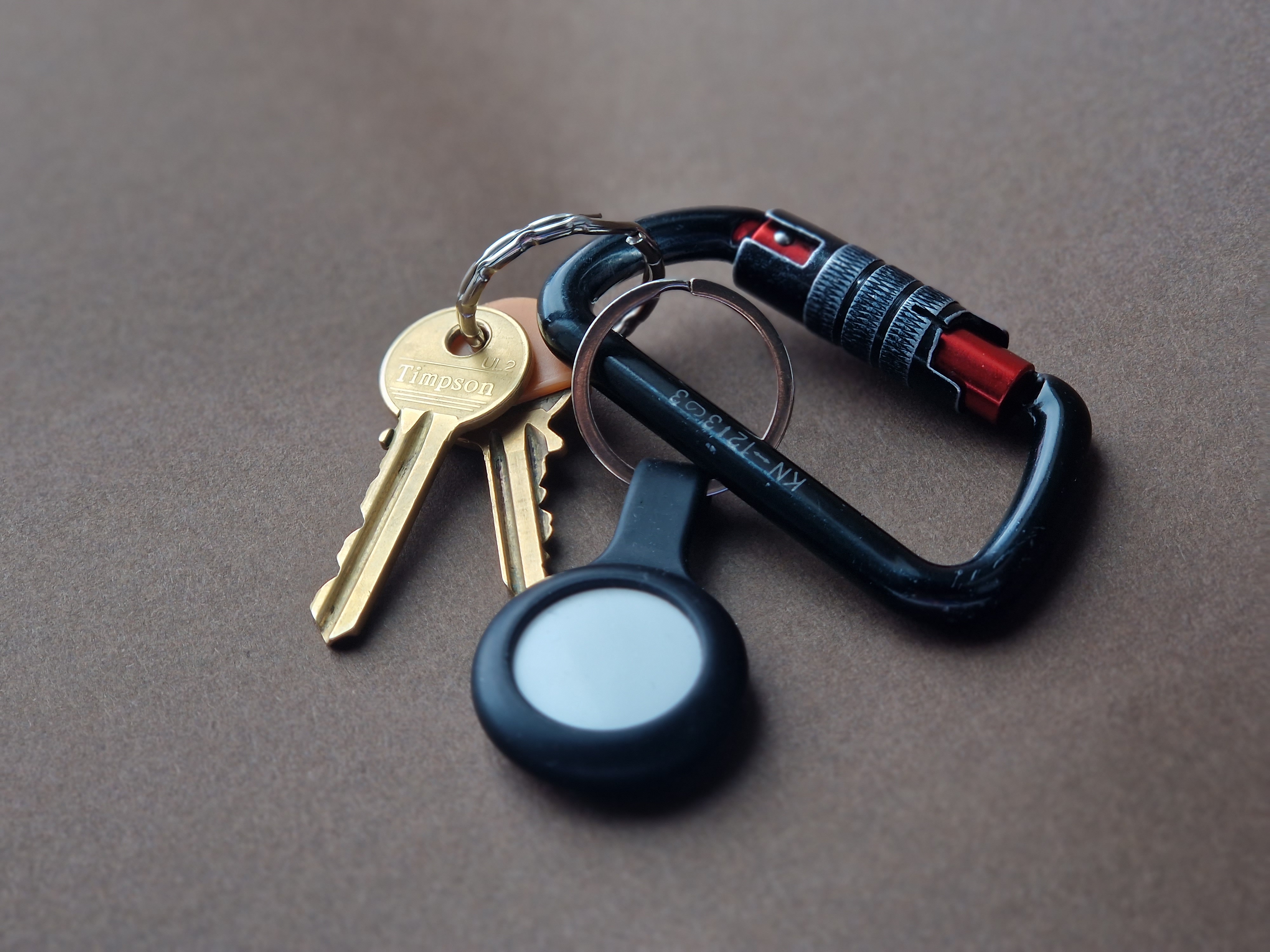
REFLECTIONS: I found the session about writing around objects very applicable and something that I will keep in mind when writing my Personal Reflection for the unit. I was slightly confused about the second part of the seminar when we described objects and photographed them against a piece of paper. I struggled to think how this was relevant to our unit in a learning sense, but I enjoyed working with a group (not my group, unfortunately, as they do not come to the sessions) and getting to know some people from my year.
TUTORIAL WITH SIAN
NOTES:
- Very Nice, Very Nice. 1961. Short. Arthur Lipsett.
Arthur Lipsett.Oscar nominated for short in 1962.
- Book by Laurie Anderson Dal Vivo
- Jonathan Glazer https://www.academyfilms.com/jonathan-glazer
Jonathan first found fame for his revolutionary work on Radiohead’s ‘Street Spirit’ and Jamiroquai’s multi-MTV award winning ‘Virtual Insanity’ video.
In 1999 he directed the ground-breaking Guinness ‘Surfer’, which picked up 2 D&AD Black Pencils and the top spot at most of the other awards festivals that year. The film still heads many lists as one of the best commercials of all time. He has made iconic commercials for Stella Artois, Levis, Nike, Sony, Volkswagen, Channel 4, Wrangler, Apple and many others. His film for Alexander McQueen won a Grand Prix at the Ciclope Festival in Berlin.
In 2000 Jonathan directed Sexy Beast which was nominated for Best British Film by BAFTA. This was followed 4 years later with Birth, staring Nicole Kidman and Lauren Bacall. His 2014 film, Under The Skin stars Scarlett Johansson and is an adaptation of Michel Faber’s 2000 novel of the same name. Under The Skin received 2 BAFTA nominations and won critical acclaim as a ‘landmark in filmmaking’.
More recently Jonathan has directed work for the BBC in the form of 2019’s ‘The Fall’, a short film influenced by Goya’s ‘The Sleep of Reason Produces Monsters’ and a hunting photograph of Donald Trump’s two sons posing with a dead leopard; and 2020’s Strasbourg 1518, a collaboration in isolation created during Covid, inspired by a unique plague striking inhabitants of the city who danced until their ultimate demise.
Jonathan’s new film, ‘The Zone Of Interest’ won the Grand Prix at the Cannes Film Festival earlier this year and will be released in December.
- Chris Cunningham – music videos
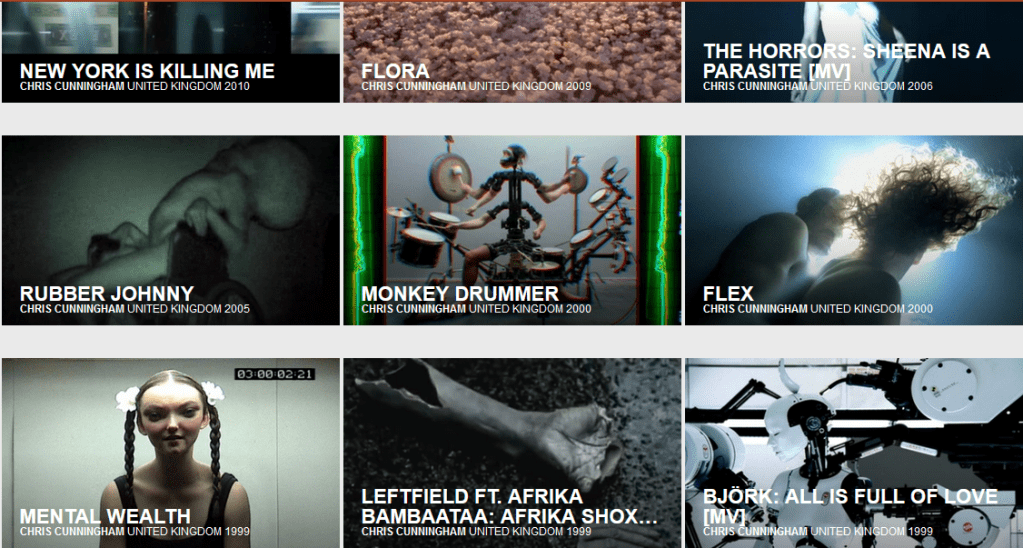
- Matthew Barney http://matthewbarney.net/
Matthew Barney (born March 25, 1967) is an American contemporary artist and film director who works in the fields of sculpture, film, photography and drawing. His works explore connections among geography, biology, geology and mythology as well as themes of conflict and failure. His early pieces were sculptural installations combined with performance and video. Between 1994 and 2002, he created The Cremaster Cycle, a series of five films described by Jonathan Jones in The Guardian as “one of the most imaginative and brilliant achievements in the history of avant-garde cinema.” He is also known for his projects Drawing Restraint 9 (2005), River of Fundament (2014) and Redoubt (2018).
- Matthew Barney – The Cremaster Cycle
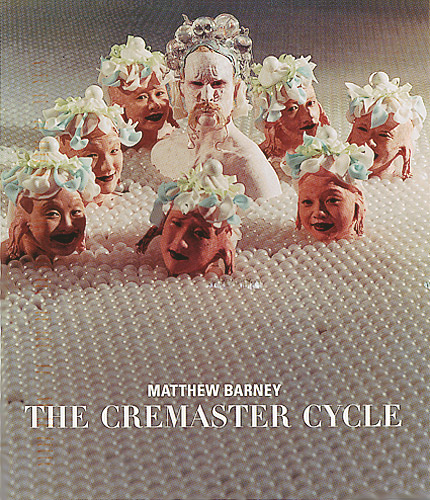
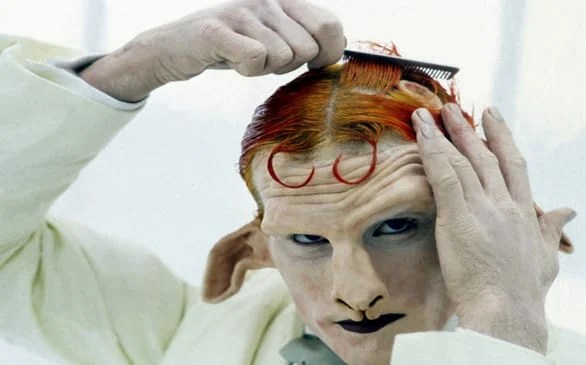
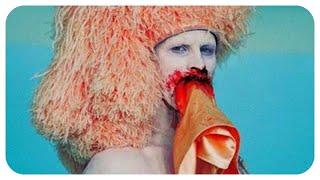
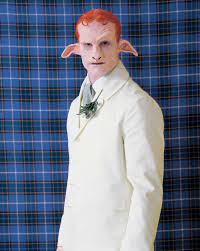
Cremaster Cycle Trailer
What on Earth is The Cremaster Cycle (1994-2002)
The Cremaster Cycle(1994-2002) is a series of art films directed by and starring contemporary visual artist Matthew Barney. The films are littered with anatomical images and explore the process of sexual differentiation in the embryonic stage. This video spotlights all five films while arguing they are about transitioning, which includes gender transitioning, as well as the transition of social politics, technology, and art.
Anyone can have an intimate relationship with the Cremaster films or the sculptures … anyone can access them from any point; from fashion, horror movies, architecture, drawing, photography, football, plastics—or just story-telling. The whole project is so porous; there are a million ways to enter it.
—Matthew D. Ryle, production designer, Cremasters 1, 2, 3, and 5
Matthew Barney is best known as the producer and creator of the Cremaster cycle, a series of five visually extravagant films created out of sequence (Cremaster 4 began the cycle, followed by Cremaster 1, etc.). The films generally feature Barney in myriad roles, including characters as diverse as a satyr, a magician, and even the infamous murderer Gary Gilmore. The title of the cycle refers to the muscle that raises and lowers the male reproductive system according to external stimuli such as temperature or fear. The films themselves are a grand mixture of history, autobiography, and mythology—an intensely private universe in which symbols and images are densely layered and interconnected. The resulting cosmology is both beautiful and complex. Barney sees the human body as a biological instrument and a sculptural tool. His works combine obsessive athletic endeavors with his own highly personalized mythology. Crossing from sculpture to film to video, he seamlessly creates dramas that inhabit a zone that is both psychological and physical.
As the cycle evolved over eight years (1994–2002), this biological model was joined by other paradigms such as biography and mythology that have added to Barney’s fantastical narrative constructs. In Barney’s eccentric universe, nothing can be construed as simply one thing or the other. He challenges our dualistic categories (male/female, entropy/order, motion/inertia) with new possibilities.
REFLECTIONS: The tutorial is never a bad idea. After this session with Sian, I had plenty of new ideas and areas to look at from archival footage (music videos). She directed me towards many interesting artists, which has been very beneficial to the development of my idea.
COLLAB SEMINAR 17.11 – REFLECTIVE WRITING
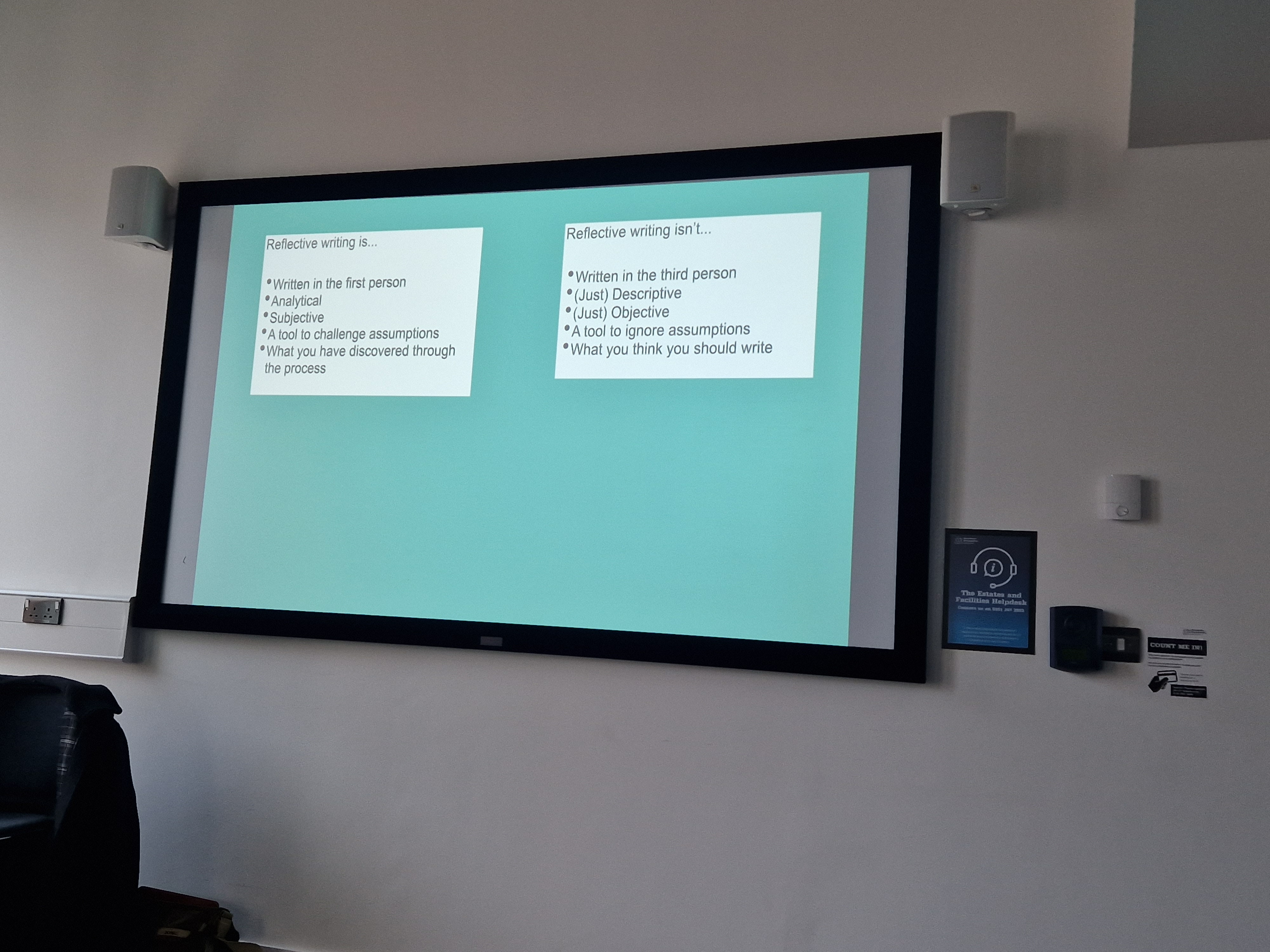
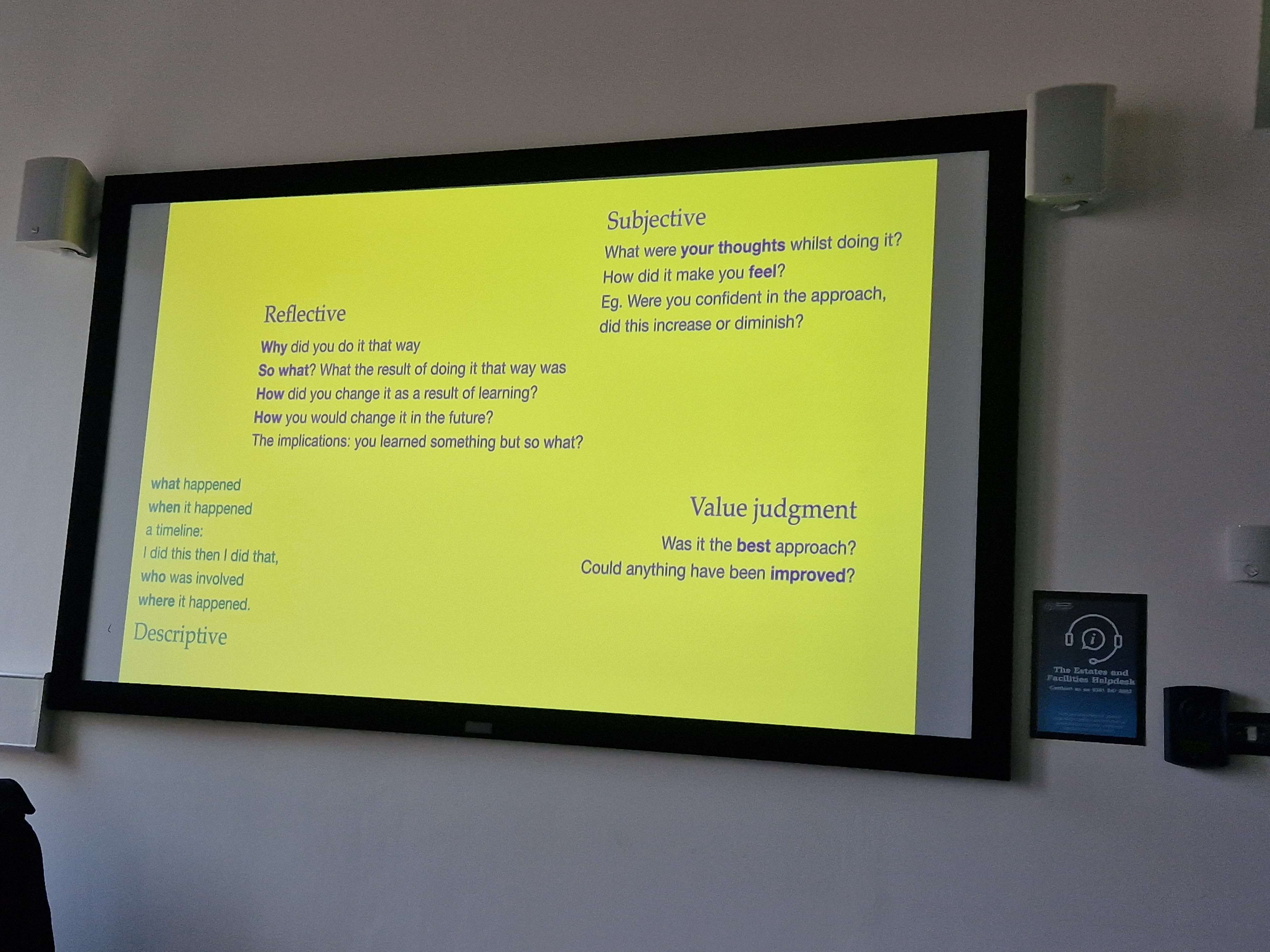
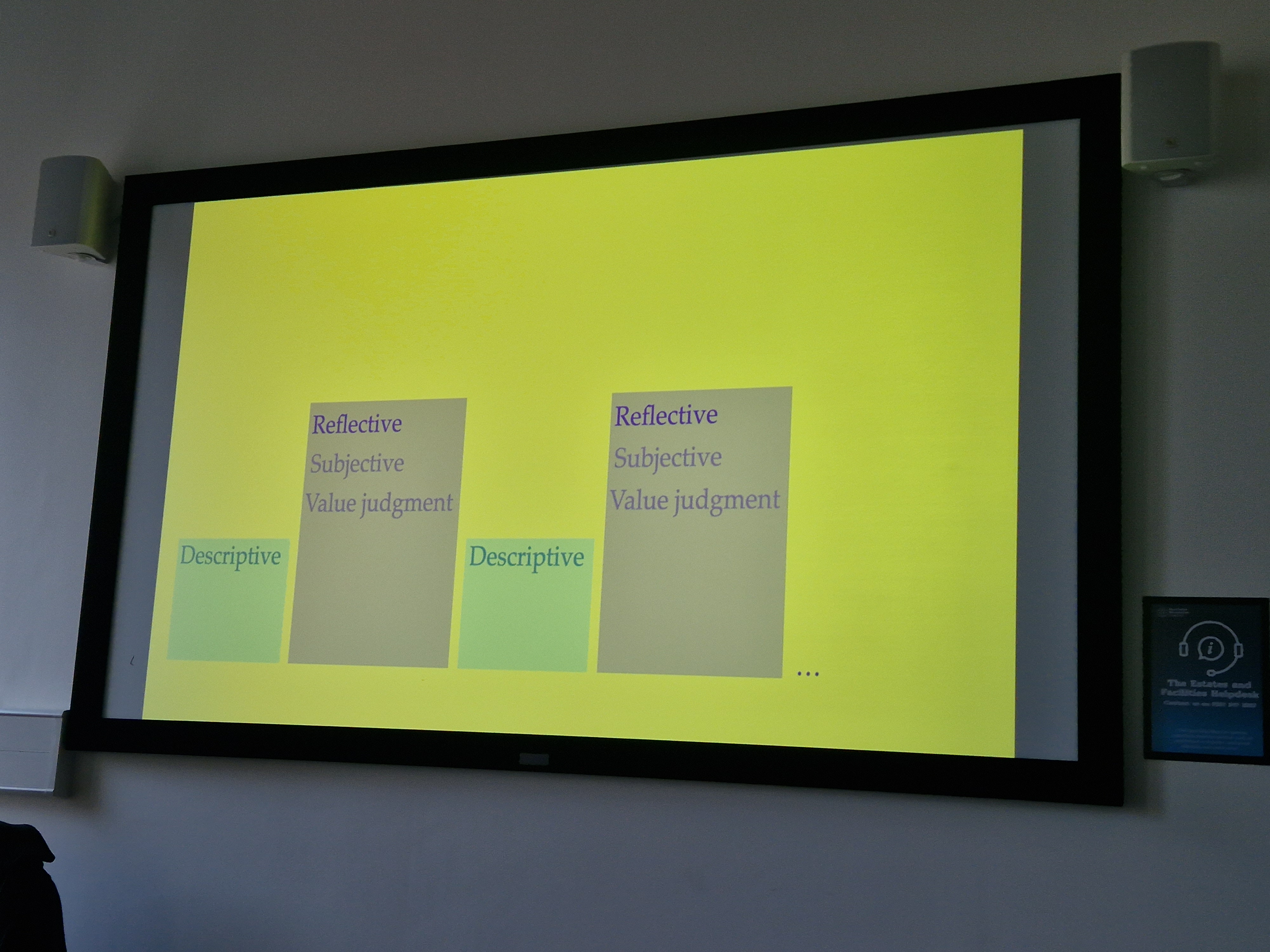
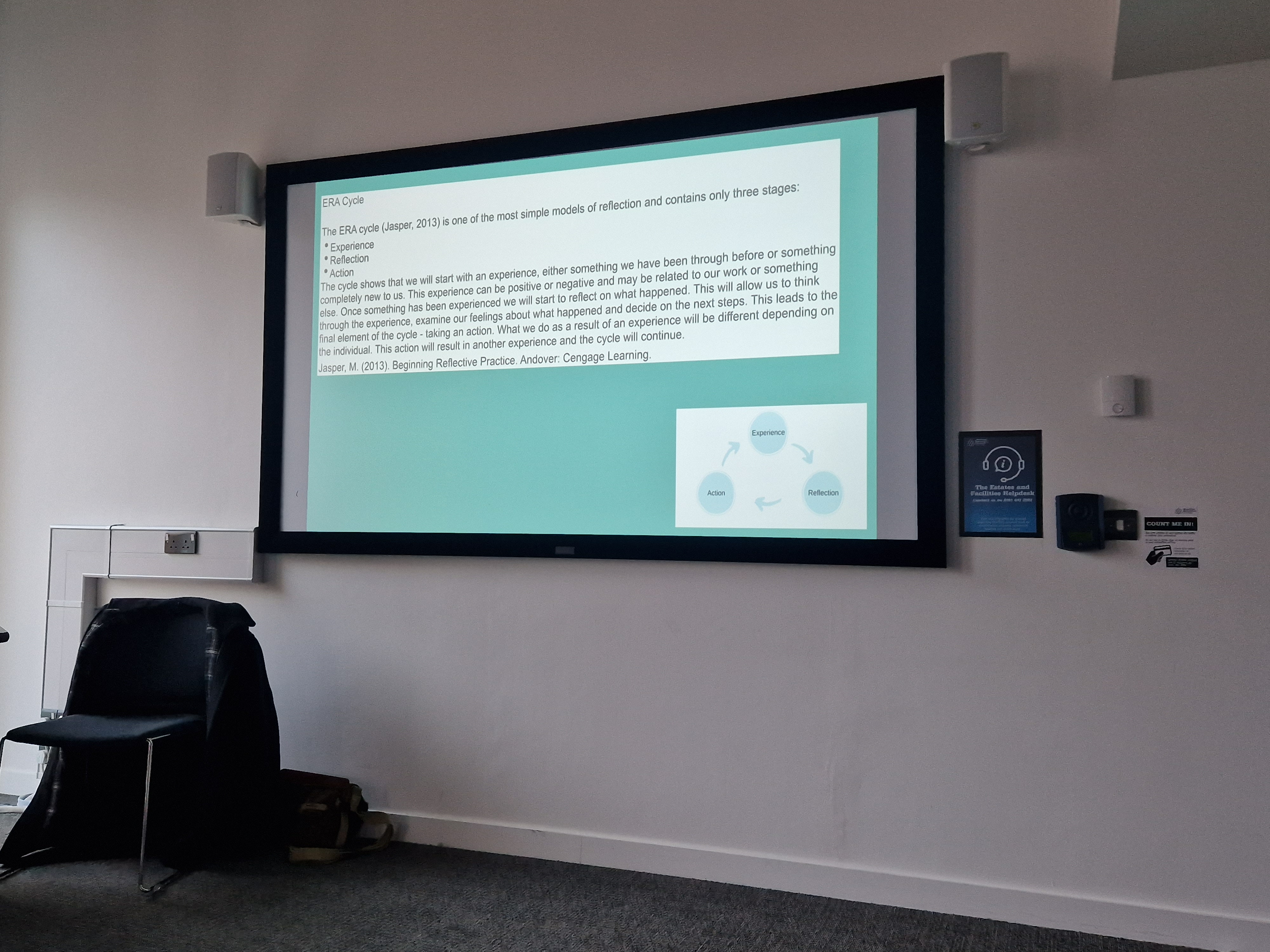
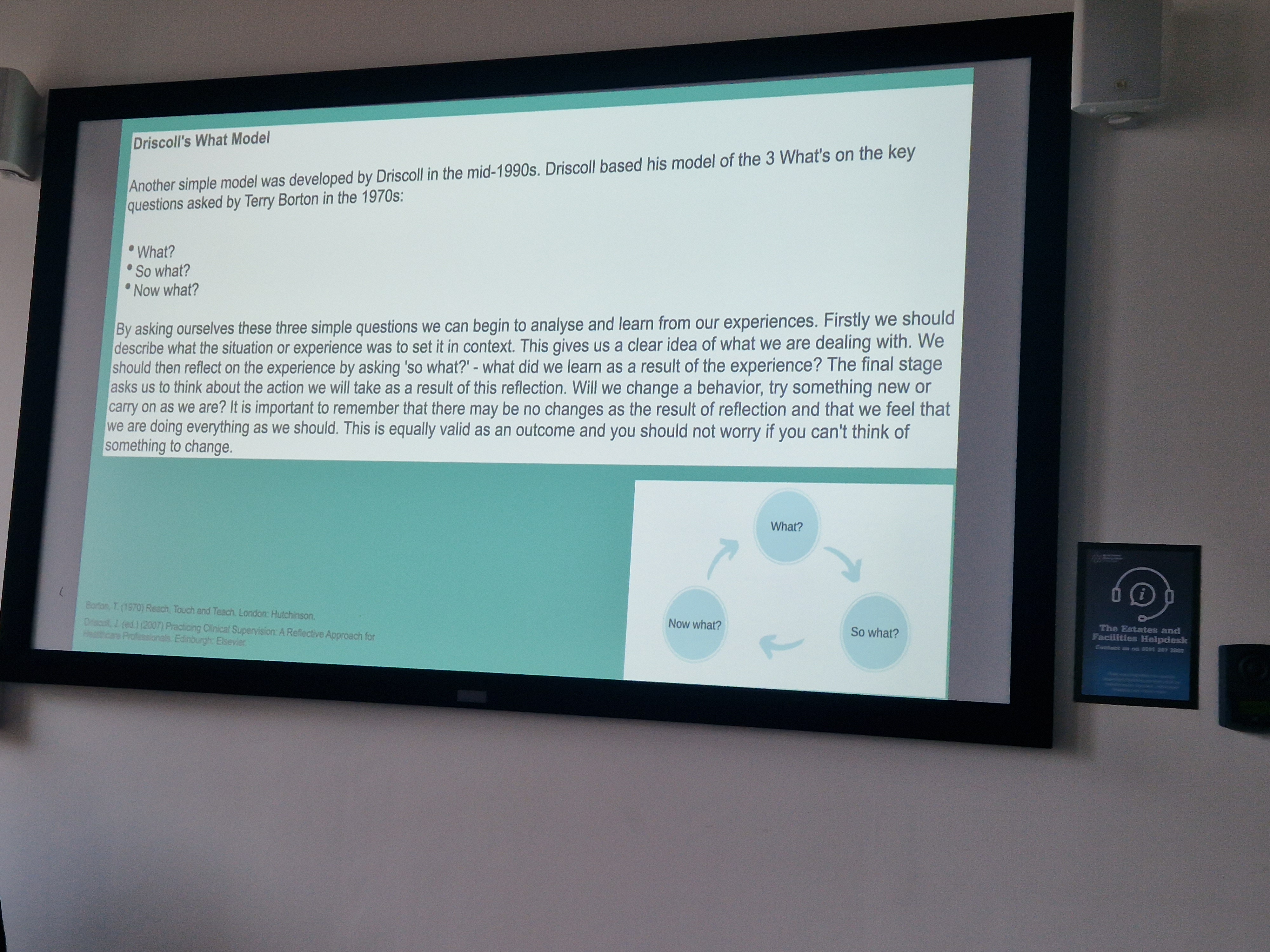
NOTES:
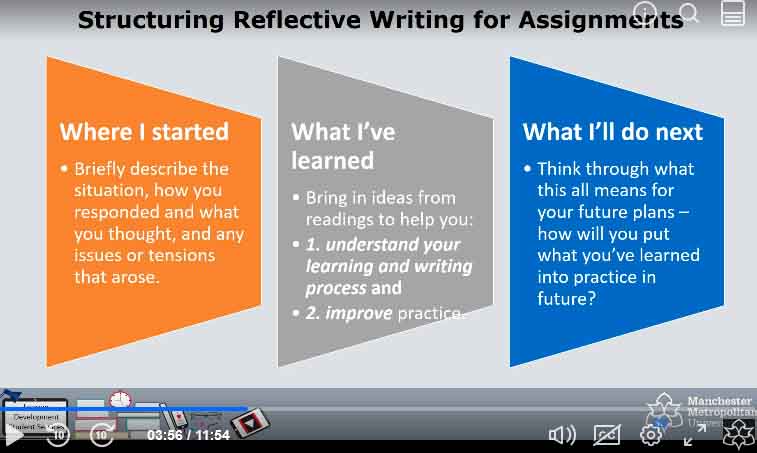
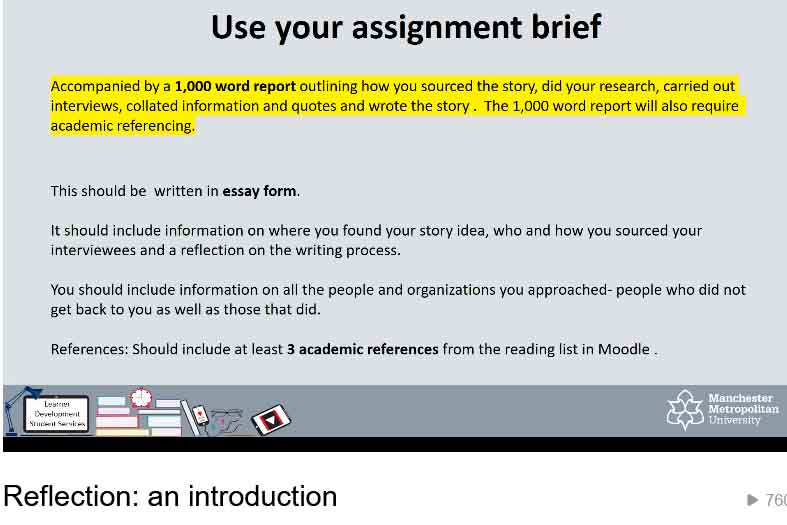
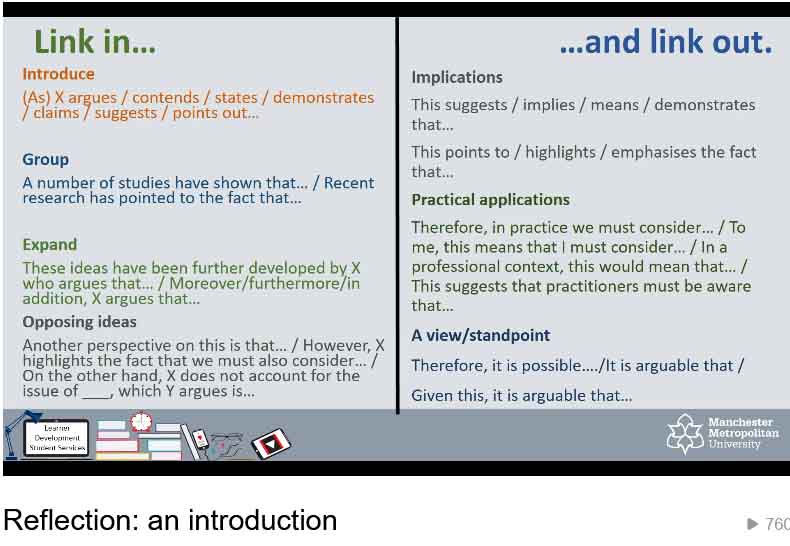
- how you developed the idea – slides on Moodle or mmutube on reflective writing (watch it will help as writing like this is different to essay)
- pictures of useful slides on Moodle
Reflective writing is…
•Written in the first person
•Analytical
•Subjective
•A tool to challenge assumptions
•What you have discovered through
the process
Reflective writing isn’t…
•Written in the third person
•(Just) Descriptive
•(Just) Objective
•A tool to ignore assumptions
•What you think you should write
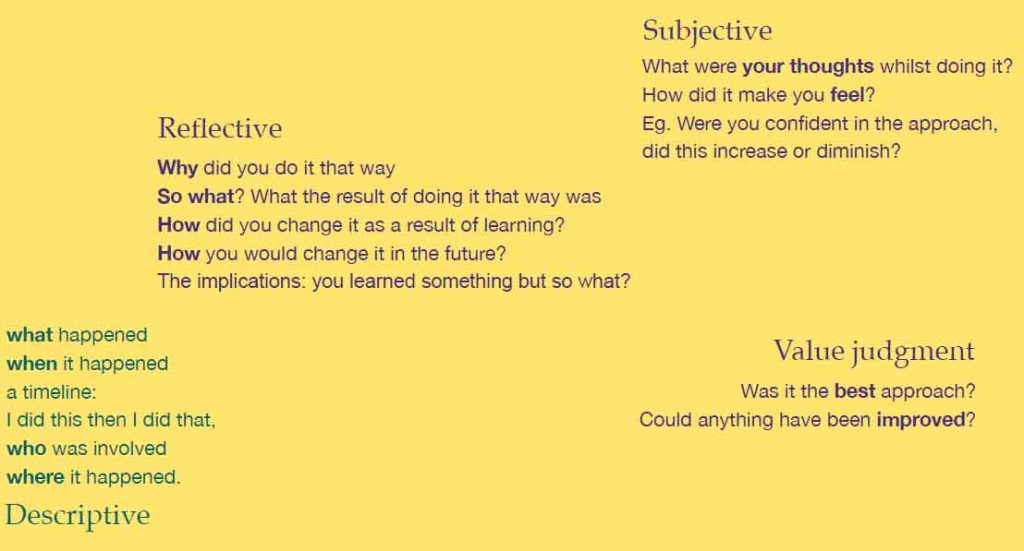
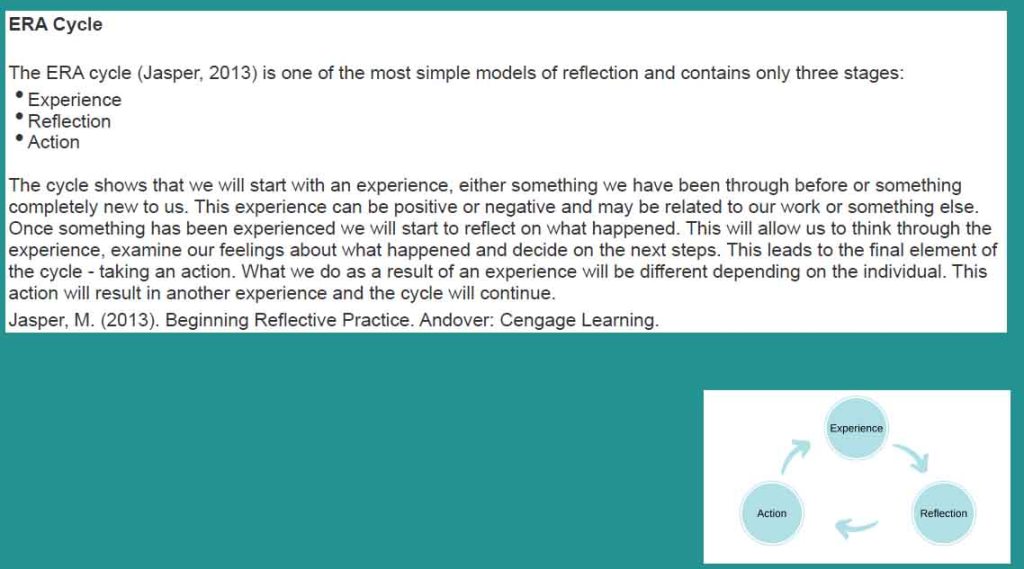
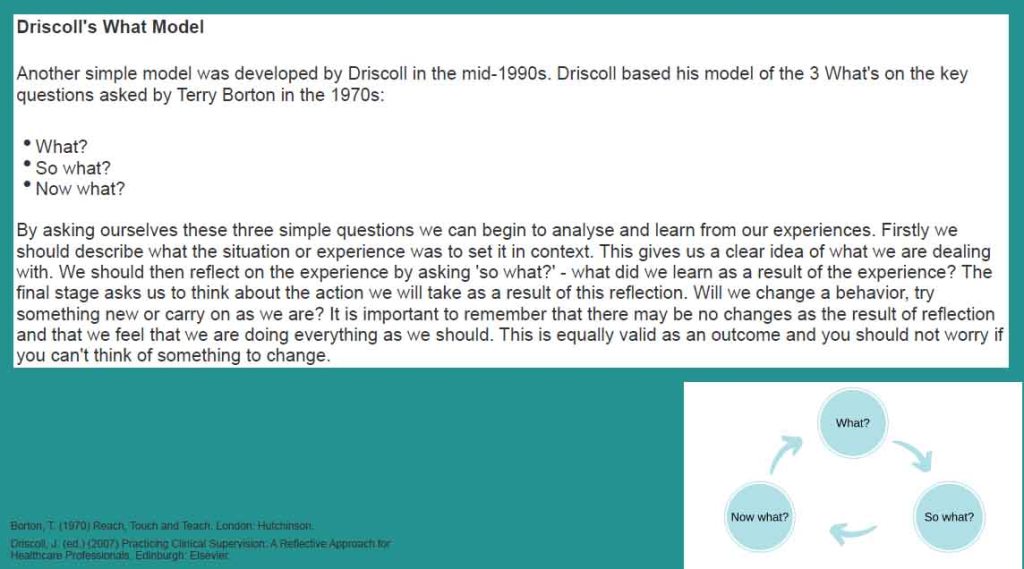
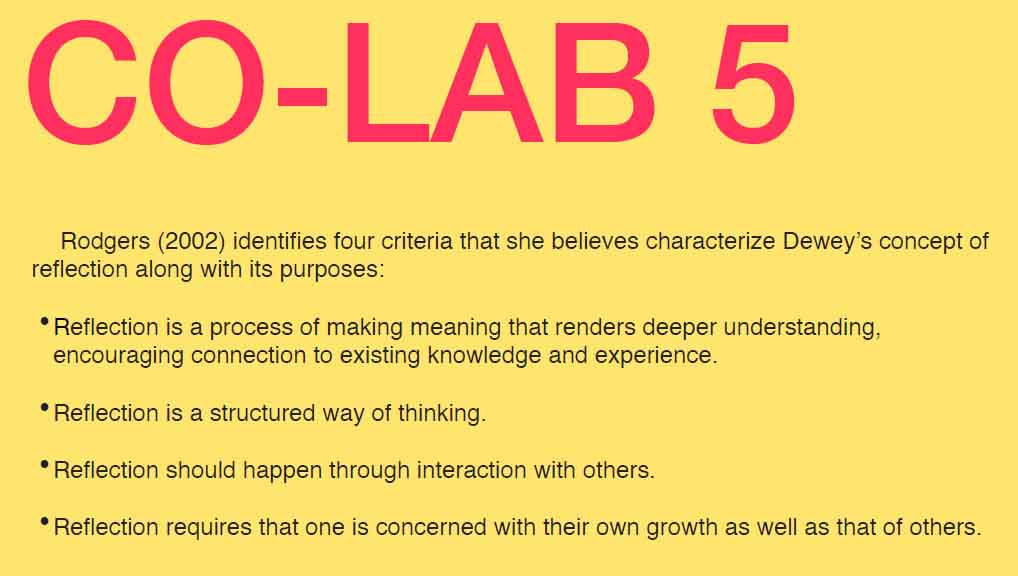
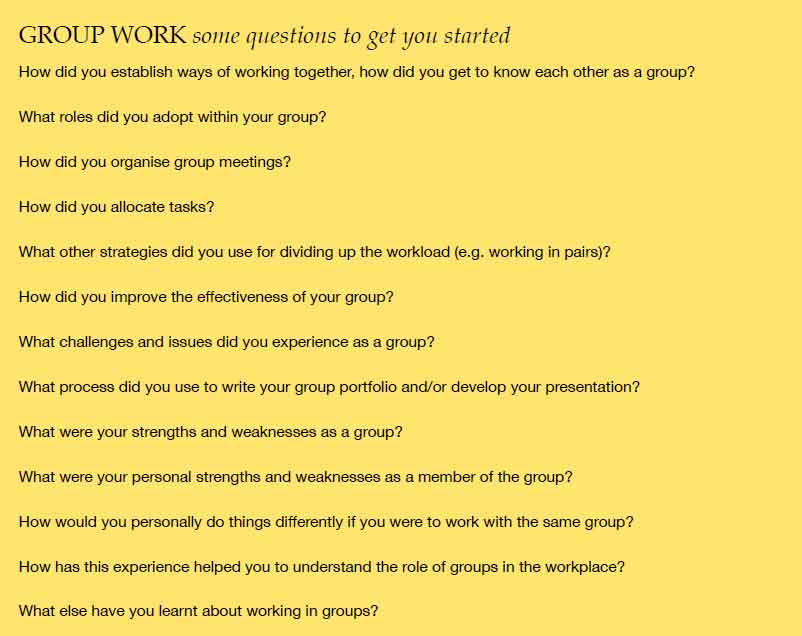
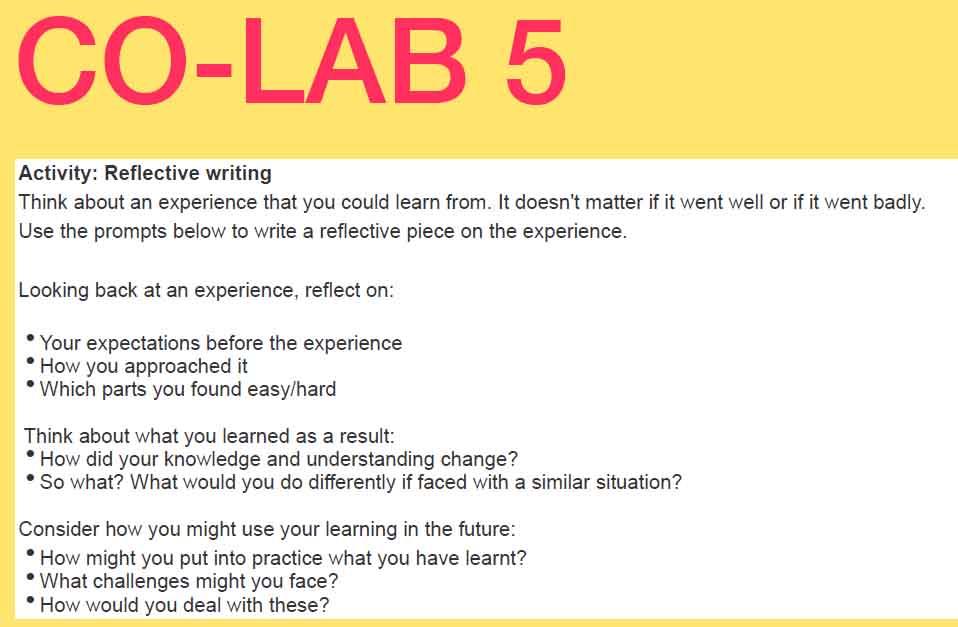
Reflective Writing
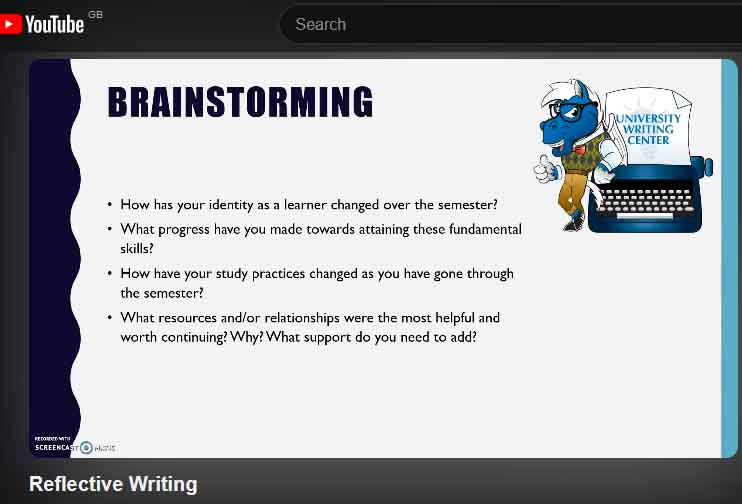
https://mmutube.mmu.ac.uk/media/Reflective+writing+for+assignments/1_ml46ta3b
RESEARCH AND ARCHIVAL MATERIALS FOR SHORT FILM
A cyborg is a cybernetic organism, a hybrid of machine and organism, a creature of social reality as well as a creature of fiction.
Donna J. Haraway
The Tragic Death Of The World’s First Human Cyborg
If you think cyborgs are a thing of the future, then you’ve never heard of Dr. Peter Scott-Morgan. Scott-Morgan, a scientist by trade, was reportedly given two years to live when he was diagnosed with motor neuron disease in 2017. The debilitating illness, also known as amyotrophic lateral sclerosis or Lou Gehrig’s disease, is a rare and so far incurable condition that causes progressive weakness and muscle wasting, usually leading to death within two to four years. Scott-Morgan died on June 15, 2022 at the age of 64. He spent his final years undergoing several procedures to alleviate his symptoms, effectively combining man and machine in a remarkable way. Here’s what you need to know about the tragic death of the world’s first human cyborg.
REFLECTIONS: Eye-opening reportage that made me realise where we are, or in fact have been for a while when it comes to cybernetics. I didn't realise before that things have gone so far already, and the possibilities that exist. It made me wonder what the future will bring? Things are moving so fast and the possibilities seem to be nearly endless.
How we’ll become cyborgs and extend human potential | Hugh Herr
Humans will soon have new bodies that forever blur the line between the natural and synthetic worlds, says bionics designer Hugh Herr. In an unforgettable talk, he details “NeuroEmbodied Design,” a methodology for creating cyborg function that he’s developing at the MIT Media Lab, and shows us a future where we’ve augmented our bodies in a way that will redefine human potential — and, maybe, turn us into superheroes. “During the twilight years of this century, I believe humans will be unrecognizable in morphology and dynamics from what we are today,” Herr says. “Humanity will take flight and soar.”
REFLECTIONS: very enthusiastic and pro cyborg talk. He makes a lot of good points e.g. about ending disability with the use of technology, but I am not sure about the ''blurring the line between mechanical and natural'' part. I think that combining the two is the solution to a lot of issues, and the future, but we should remember to keep the separation of the two as well, remember who we are, and we are nature.
Donna Haraway, “A Cyborg Manifesto”
This lecture covers Donna Haraway’s 1985 article “A Cyborg Manifesto” for Philosophy and Technology
REFLECTIONS: Incredibly useful and very informative and interesting lecture that speaks of the manifesto but also all aspects of a CYBORG. I found it especially interesting when she says that a cyborg is not a stand alone individual but a part of the system as it's inextricably connected to the system. Also the idea of genderlessness that is assigned to a cyborg as it is neither a man or a woman - it questions identity.
Neil Harbisson: I listen to color
Artist Neil Harbisson was born completely color blind, but these days a device attached to his head turns color into audible frequencies. Instead of seeing a world in grayscale, Harbisson can hear a symphony of color — and yes, even listen to faces and paintings.
https://www.cyborgfoundation.com/
REFLECTIONS:A very interesting talk that sheds another light on cybernetics and how it can improve human lives, and an amazing concept of hearing colours which I would like to know more about. He also started a cyborg foundation, a foundation that helps humans become cyborgs.
Moon Ribas – The dancer whose arm vibrates every time there’s an earthquake
Moon Ribas is a Catalan contemporary choreographer and the co-founder of the Cyborg Foundation, an international organisation that aims to help people become cyborgs, defend cyborg rights and promote cyborgism as an artistic and social movement. Moon graduated in Choreography at Dartington College of Arts (England), and studied at Theatreschool of Amsterdam SNDO (School for New Dance Development). Since 2007 Moon has been experimenting with different cybernetics devices that allow her to perceive movement in a deeper way. Moon’s main research consists in developing the seismic sense, perceiving the movement of real-time earthquakes all around the world, small as 1 in Richter scale. Moon then translates this new sense on stage, her main piece is called Waiting for Earthquakes, a piece where she stands waiting for an earthquake to take place, when this happen she moves according to the intensity of the earthquake, so if there are no earthquakes there will be no dance. Ribas has performed and given talks in several venues and festivals such as TedxMunich (Germany), TedxMuscat (Oman), Campus Party London (UK), Fierce Fest (UK) or TNT (Festival of New Trends, Spain).
Chip implants to enhance my connection with the planet | Moon Ribas | TEDxManchester
If we could extend our senses in order to perceive the planet in a deeper way, would our understanding and our behaviour towards it be different? Moon will guide us on a mind-blowing cyborg journey to discover how technology can bring us closer to nature. Moon Ribas is a Catalan avant-garde artist and a cyborg. She is best known for developing the Seismic Sense, an online seismic sensor implanted in her feet that allows her to perceive earthquakes taking place anywhere in the planet through vibrations in real time. Moon transposes the earthquakes into either sound or dance. Moon’s seismic sense also allows her to feel moonquakes, the seismic activity on the Moon. She believes that by extending our senses to perceive outside the planet, we can all become senstronauts. Adding this new sense allows her to be physically on Earth while her feet feel the Moon. Since 2007 Moon has been experimenting with the union between technology and her body to explore the boundaries of perception and to experience movement in a deeper way. In 2010 she co-founded the Cyborg Foundation, an international organisation that aims to help people become cyborgs, defend cyborg rights and promote cyborg art.
REFLECTIONS: I was pretty flabbergasted upon finding out about this artist and how she modified her body with electronic devices for her art. I think it's very impressive, but I guess also, perhaps a bit scary (for me) to permanently affect your body and as a result, your mind like that.

I am a big fan of tattoos, and I have many. I consider them my personal choice and decoration of my body, but these 'modifications' are from the outside - they don't change who I am or how I respond to the world, unlike in Riba's case.

I wonder if I would ever go to such lengths for my art.
How far would I be willing to go to express myself, to communicate my inner self to others?
Two robots debate the future of humanity
Hanson Robotics Limited’s Ben Goertzel, Sophia and Han at RISE 2017. Now for something that’s never been done onstage before. While they may not be human, our next guests are ready to discuss the future of humanity, and how they see their types flourish over the coming years.
This intense AI anger is exactly what experts warned of, w Elon Musk.
AI, Ameca, Elon Musk and Boston Dynamics. A big month for AI. Please visit https://brilliant.org/digitalengine – a great place to learn about AI and STEM subjects. You can get started for free and the first 200 people will get 20% off a premium annual subscription.
REFLECTIONS: It was at this point I think I had to check myself not to get sidetracked off topic. However fascinating the subjects of AI, Robots etc. are, my focus should be on CYBORGS specifically. Otherwise, it will be evident that I lost myself in a train of thought, it will be confusing what I want to say and, simply, it will be too much material.
It was an important realisation that helped shape my outcome and allowed me to refocus and ask myself some basic questions that formed the foundations of my work.
Top 10 Memorable Female Robots in Movies and TV
Some movies to looks at:
- Ex-machina
- Metropolis (Maria)
- Ghost in the Shell
- Terminator 3
- Borg queen – Star Trek
- Eve from Wally
- Caprica six – Battlestar Galactica
- Fembots- Austin Powers
- Arcee – The Transformers 84
BOOK: Do Androids Dream of Electric Sheep? by Philip K. Dick
Blade Runner – Final scene, “Tears in Rain” Monologue (HD)
The climax of the classic Sci-fi film “Blade Runner”. Taken from the “Final Cut” version.
Cyborg (1/10) Movie CLIP – I’m a Cyborg (1989) HD
Ghost in the Shell (Boat Scene)
I Think, Therefore I Am | Blade Runner (1982) 4K Clip
blade runner – i want more life father – HD
björk – all is full of love
Directed by Chris Cunningham. Written by Björk.
eXistenZ (Trailer)
Are Cyborgs Really Monsters?
Advances in technology are always met with some degree of technophobia—and villainization. And cyborgs represent a special kind of fear inherent in losing ourselves in the technologies we create.
The Six Million Dollar Man Opening and Closing Theme (With Intro) HD Surround
Artificial Muscles Robotic Arm Full Range of Motion + Static Strength Test (V11)
We have achieved strong, fast, power-dense, high-efficiency, biomimetic, soft, safe, clean, organic and affordable robotic technology. The dumbbell weights 7 kg (15,6 lbs), forearm with hand only 1 kg (2,2 lbs). This artificial muscles robotic arm is operated by water and consumes 200W at peak. We invent and produce portable power supply and our own valves to have complete controllability of speed contraction and compress the whole powering system (for a full body) inside humanlike robot torso. At this moment our robotic arm is operated only by a half of artificial muscles when compared to a human body. Strongest finger-bending muscle still missing. Fingers are going to move from left to right but they don’t have muscles yet. Metacarpal and left-to-right wrist movement are also blocked. This version has a position sensor in each joint but they are yet to be software-implemented. We are going to add everything mentioned above in the next prototype. The movement sequence was written and sent by simple commands to a hand. We wish to develop a platform for reinforcement learning purposes, prosthetic arms and ultimately a full humanoid robots to serve people for fun, as butlers, cleaners, chauffeurs, construction workers (also in space) and even in the future achieve human immortallity by transplanting the brain into the machine. If you want your personal android sooner than later you can easly accelerate it by buying shares in Clone via Republic. https://republic.com/clone http://www.clonerobotics.com
Luke gets his new hand, but robot advises
REFLECTIONS: When I watched these two videos, I immediately knew I had to use them in my work, juxtaposing fiction and reality.
Through these means, I wanted to point out how fast everything, especially technology, progresses, and how things we see in the movies as fiction, before we know it, become a reality! It's scary how fast everything moves, but also seems like there is no stopping! Is that a good thing? I wonder...
Star Trek: First Contact: The Borg Queen
Spider-Man 2 – How Otto Octavius became Dr. Octopus [4K]
1. What does “POSTHUMAN” mean? Dr. Ferrando (NYU) – Course “The Posthuman” Lesson n. 1
This video is part of the online course in the Philosophy of “The Posthuman”, Lesson n. 1, by Dr. Francesca Ferrando (NYU) More info: http://www.theposthuman.org
ARTICLES
https://thefunambulist.net/editorials/deleuze-the-body-as-a-desiring-machine
QUOTES
“A human being is a part of the whole called by us universe, a part limited in time and space. He experiences himself, his thoughts and feeling as something separated from the rest, a kind of optical delusion of his consciousness. This delusion is a kind of prison for us, restricting us to our personal desires and to affection for a few persons nearest to us. Our task must be to free ourselves from this prison by widening our circle of compassion to embrace all living creatures and the whole of nature in its beauty.”
― Albert Einstein
To deny people their human rights is to challenge their very humanity.” — Nelson Mandela. …
“An individual has not started living until he can rise above the narrow confines of his individualistic concerns to the broader concerns of all humanity.”
— Martin Luther King Jr.
MAKING
When I reflected on the theme of MACHINE, I instantly thought about the human body as the ultimate machine, and for my project, I decided to oscillate between the themes of MACHINE and BODY, using the CYBORG to explore these topics.
During one of the seminars my tutor directed me towards Donna Haraway’s emblematic essay A Cyborg Manifesto.
In her writing, she made a radical statement when she declared that we are all, in fact, already cyborgs. She said:
‘’(…) It is not clear who makes and who is made in the relation between human and machine. It is not clear what is mind and what is body in machines (…)
Insofar as we know ourselves in both formal discourse (…) and in daily practice (…), we find ourselves to be cyborgs, hybrids, mosaics, chimeras.’’
Haraway’s work was a conceptual basis for my project. Based on The Cyborg Manifesto, I investigated the notion that we are already cyborgs and reflected on the future ahead of human-machine relationship, considering the technological advancements and our intrinsic need for constant improvement, evolution and prolonging life.
PROCESS
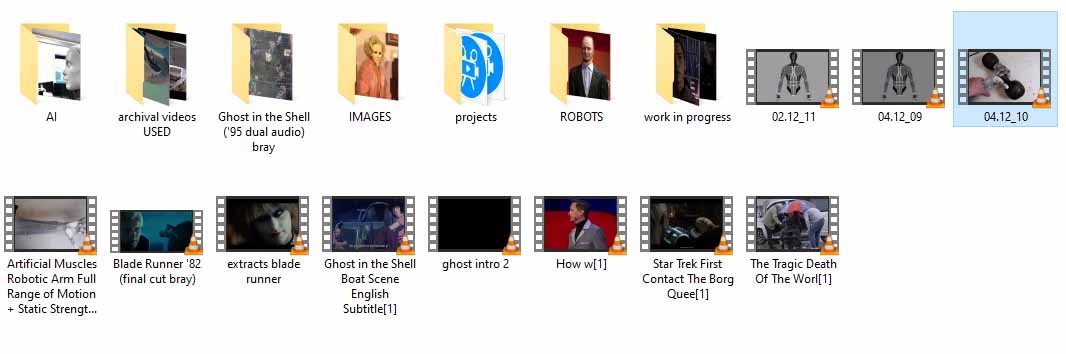
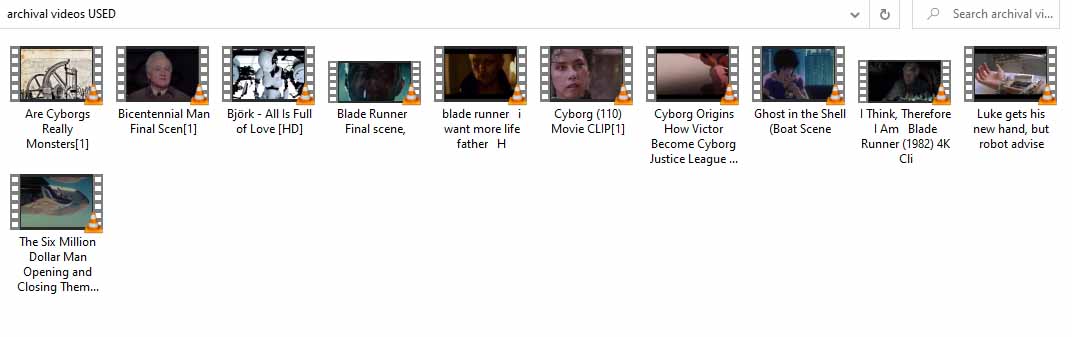
My process was mainly based on watching hours of archival footage, films, videos, and reportages, some from my private collection, some from YouTube and other internet channels.
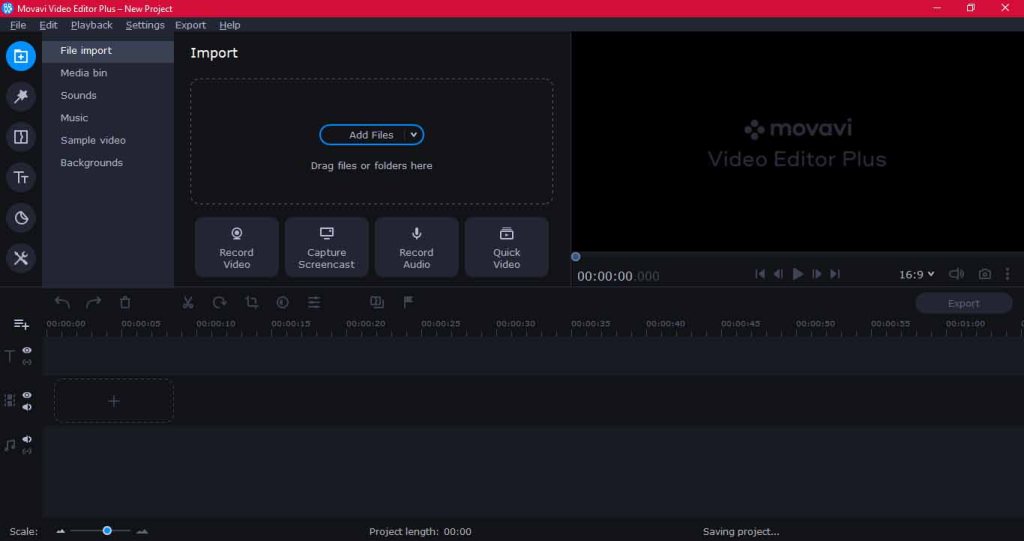
I used the MOVAVI video editing program, which I describe as baby PremierePro, as it’s precisely what it is – a very straightforward tool that does all the basic video editing but is not as daunting or overwhelming to use as some advanced software can be.
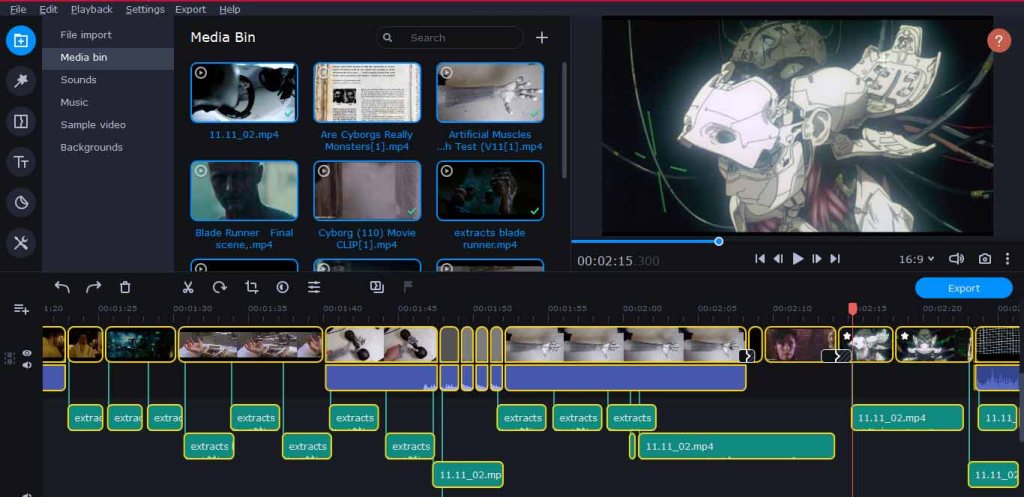
I spent days and hours cutting up the material, picking up visuals and sounds that I found suitable. Only during the process of assembling my idea and my voice fully formulated. When I make video art based on archival moving images, I only have a vague concept that is fuelling the process, like a thought/prompt at the back of my mind. Everything becomes coherent and comes together in a cohesive piece as a MAKE, SEE and HEAR.
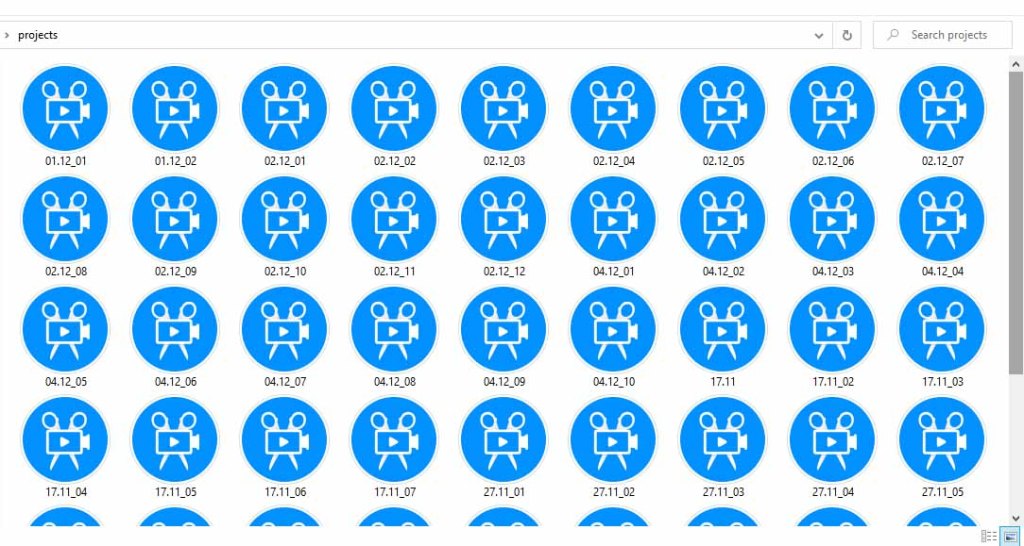
After multiple versions of the video, I settled on my final version, which I cut to 7 minutes. I wanted to include so much more thought-provoking material, but I was aware that this piece of art couldn’t be too long – I was conscious that people might not engage with it otherwise.
PRESENTING
Once I finalised my short film, I thought about how to present my work creatively and at the same time, how to elevate my investigation of the relationship between MACHINE and BODY.
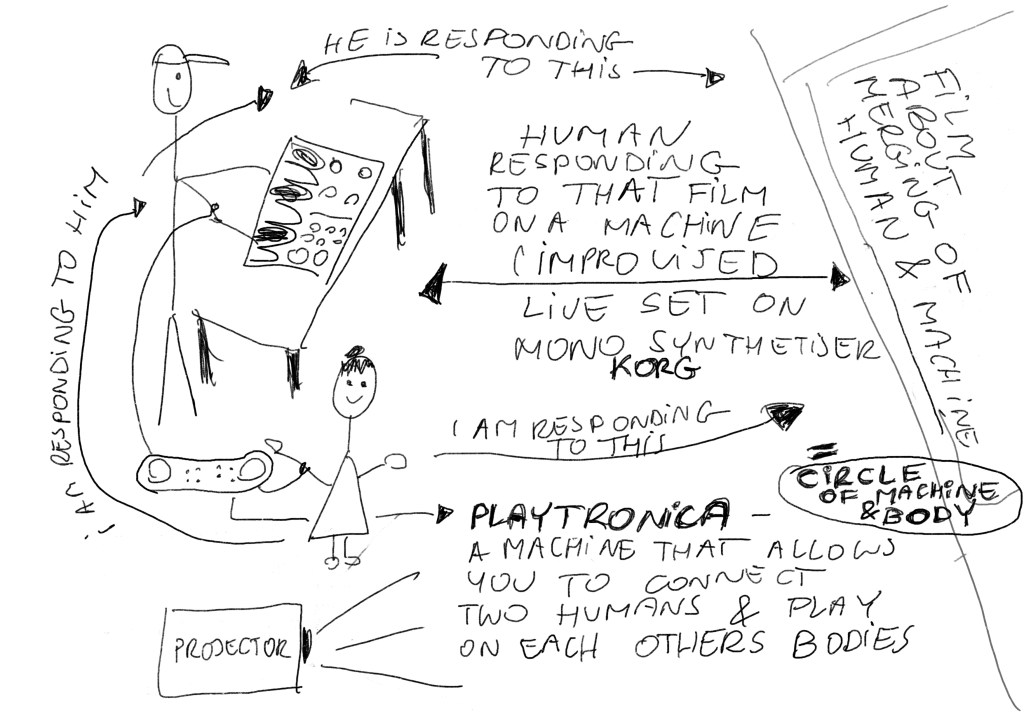
After considering a few options, I decided to project my short film accompanied by a live set on a KORG monolog synthesiser.
During the performance, the music artist will improvise, reacting in time to the video that he will be seeing.
As my collaboration group did not get involved in the assignment, I reached out to a person outside the university to collaborate with. My partner Shaun Azrak, who is a painter and music producer, came on board to be a part of the project.
I also wanted to involve an instrument called PLAYTRONICA, which allows you to connect it to various things like skin, water etc. and play on these objects.
In this case I wanted to connect myself to Shaun and for us to play on each other during the performance.
Unfortunately, the item was shipped from outside the UK and did not arrive on time.
Play music by touch or wrestling | Playtronica Devices
The world we live in is afraid of touch and interaction, so we decided to highlight it – turn human skin into a musical instrument. Now you can experience the future of human touch and do it with style. The video is filmed and edited during OneBeat Residency, supported by Found Sound Nation. TouchMe is a midi controller that connects people to play music by measuring the intensity of touch. We developed this technology to fight lack of human connection and touch. It is plug-and-play, no specific knowledge needed.
PERFORMANCE PLAN
I made this performance plan in which Shaun reacts to the video on the KORG machine, and the PLAYTRONICA machine connects us and allows us to react to each other while I also respond to the video. Through this arrangement, I aim to create a full circle of the machine-body relationship, interaction and connection.
TESTING AT HOME
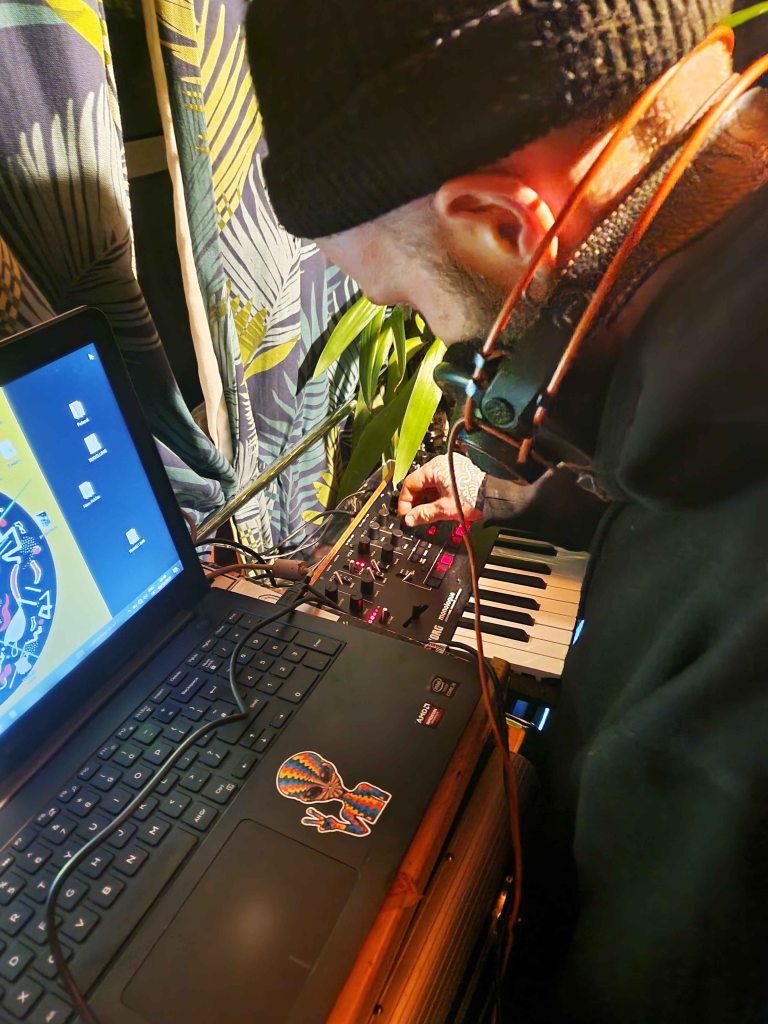
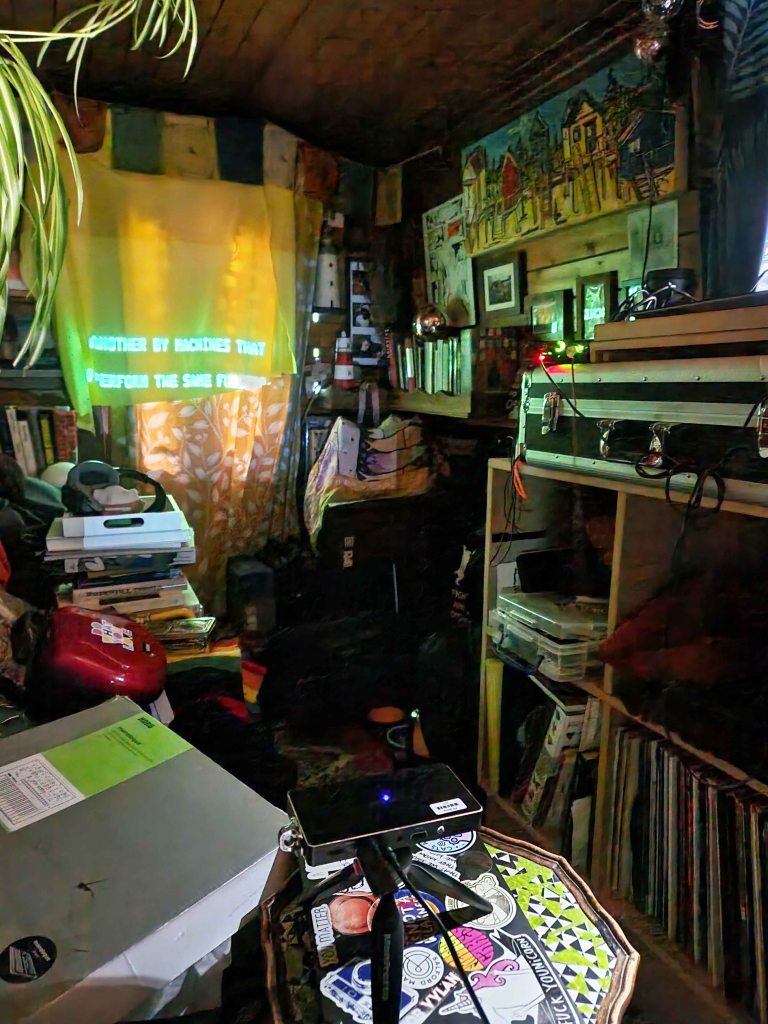
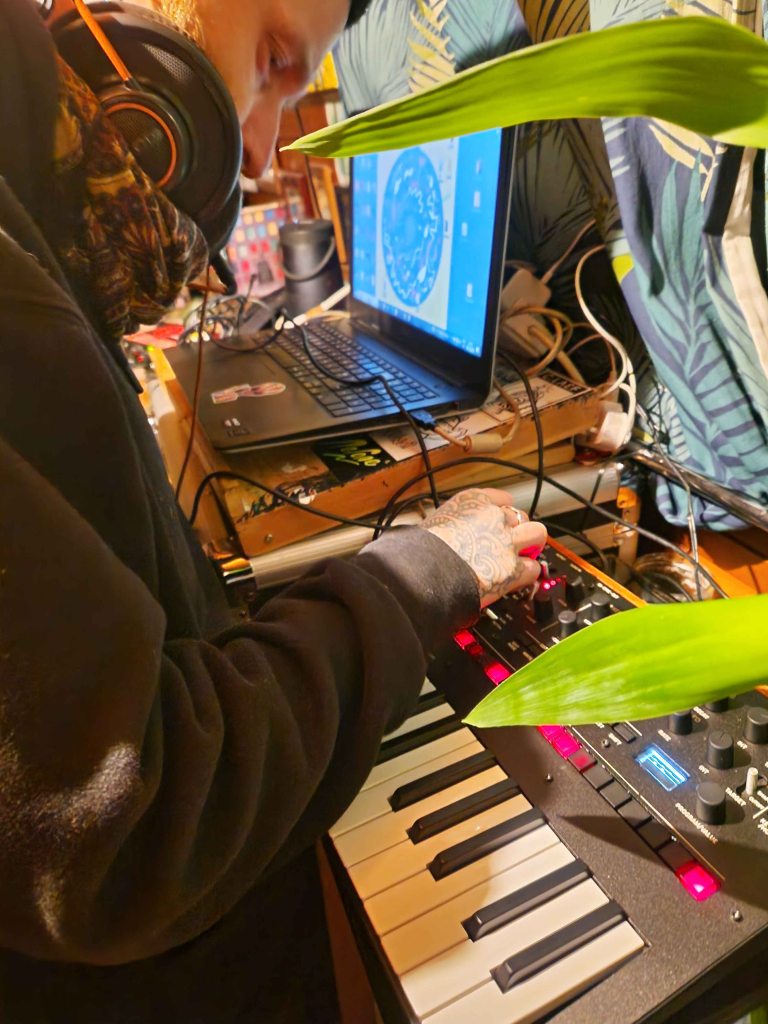
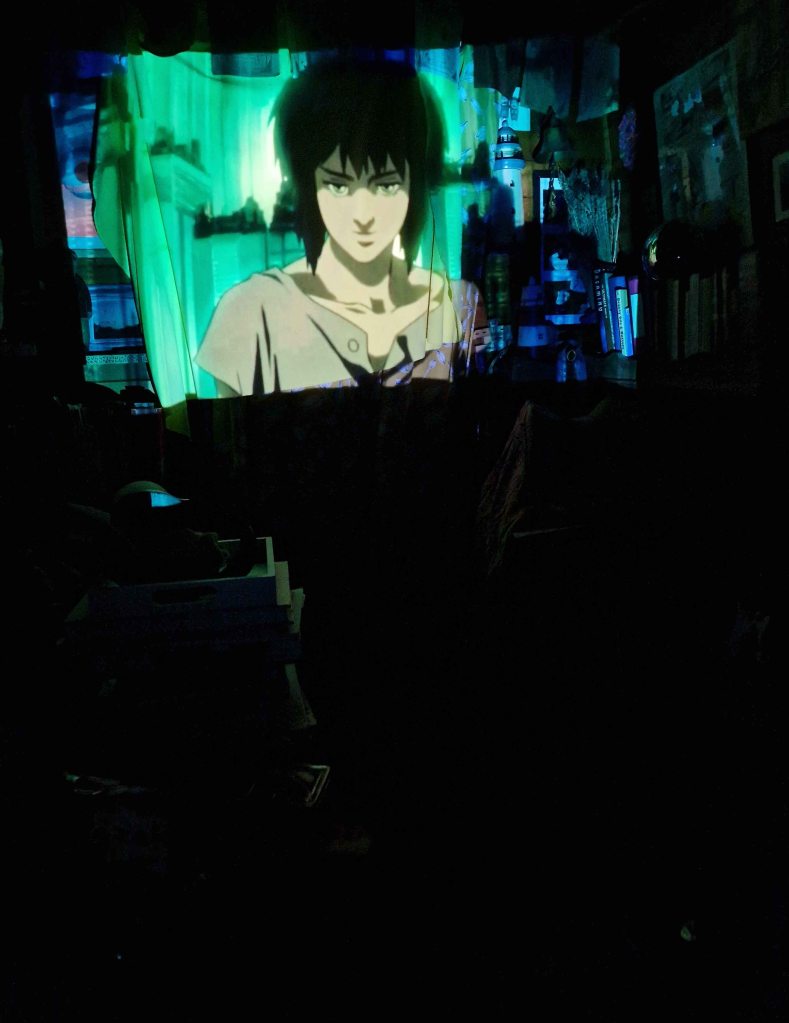
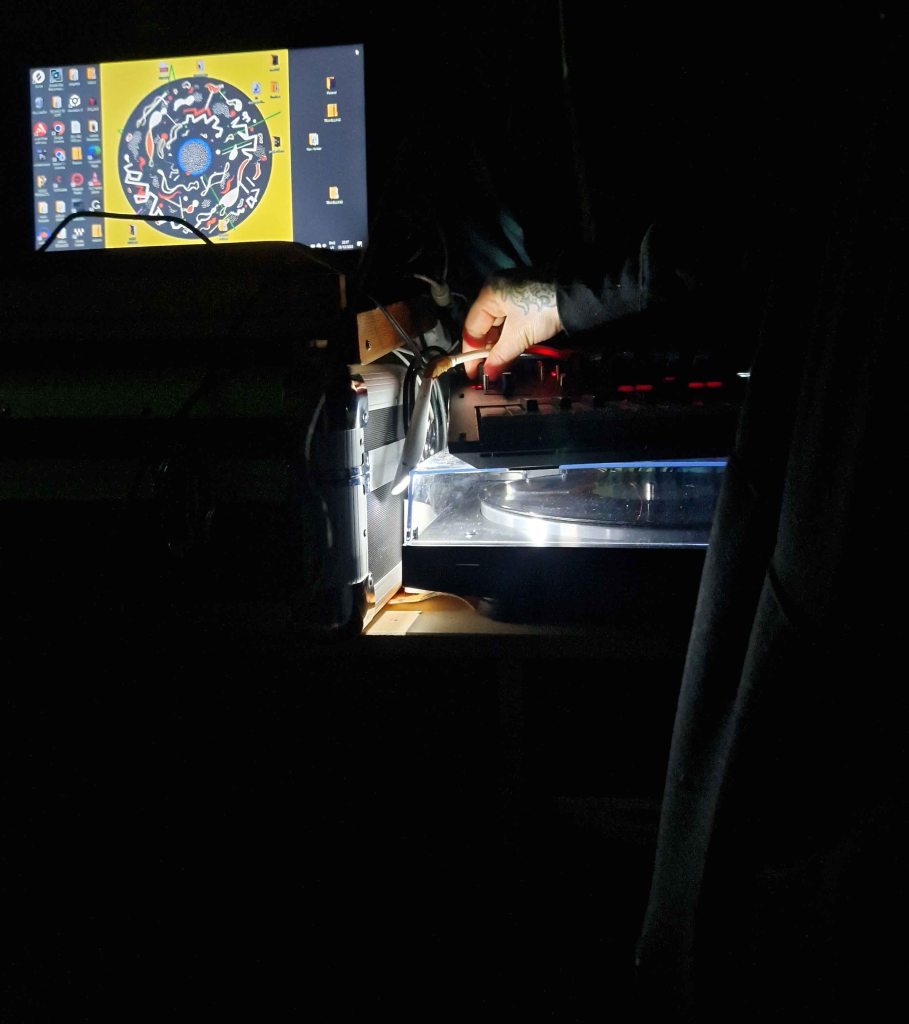
We tested the idea at home, to see if it works. We were both really satisfied with results and decided to do another test at the university on Thursday, a day before showcasing.
I wanted the synthesizer performance to be improvised so we didn’t rehearse it as such, just saw how it looks and sounds.
TESTING AT THE UNIVERSITY – THURSDAY
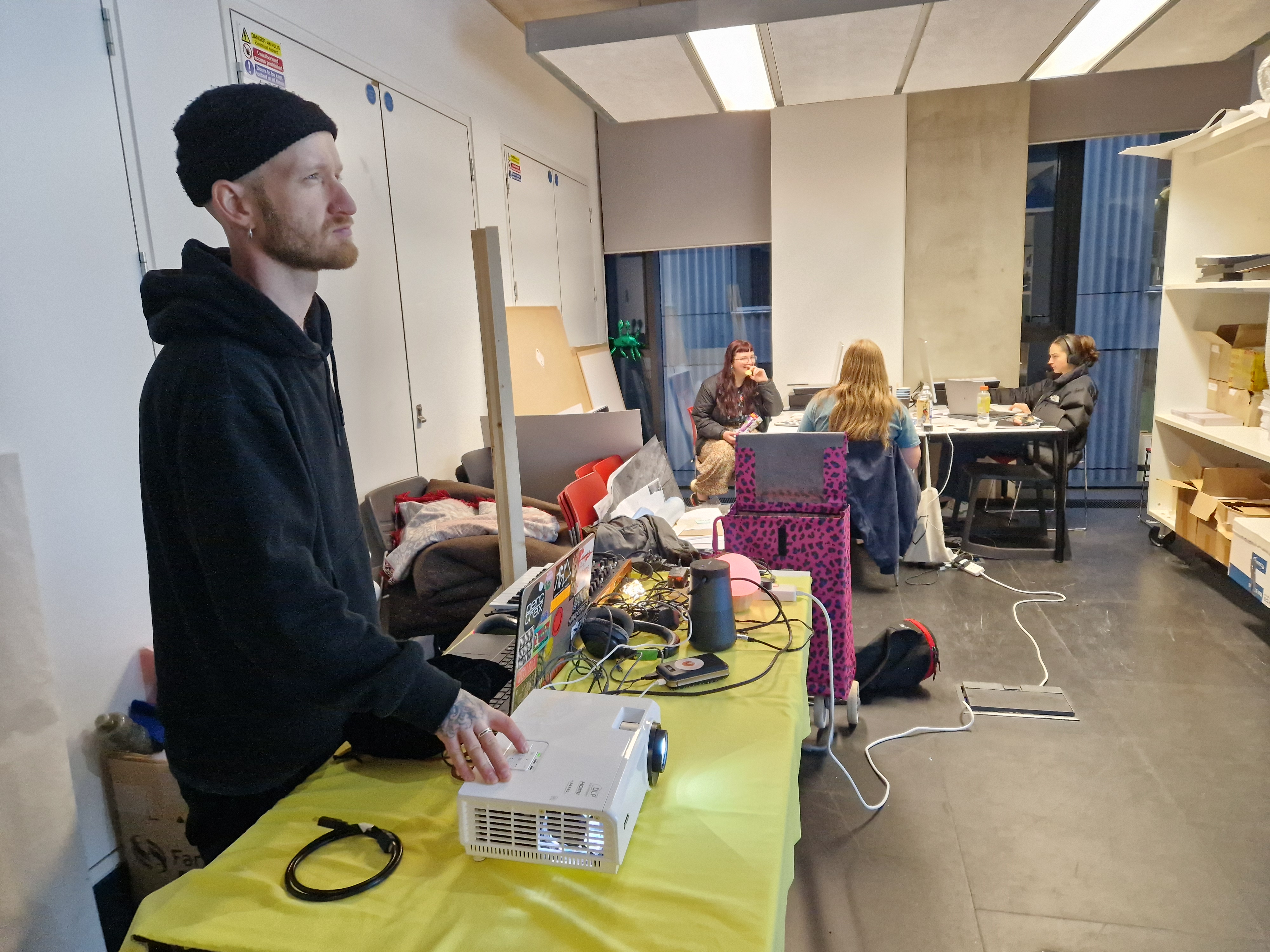
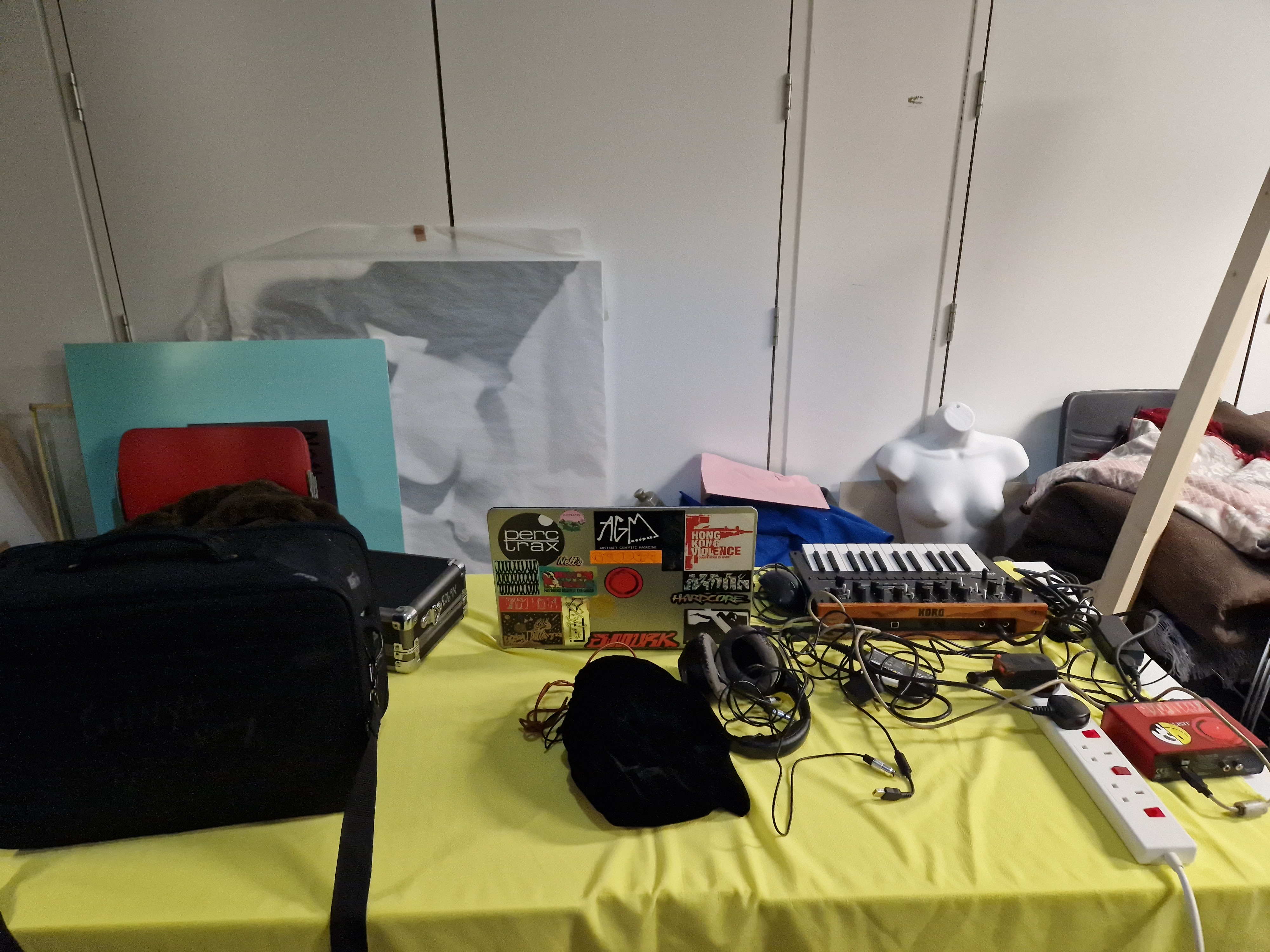
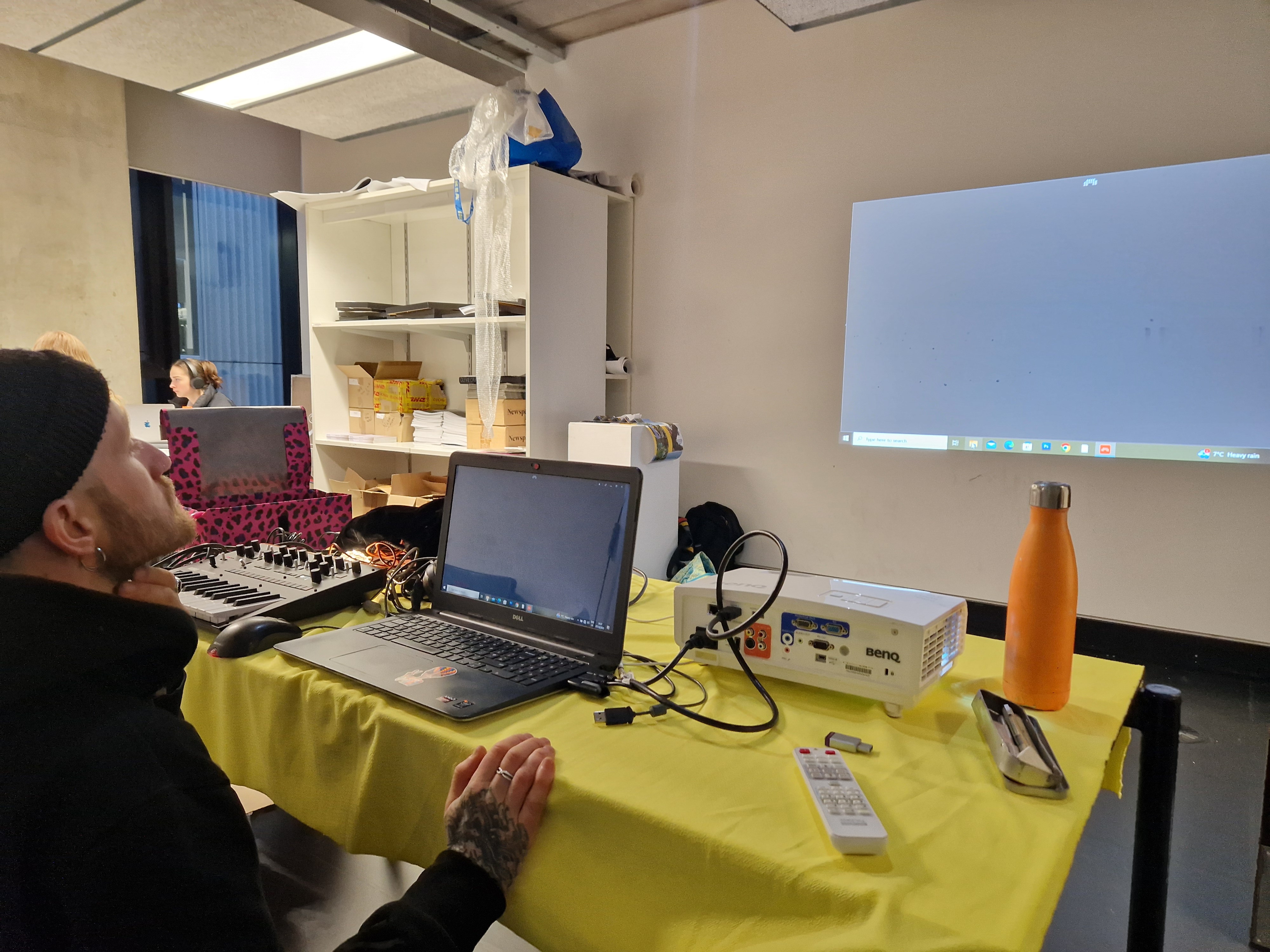
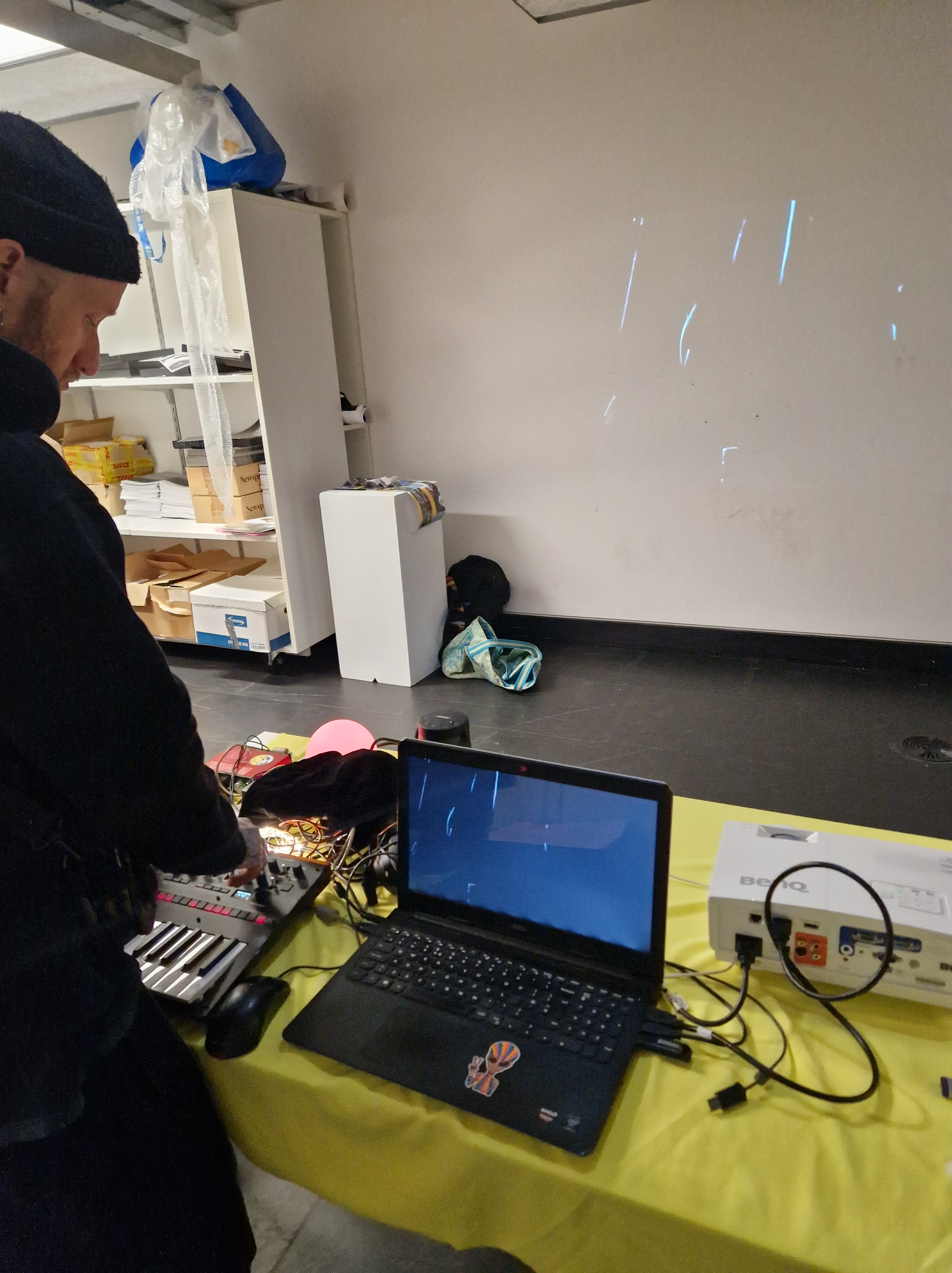
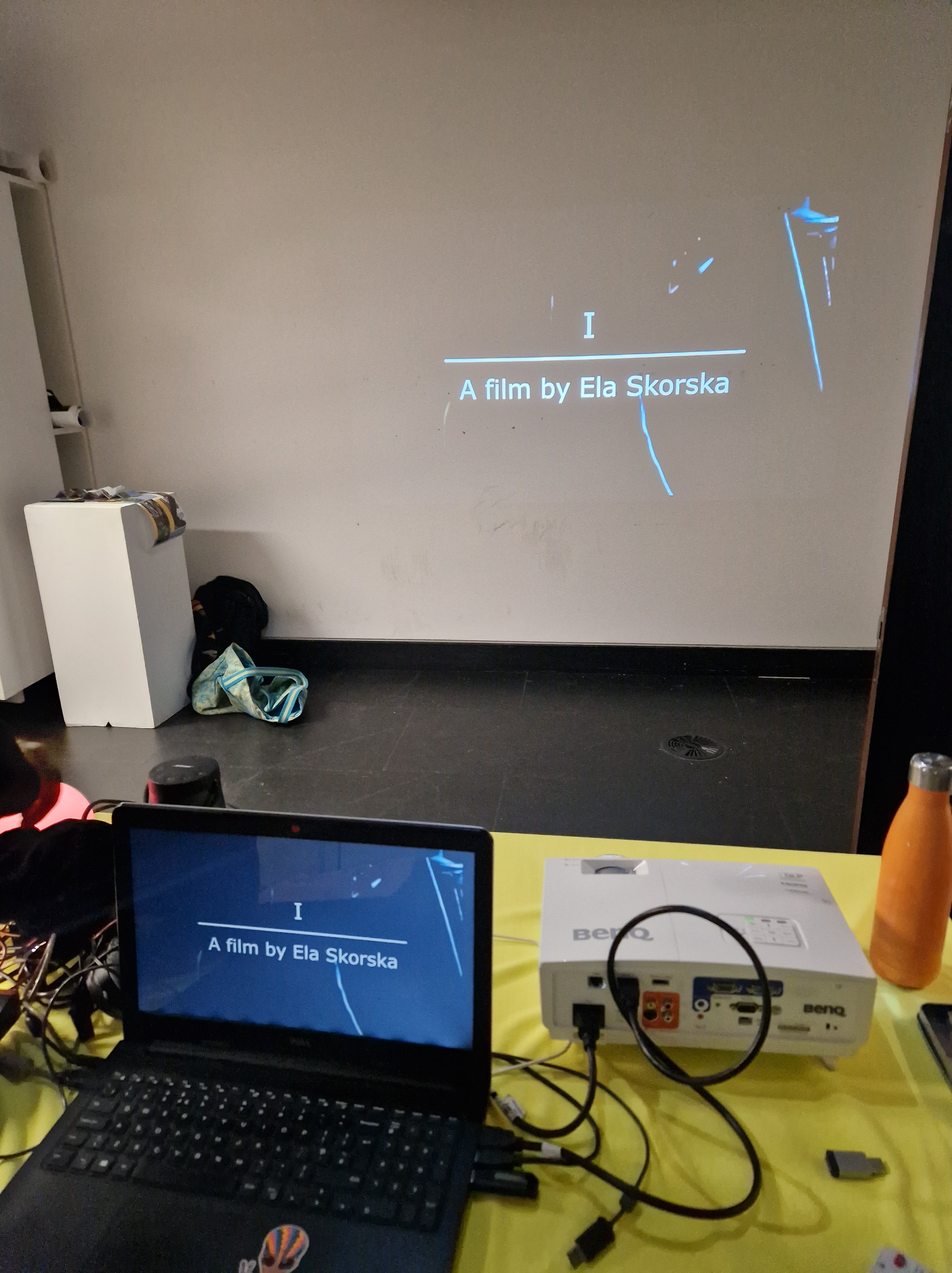
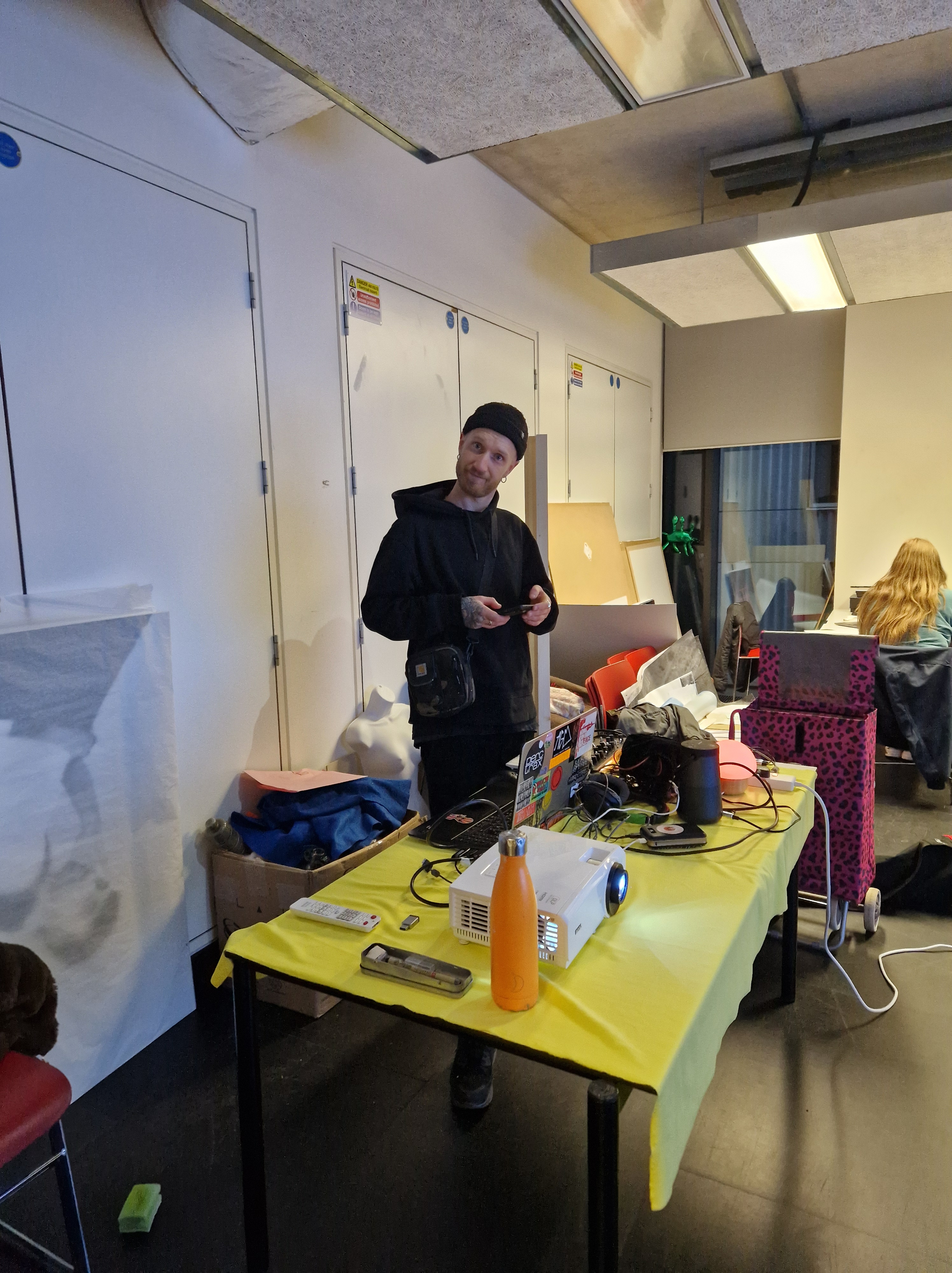
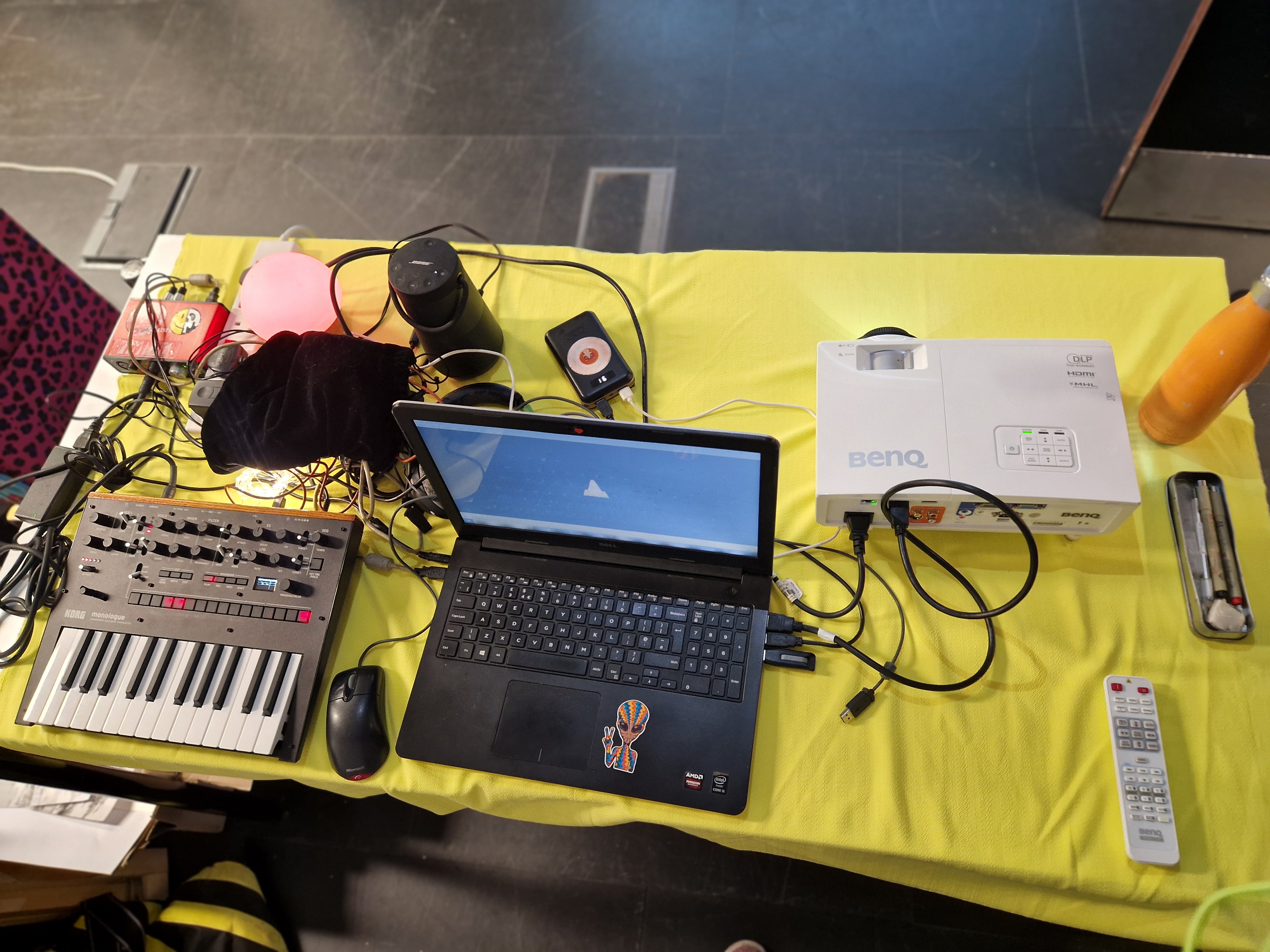
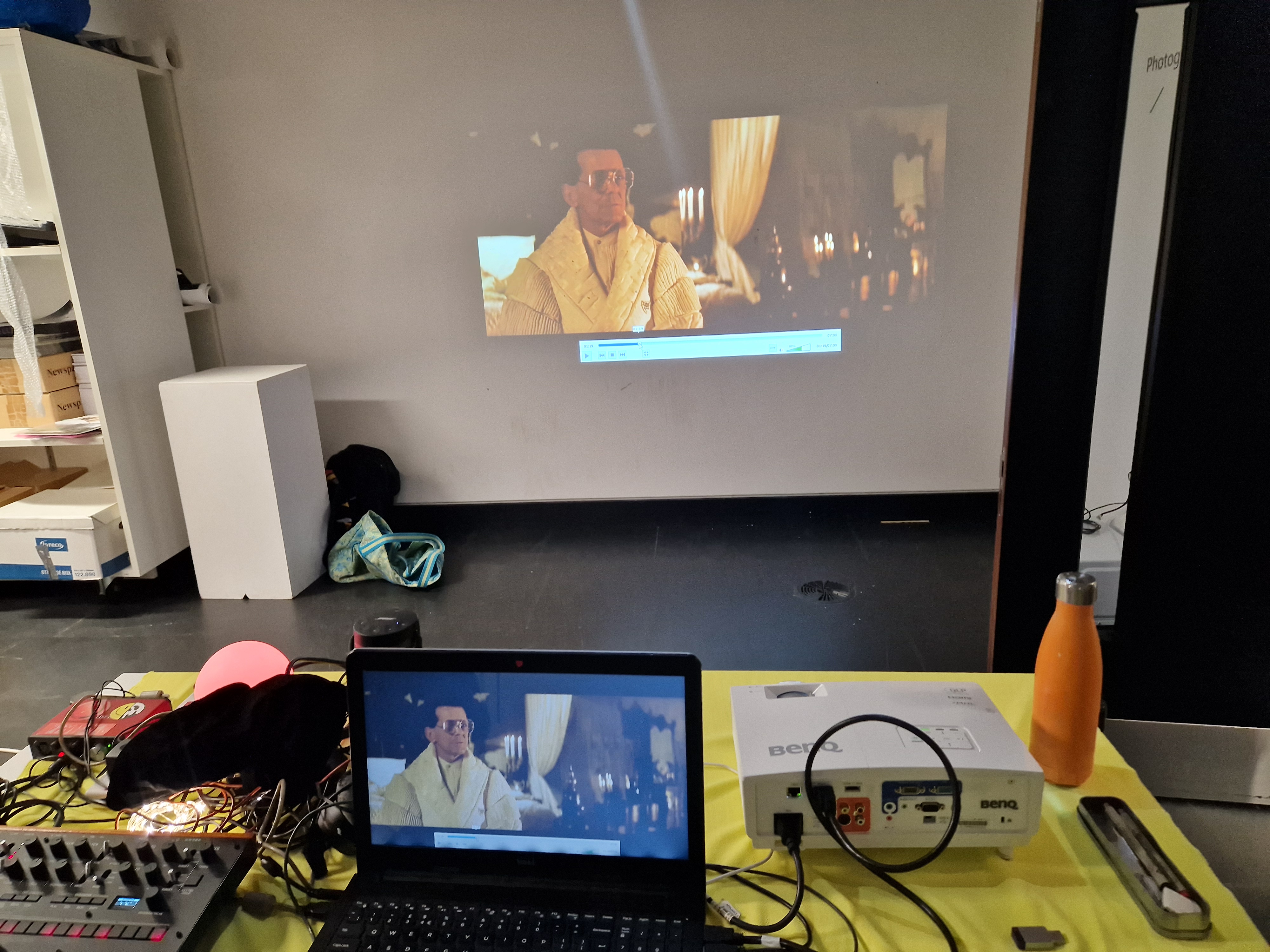
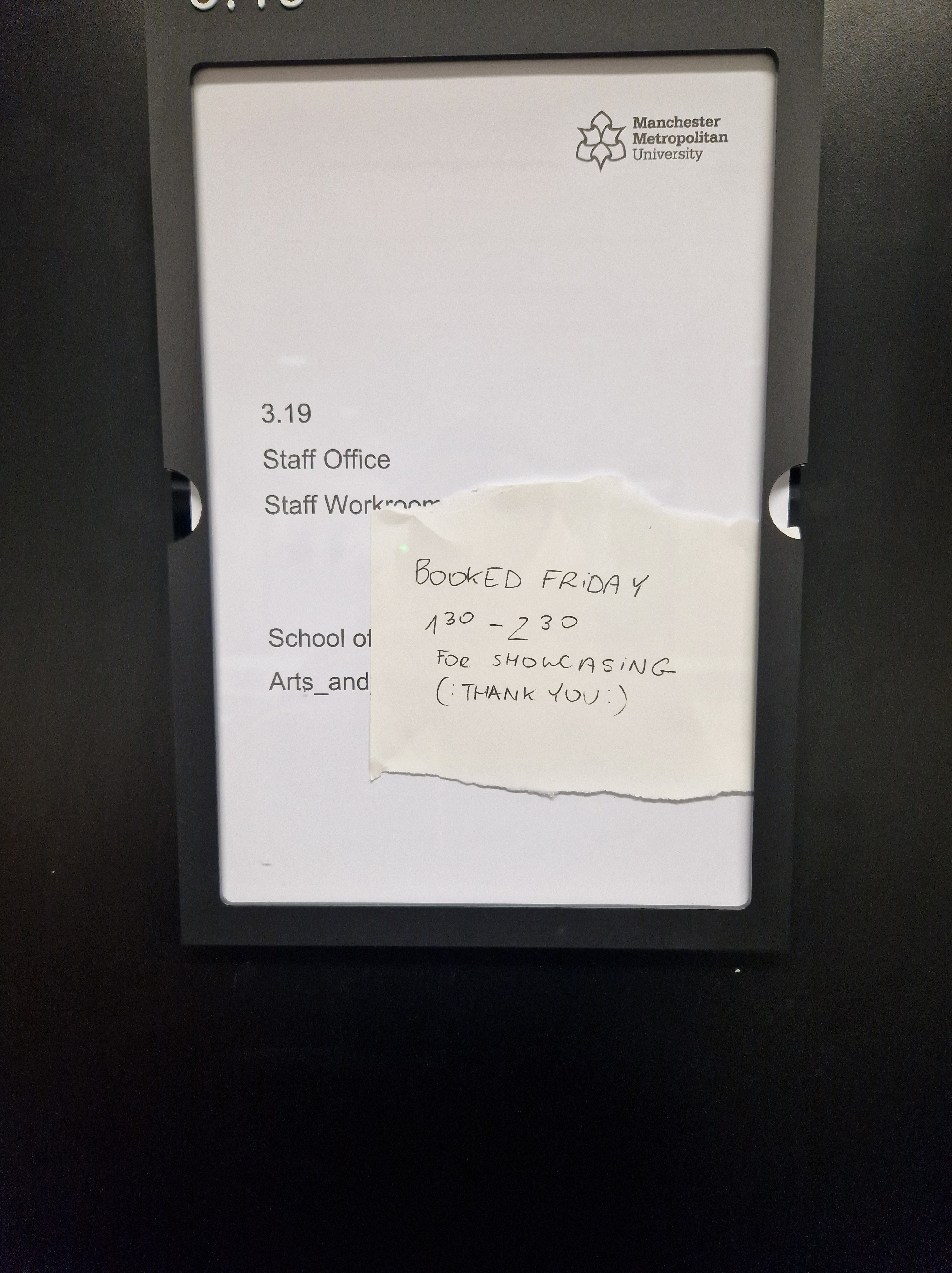
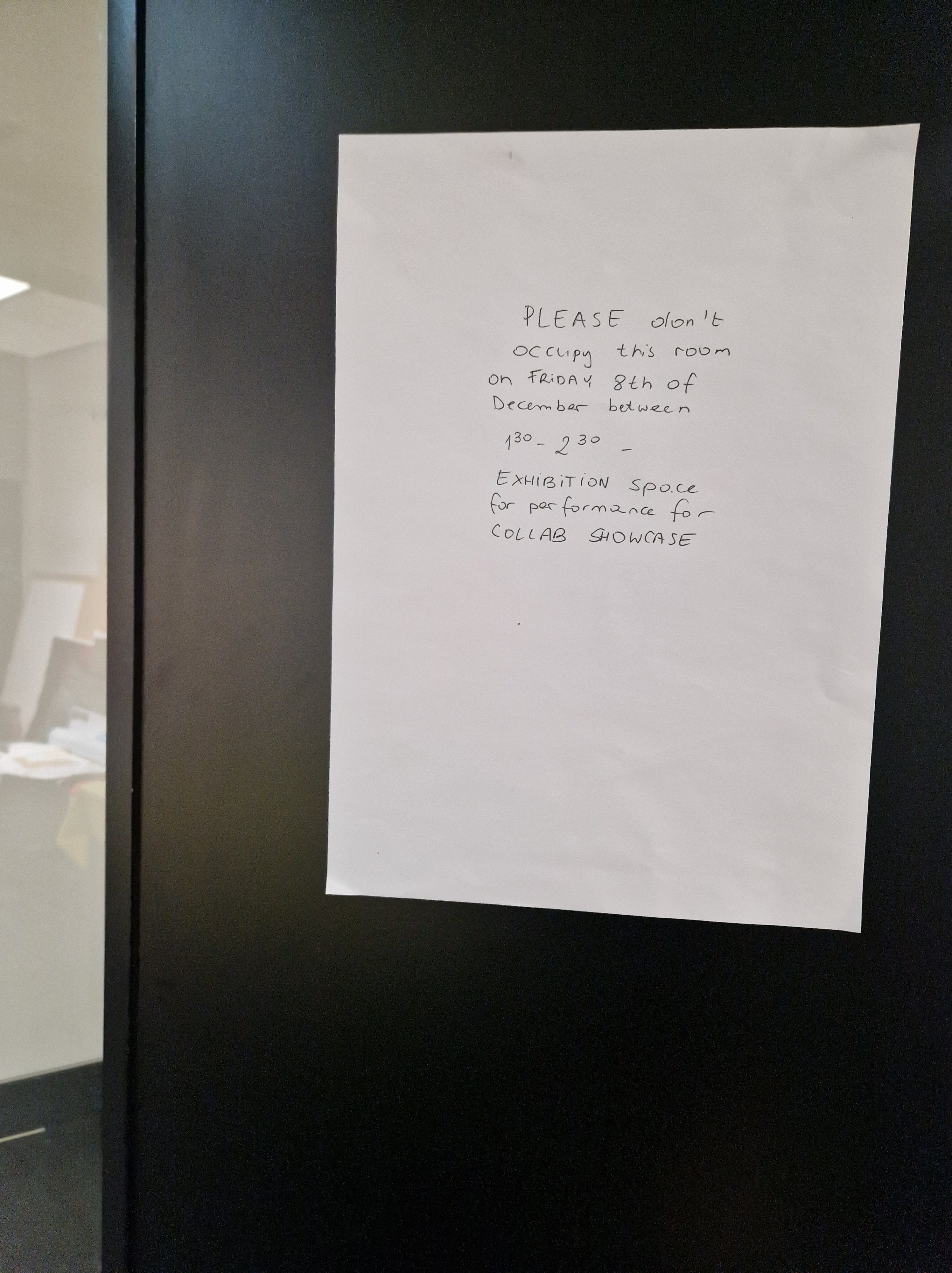
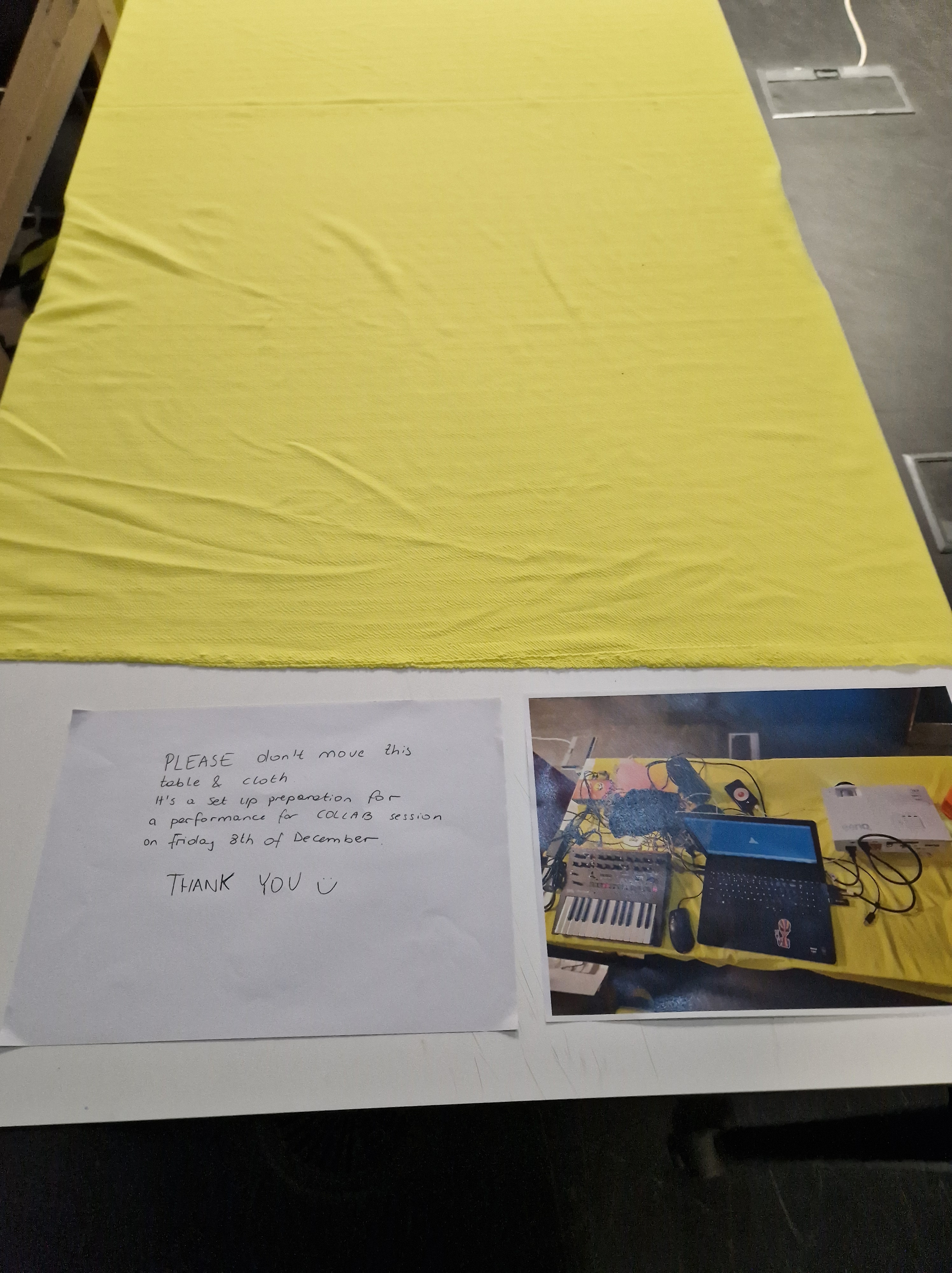
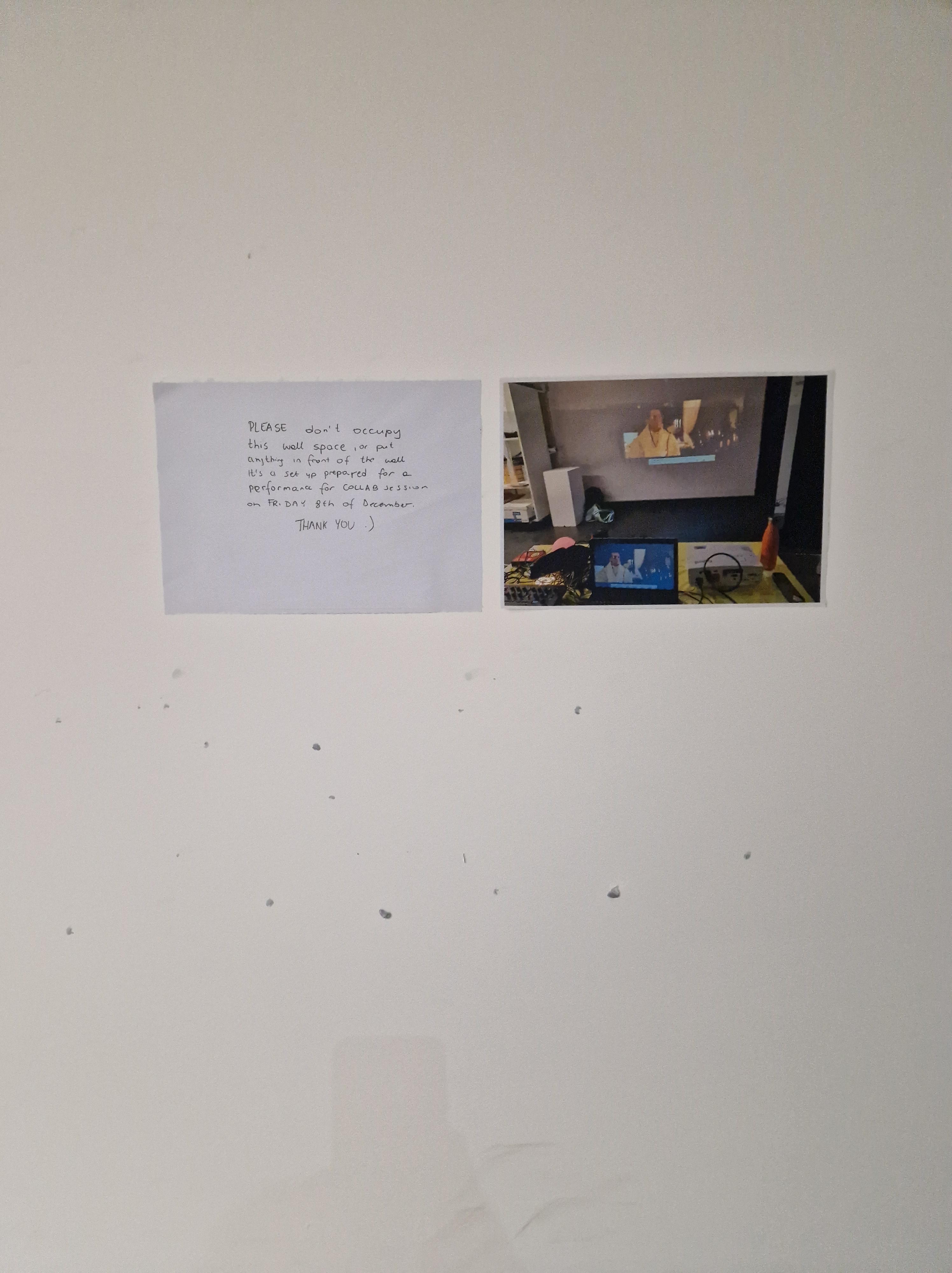
REFLECTIONS: Repeated testing was essential to make sure everything went to plan during the main presentation of the performance. I was feeling calm (well as much as it was possible in this situation) and prepared, and like we did everything we could for things to go smoothly on Friday.
I printed out images and hung them around the space, alongside notes, informing others of this room being used tomorrow so there are no surprises with someone taking over the space. With all the equipment ready and all the testing done, we felt enthusiastic and set to present our collaborative work.
PRESENTATION AND SHOWCASING 8TH OF DECEMBER
PRESENTATION POWERPOINT
REFLECTIONS: Presentation in front of the class went very well, I think I could have spoken a bit slower, as I was a bit nervous I presented a little bit too quickly. The video embedded in the presentation didn't work - test that next time and make sure it does.
PERFORMANCE
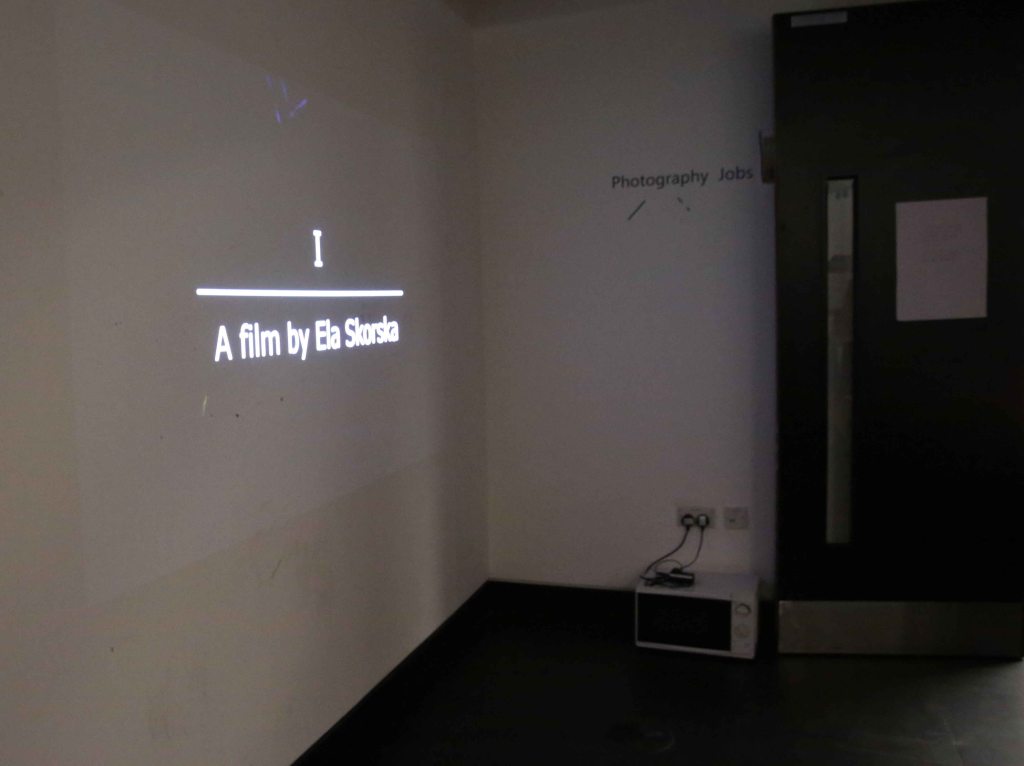
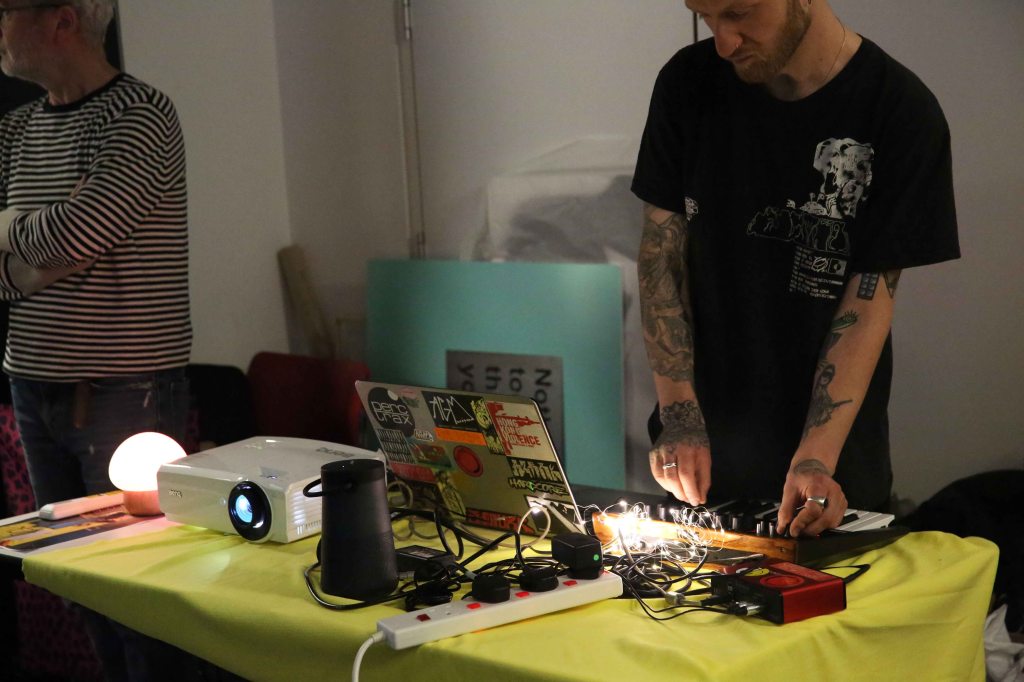
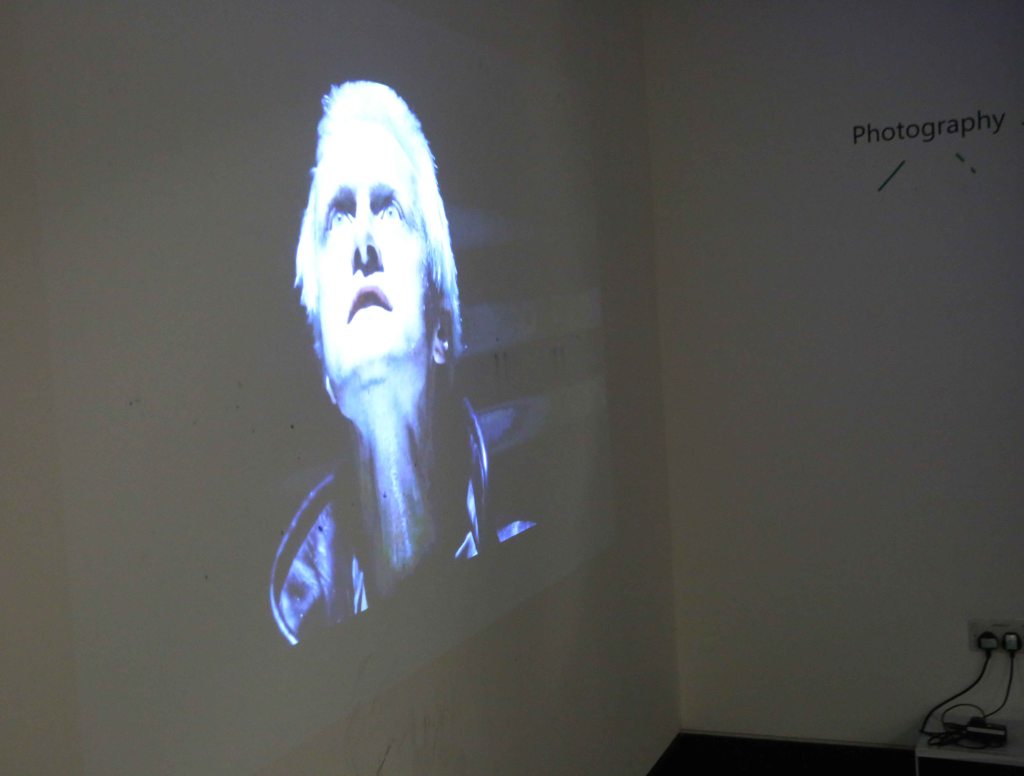
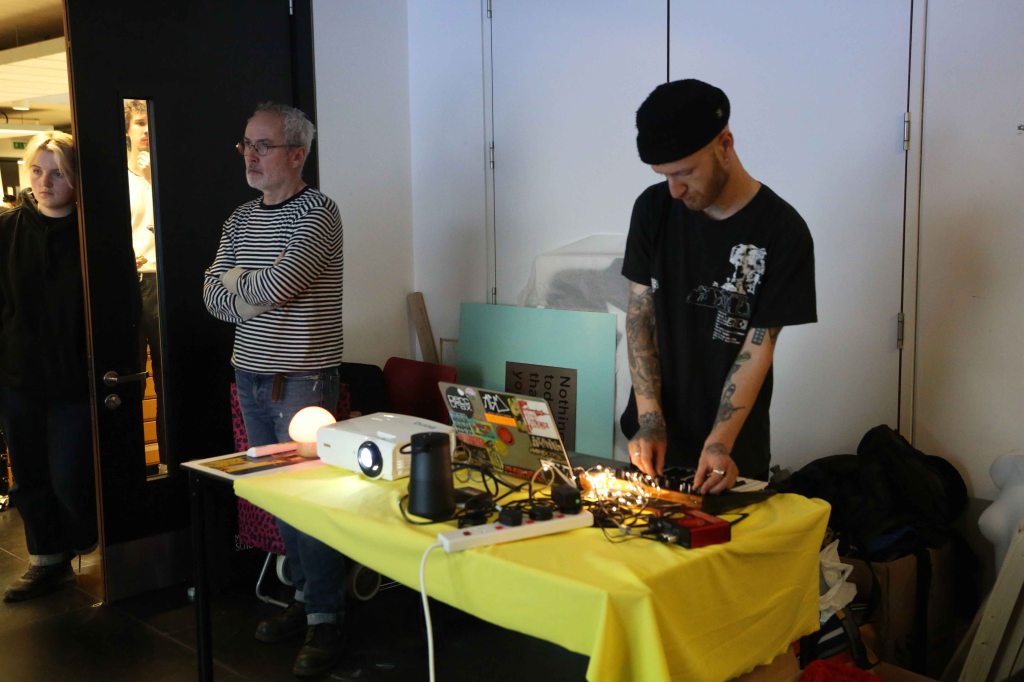
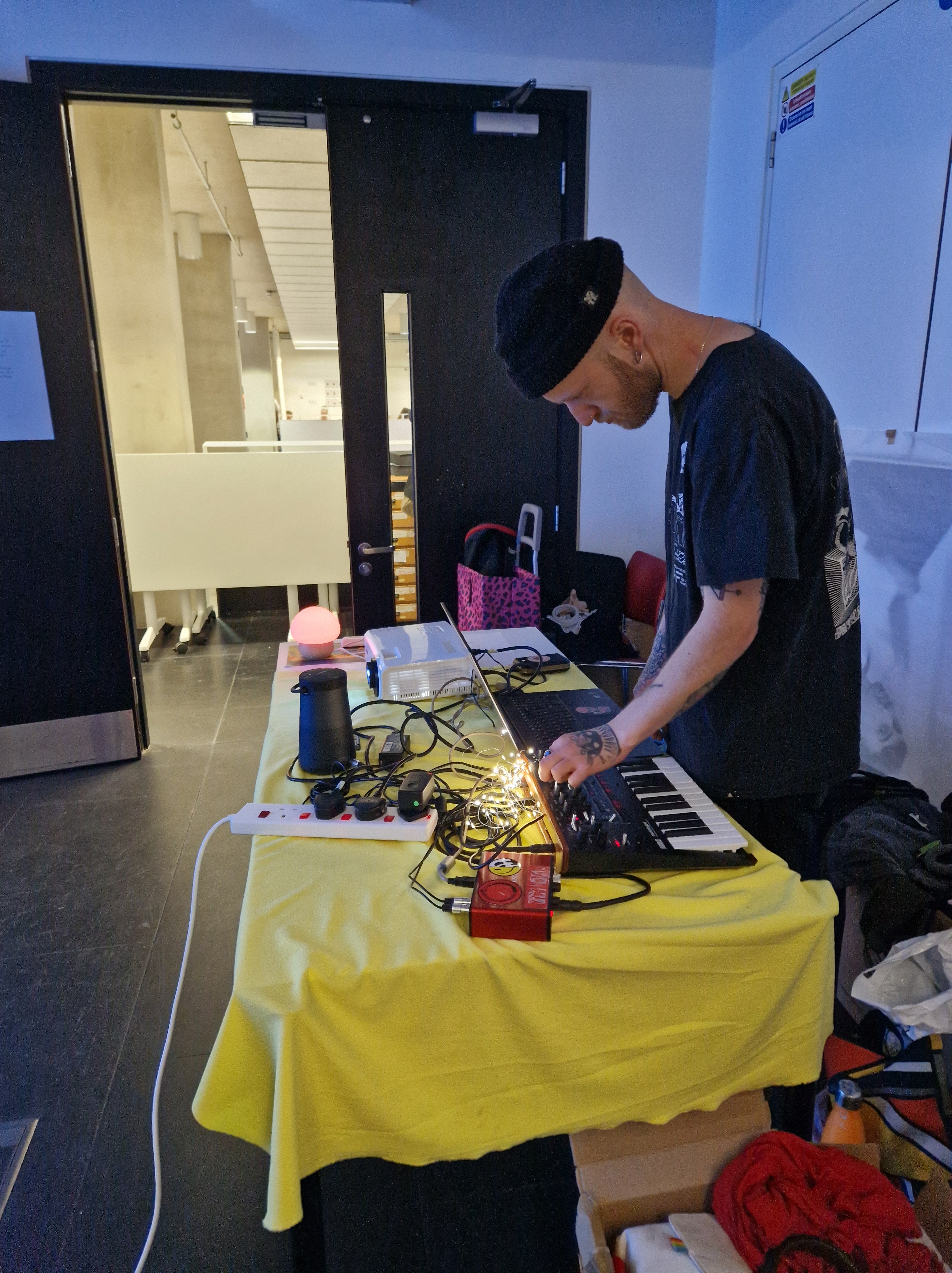
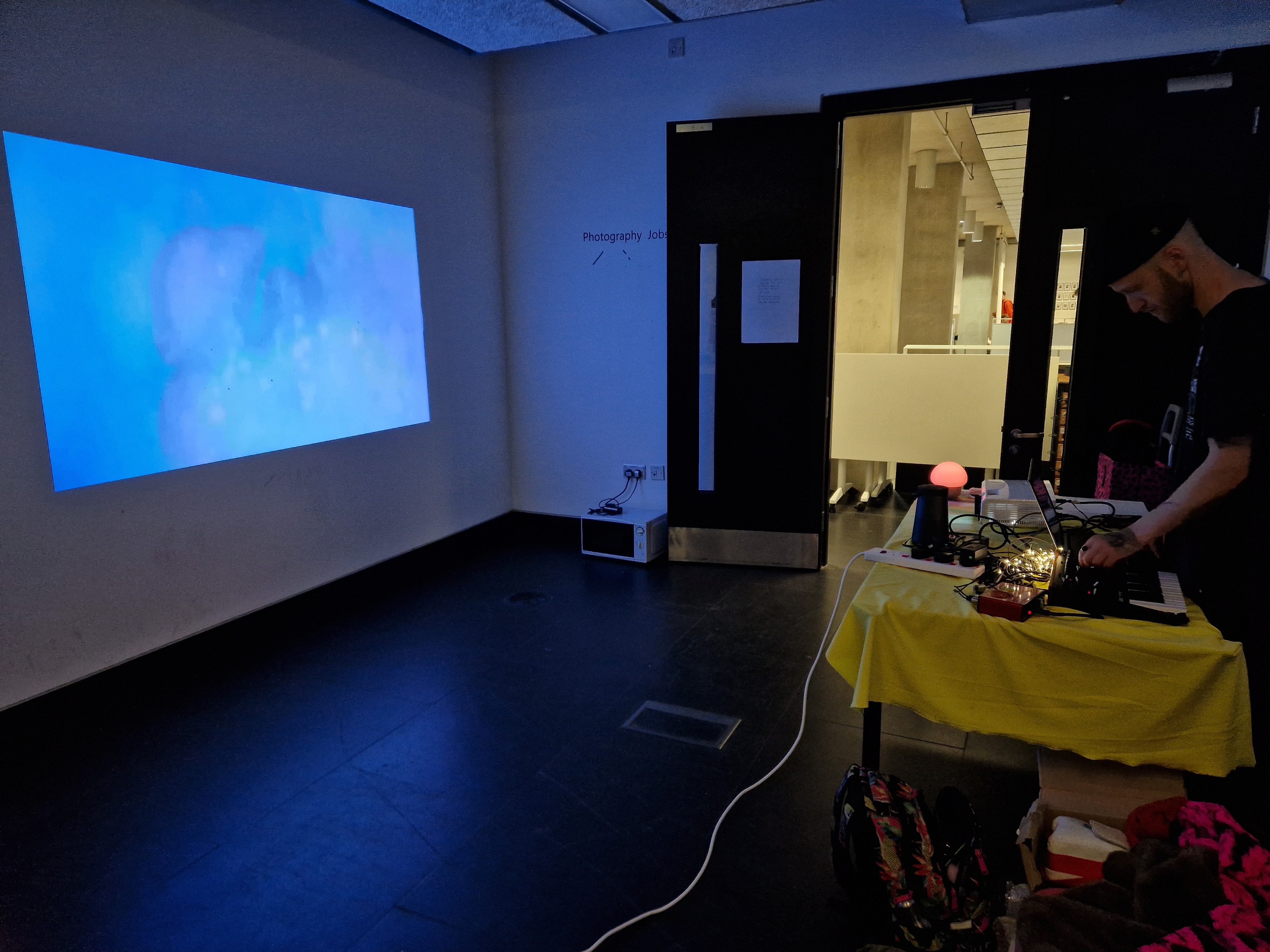
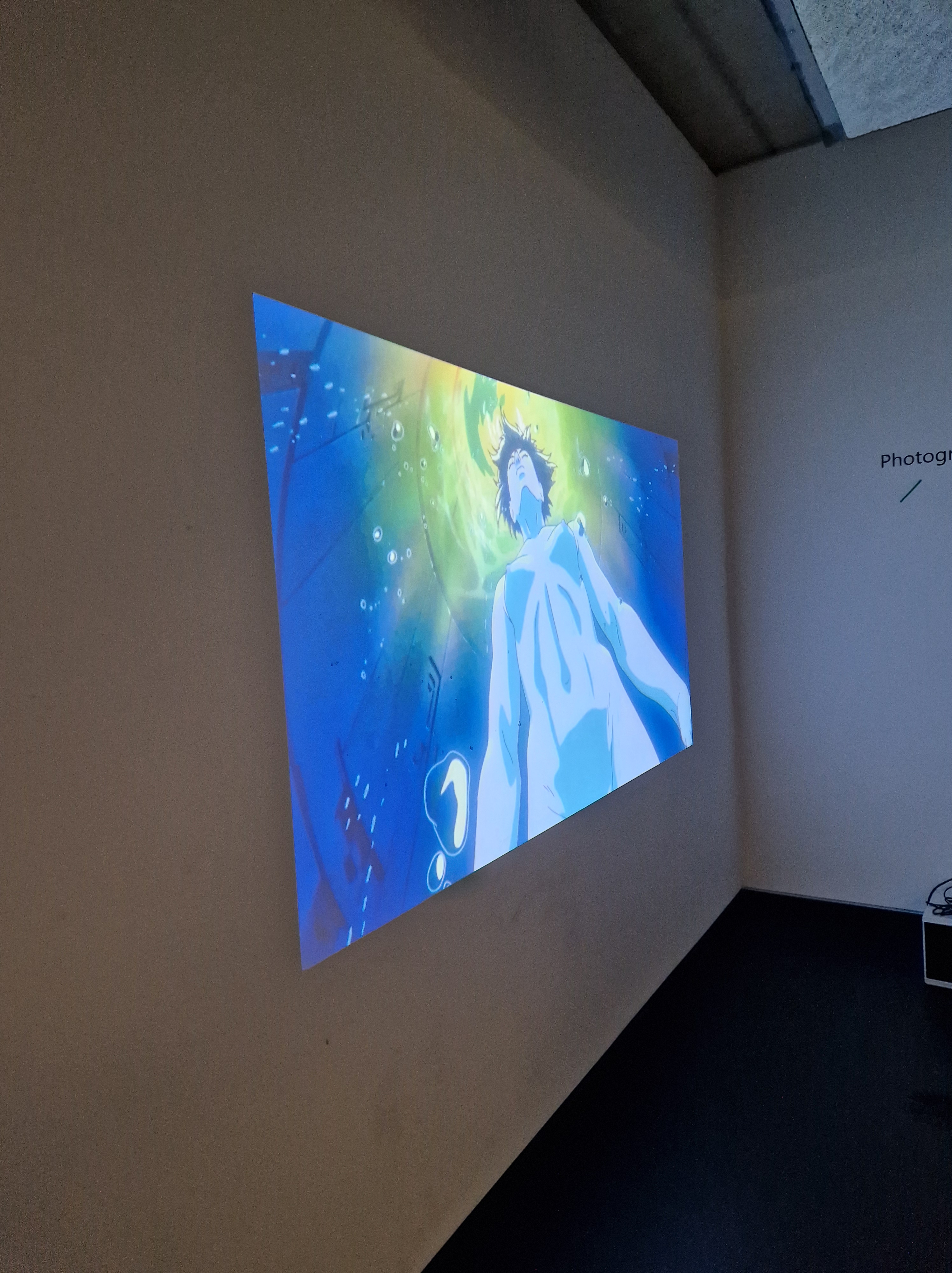
I think that the performance went well, and I am absolutely buzzing from this experience and already thinking of how and where we could perform it again.
We gave ourselves a good time to set up - 30 minutes, and everything was ready for the tutor's arrival. I was happy to see that quite a few students came as well, as I did not advertise it at all. Overall, we had a decent crowd. I am very proud of my film, and I think it came out very well - it was evident how hard I worked on it.
Shaun's synthesiser set was excellent and functioned very well with the film - as expected and as we practised. I really enjoyed collaborating with Shaun, and I am looking forward to doing more projects with him, as it's always such a fantastic experience.
If given the possibility to perform this in a different space, I would love to film the whole performance (that is one thing I wanted to do but didn't as the room was too short for the camera to have a good view). I also envisioned the performance to take place in complete darkness, with only the film lighting up the space. Unfortunately, we had issues with lights, which we couldn't turn off as they were sensory lights (I should have checked that).
The last thing is that I couldn't involve the device that didn't arrive on time - PLAYTRONICA, which would allow us to play on each other's bodies as a part of the performance and extension of my investigation of the human-machine relationship. I believe that it would elevate the performance even more and strengthen the point I wanted to make.
Overall, I am very content with how everything came together, and the amount of practice, preparation, and execution. There is, of course, a space for improvement, but as always, you learn and realise certain things only when you DO THEM!
COLLABORATION RESULT – SHORT FILM
I – BY ELA SKORSKA
https://drive.google.com/file/d/1abPhf9sIrjp4vBR34mk-wsO8IQ8l-9D1/view?usp=sharing
PERSONAL REFLECTION
Elzbieta Skorska 20055782 – Personal Reflection COLLAB.docx
My experience of collaboration at university has been a rollercoaster. Each venture has been quite challenging. So I was apprehensive about embarking on a collaborative assignment. I decided to approach it with an open mind and hopeful heart. I was excited about the challenges and growth ahead of me and the prospect of learning from others.
I chose the subject of MACHINE as it feels particularly relevant for the 21st century experience, where machines are increasingly intertwined with our lives. As Ferrari et al. aptly puts it, the lines between the human and the mechanical have been blurred.
Despite approaching the task with an unbiased and friendly attitude, my group decided not to participate or engage with me, so I was left alone to realise the project.
During my year abroad on student exchange in Spain, I was fortunate to have studied video art and experimental cinema as part of my curriculum. This opened my creative mind to the visual art of moving images.
Inspired by this newly found passion, I decided to use archival footage to create a short film, and with the support from seminar discussions and my tutors Sian Macfarlane and Martin Bence, I settled on making a piece about the subject of CYBORG.
When I contemplate this theme, I immediately think about the human body as the ultimate machine. I decided to oscillate between the MACHINE and BODY topics, using the concept of CYBORG to examine the relationship between the human body and technology.
My tutor, Martin Bence, directed me to Donna Haraway’s essay The Cyborg Manifesto. This work formed the conceptual basis of my project.
‘’It is not clear who makes and who is made in the relation between human and machine. It is not clear what is mind and what is body in machines (…). Insofar as we know ourselves in both formal discourse (for example, biology) and in daily practice (for example, the homework economy in the integrated circuit), we find ourselves to be cyborgs, hybrids, mosaics, chimaeras’’ (Haraway, 2016: p. 60)
Using archival moving images and a video editor, I pieced together a short film in which I reflected on what the future holds for the human-machine relationship, considering our intrinsic need for constant improvement, evolution, prolonging life and cybernetics as an answer to the error in coding we call death.
When the short film was ready, I began to consider creative ways to present my results. I reached out to music producer Shaun Azrak and invited him to improvise a monologue synthesiser live-set in response to the film. It was an important step that not only elevated the presentation of my film, but provided a rare and refreshing positive experience of collaboration.
If I could change one thing about the project, it would be access to a better space for the presentation. I had envisioned the performance in a very dark room, large enough to invite an audience. Additionally, because of the restrictions with space, I was unable to set up a camera to film the performance. I had also wanted to bring an instrument which allows you to play on the human body, but sadly it did not arrive on time as it was posted from outside the UK.
By diving deeply into my chosen topic, I expanded my understanding and arrived upon ideas that I had not considered before like cybernetics and presenting work in the form of performance.
It encouraged me to think beyond my usual approach, to look in a different direction, study topics outside of photography, seek inspiration in alternative places, and feed them back to my visual art practice.
I was grateful for the opportunity to further my exploration of video art; I am very passionate about it and would like to keep integrating it into my practice.
Ultimately, I learned some valuable lessons about collaboration. I now understand that collaboration works if you choose who to work with. Collaborating with people I have decided to collaborate with has been the most satisfying and enriching experience. I also understand that just because something doesn’t work within the university environment, this doesn’t mean it won’t work in the outside world and I should still try it to see what it feels like and how it can benefit me.
Despite a mixed experience with collaboration, I got fully immersed in practice, which Aristotle defined as ‘action that is valuable in itself (…)’ (Boon and Levine, 2018:13) – I believe it to be the point of any artistic endeavour. I struggled, I lost, I won, I learned and I collaborated, but most importantly – I took action that is valuable in itself – I created.
REFERENCES FOR PERSONAL REFLECTION
Boon, M. and Levine, G. (2018) Practice. Cambridge Massachusetts: The MIT Press
Haraway, D. (2016) Cyborg Manifesto [Online] University of Minnesota Press [Accessed on 2nd November 2023] http://ebookcentral.proquest.com/lib/warw/detail.action?docID=4392065
Francesco Ferrari, F; Paladino M-P; Jetten, J. (2016) ‘Blurring Human–Machine Distinctions: Anthropomorphic Appearance in Social Robots as a Threat to Human Distinctiveness’. International Journal of Social Robotics. 8:287–302
REFERENCES
Are Cyborgs Really Monsters?. Storied. [Online video] Available through YouTube [Accessed on 11/11/23] https://youtu.be/c9JMMXriVxY?si=192NqcQyRTe5JmP_
Artificial Muscles Robotic Arm Full Range of Motion + Static Strength Test (V11). Clone. [Online video] Available through YouTube [Accessed on 11/11/23] https://youtu.be/guDIwspRGJ8?si=jkQ1XDc-PxeONJZI
björk – all is full of love. björk. [Online video] Available through YouTube [Accessed on 11/11/23] https://youtu.be/u0cS1FaKPWY?si=RC5n4j2r1Ek-AUFK
Blade Runner – Final scene, “Tears in Rain” Monologue (HD). Guillermo St. [Online video] Available through YouTube [Accessed on 27/10/23] https://youtu.be/NoAzpa1x7jU?si=gEzQP-FfDs5SZgyX
blade runner – i want more life father – HD. —. [Online video] Available through YouTube [Accessed on 01/11/23] https://youtu.be/O5MDGMvrSJc?si=phXTVHOgDNvtdOBm
Chip implants to enhance my connection with the planet | Moon Ribas | TEDxManchester. TEDxTalks. [Online video] Available through YouTube [Accessed on 02/11/23] https://youtu.be/O92DEeTcTQg?si=sPUs5_IJVqMKVqc6
Cremaster Cycle Trailer. Celluloiddreams. [Online video] Available through YouTube [Accessed on 27/10/23] https://youtu.be/6xWtS9HsP4U?si=X9n4HpGuXMgwhZWz
Cyborg (1/10) Movie CLIP – I’m a Cyborg (1989) HD. Movieclips. [Online video] Available through YouTube [Accessed on 27/10/23] https://youtu.be/B62wGNHDYHA?si=tvam68l5cFmoTuWR
eXistenZ (Trailer). Behind The Science Fiction. [Online video] Available through YouTube [Accessed on 10/11/23] https://youtu.be/CXgOUa91GHg?si=I2hTakyUThheR7J-
Ghost in the Shell (Boat Scene). Detello_. [Online video] Available through YouTube [Accessed on 28/10/23] https://youtu.be/7JukN3q4YOg
Donna Haraway, “A Cyborg Manifesto”. Rebecca Longtin. [Online video] Available through YouTube [Accessed on 20/10/23] https://youtu.be/XiF9SBrzWoU?si=sBvsHqHa-Ukadf1q
How we’ll become cyborgs and extend human potential | Hugh Herr. TED. [Online video] Available through YouTube [Accessed on 20/10/23] https://youtu.be/PLk8Pm_XBJE?si=S92pcdAq_9g95dkB
‘Is the Human Body ”The Ultimate Machine”? ‘. Pain and Performance Solutions. [Online] April 12 2019.[Accessed on 02/10/23]
‘Is the Human Body ”The Ultimate Machine”? ‘. Pain and Performance Solutions. [Online] April 12 2019.[Accessed on 02/10/23] https://santarosapainandperformance.com/human-body-muscle-dysfunction/
I Think, Therefore I Am | Blade Runner (1982) 4K Clip. Sci-Fi Punisher. [Online video] Available through YouTube [Accessed on 20/10/23] https://youtu.be/5hHtgt7tK_A?si=__6ffszkML_jL-Qu
Luke gets his new hand, but robot advises. Kyle Campbell. [Online video] Available through YouTube [Accessed on 11/11/23] https://youtu.be/g2r_I0xe02g?si=H27yxP0Ech4LBns8
Moon Ribas – The dancer whose arm vibrates every time there’s an earthquake. BigSpeak Speakers Bureau. [Online video] Available through YouTube [Accessed on 26/10/23] https://youtu.be/A8o9ISOgLBc?si=lhd2OT6xQpShlw6P
Neil Harbisson: I listen to color. TED. [Online video] Available through YouTube [Accessed on 26/10/23] https://youtu.be/ygRNoieAnzI?si=gZO97A2PPXkSNYc2
1. What does “POSTHUMAN” mean? Dr. Ferrando (NYU) – Course “The Posthuman” Lesson n. 1. Posthumans. [Online video] Available through YouTube [Accessed on 12/11/23] https://youtu.be/zi6APy0oW9A?si=TzvTyz1BUeBYFHgz
Play music by touch or wrestling | Playtronica Devices. [Online video] Available through YouTube [Accessed on 20/11/23] Playtronica.https://youtu.be/UkdHc5RB_io?si=oFeAq7xr84oH0lko
Reflective Writing. The Writing Center at MTSU. [Online video] Available through YouTube [Accessed on 27/10/23] https://youtu.be/ME8BrEVa7yU?si=lw0Ei2FT3LgsK52N
Spider-Man 2 – How Otto Octavius became Dr. Octopus [4K]. CINEMATIC STYLE. [Online video] Available through YouTube [Accessed on 02/11/23] https://youtu.be/ZNkBNFuBwUc?si=zXOBm5GSUdWsyCLE
Star Trek: First Contact: The Borg Queen. Binge Society. [Online video] Available through YouTube [Accessed on 02/11/23] https://youtu.be/VPeCMZpvAhY?si=0pWttq26KYkjCpq1
‘The Funambulist. Deleuze Episode 5: The Body as a Desiring Machine.’ The Funambulist. [Online] 24 June 2011. [Accessed on 02/10/23] https://thefunambulist.net/editorials/deleuze-the-body-as-a-desiring-machine
The Six Million Dollar Man Opening and Closing Theme (With Intro) HD Surround. TeeVees Greatest. [Online video] Available through YouTube [Accessed on 11/11/23] https://youtu.be/0CPJ-AbCsT8?si=o4pZfrPyHz2b8quu
The Tragic Death Of The World’s First Human Cyborg. Grunge. [Online video] Available through YouTube [Accessed on 20/10/23] https://youtu.be/81H7gZjwNJg?si=j1XHrxljMzslLVUI
This intense AI anger is exactly what experts warned of, w Elon Musk. Digital Engine. [Online video] Available through YouTube [Accessed on 02/10/23] https://youtu.be/b2bdGEqPmCI?si=LS2P4yYrxi1R3y-z
Top 10 Memorable Female Robots in Movies and TV. Watch Mojo.com. [Online video] Available through YouTube [Accessed on 28/10/23] https://youtu.be/qghADJ_YnP4?si=sdlgjzcBWkfq_Sb-
Two robots debate the future of humanity. RISE Conf. [Online video] Available through YouTube [Accessed on 02/10/23] https://youtu.be/1y3XdwTa1cA?si=-NQ3oJOzmHwAEoCD
Very Nice, Very Nice. 1961. Short. Arthur Lipsett. [Online video] Available through YouTube [Accessed on 02/10/23] Claire Clench. https://youtu.be/YaUPoXtk6Ds?si=kNSKqpoaSHdzXY0y
What on Earth is The Cremaster Cycle (1994-2002). Style is Substance. [Online video] Available through YouTube [Accessed on 02/10/23] https://youtu.be/N2jpPvcE5_A?si=Z9-VLqYIDgs2L1v5
 Ela Skorska