PAREDOLIA
BRIEF
For this assignment we were asked to produce a single-channel video of a maximum duration of 3 minutes, whose structure must be in single sequence plane.
The resulting work must record a performative action presented in real-time, without digital editing. The action must have been designed expressly for the camera, emphasizing the relationship with it in some way, with only sound and/or credit editing allowed.
In addition, the video can optionally develop one of these options or both, although this is not essential:
– Enter images that come from a screen, establishing a relationship between the image filmed live and the ‘represented’ on that screen / s.
– Enter text, but without resorting to editing/post-production elements.
RESEARCH
Single-channel video is a video art work using a single electronic source, presented and exhibited from one playback device. Electronic sources can be any format of videotape, DVDs or computer-generated moving images utilizing the applicable playback device (such as a VCR, DVD player or computer) and exhibited using a television monitor, projection or another screen-based device. Historically, video art was limited to unedited videotape footage displayed on a television monitor in a gallery and was conceptually contrasted with both broadcast television and film projections in theatres. As technology advanced, the ability to edit and display video art provided more variations and multi-channel video works became possible as did multi-channel and multi-layered video installations. However, single-channel video works continue to be produced for a variety of aesthetic and conceptual reasons and the term usually now refers to a single image on a monitor or projection, regardless of image source or production.
Single-channel works that are produced explicitly for playback on a monitor are primarily concerned with narrative or directly addressing the audience rather than providing an immersive experience found in installation works.
A one-shot cinema (also one-take film, single-take film, or continuous shot feature film) is a full-length movie filmed in one long take by a single camera, or manufactured to give the impression it was.
This is when we talk about a single shot: when several scenes are shown using one, continuous shot, without any cut or interruption. That single shot tells more situations with a change of plans, framing, and even location!
10 Greatest ‘One Shot’ Scenes In Movie History
Notable single-channel video works
Richard Serra “Television Delivers People” (1973)
Classic short film, a critique of the corporate mass media with elevator music as the soundtrack.
Birthday Suit with Scars and Defects – Extrait
By Lisa Steele (1974). A nude lady who on camera points out the scars and defects on her body, describing it as a birthday suit. She also depicts them by the way she got the scars/defects. It is an interesting work, and I guess back in the day, it was pioneering and original. However, since then I have heard of many works of art/performances based on this concept. Nevertheless, it is a brilliant idea in its simplicity and impact, and something to consider and build on, but not copy.
Kiss the Girls: Make Them Cry
https://stiftung-imai.de/en/videos/katalog/medium/0247
By Dara Birnbaum (1979). A video based on zooming in and out of short clips of what looks like a TV show (shots of men and women). Text and voice reading and singing, then the theme song playing, then more footage of women from the tv show. Very strange, and I am rather confused and really don’t know what to think about it. If that is the point of this video, then it succeeded.
reverse television.mov
By Bill Viola (1983). Unsurprisingly, Bill Viola’s video art is very clever – what else to expect? I have been a long-term fan of this artist, and he never fails to deliver meaningful artwork.
In Reverse Television, he films people being filmed from the point of view of the TV, starting at the camera in silence. These 30 seconds clips were broadcasted on the TV between the shows. It gives you an impression of yourself – the viewer, being the TV itself, and how the world would look like to you if you were the TV, just a constant flow of people staring at you.
LECTURE 03.11.22
Today we started a new unit with a lecture on video art, experimental practices and counterculture from the 60s and 70s.
ARTSIST we looked at:
Nam June Paik https://www.paikstudios.com/
Nam June Paik was a Korean American artist. He worked with a variety of media and is considered to be the founder of video art. He is credited with the first use of the term “electronic super highway” to describe the future of telecommunications.
Nam June Paik Tv Buddha (’74)
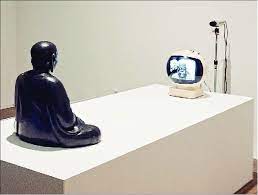
Why Nam June Paik’s “TV Buddha” Is So Cool
Nam June Paik: Electronic Superhighway
Robots, video synthesizers, experimental music—discover the multidimensional creative world of electronic artist Nam June Paik. Working across media since the 1960s, Paik established himself as an early innovator of video art, setting the scene for many of today’s contemporary art practices. Through groundbreaking performances, immersive artworks, and interdisciplinary collaborations, Paik established new approaches to music and television, and changed the way we look at screens.
Charlotte Moorman performs with Paik’s ‘TV cello’
Paik collaborated extensively with cellist Charlotte Moorman (1933-1991), including in their 1976 Kaldor Public Art Project, in which they presented an exhibition of Paik’s objects and more than 40 performances in Sydney and Adelaide. In one of these performances at the Art Gallery of NSW, pictured here, Moorman plays Paik’s ‘TV cello’
Nam June Paik : Zen for TV, 1963 (Executed 1981) at MoMA
Nam June Paik : Zen for TV, 1963 (Executed 1981) at MoMA Altered television set.
Steina and Woody Vasulka http://www.vasulka.org/
Steina Vasulka and Woody Vasulka are early pioneers of video art, and have been producing work since the early 1960s. The couple met in the early 1960s and moved to New York City in 1965, where they began showing video art at the Whitney Museum and founded The Kitchen in 1971.
Steina and Woody Vasulka Calligrams 1970
https://www.fondation-langlois.org/html/e/page.php?NumPage=474 (video here)
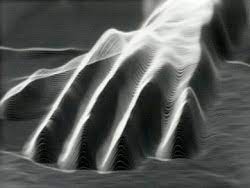
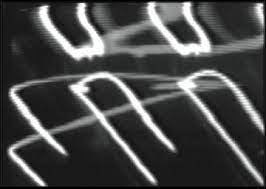
A lot of artists who created work around that time created work that spoke of/confronted the TV.
Triangle in Front of Square in Front of Circle in Front of Triangle
https://www.vdb.org/titles/triangle-front-square-front-circle-front-triangle
In this elegant demonstration, Sandin explains the mistake of using common language concepts and spatial relations to describe what actually can happen on the video screen. The images generated in the tape act according to specific parameters set by the artist. Sandin has stated “The analog Image Processor was programmed to implement the logic equations; if square, if triangle and circle show circle.” In this tape, Sandin is in effect arguing for a distinct video vocabulary that replaces the classical concept of perspective. This tape was produced at the University of Illinois Chicago.
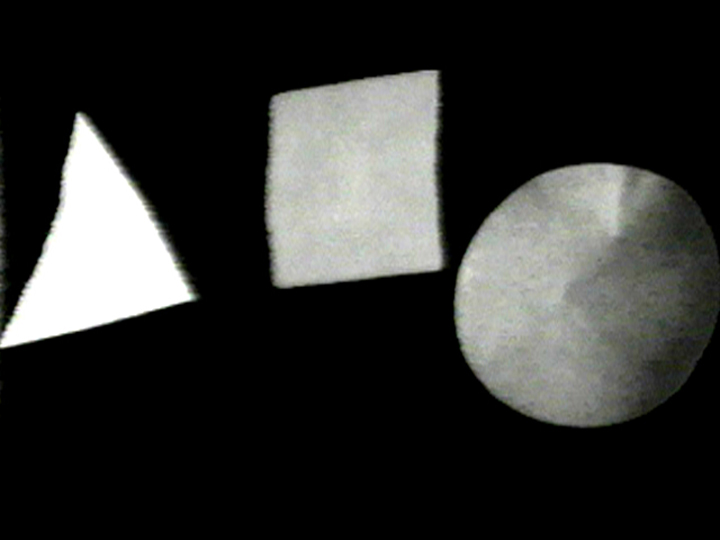
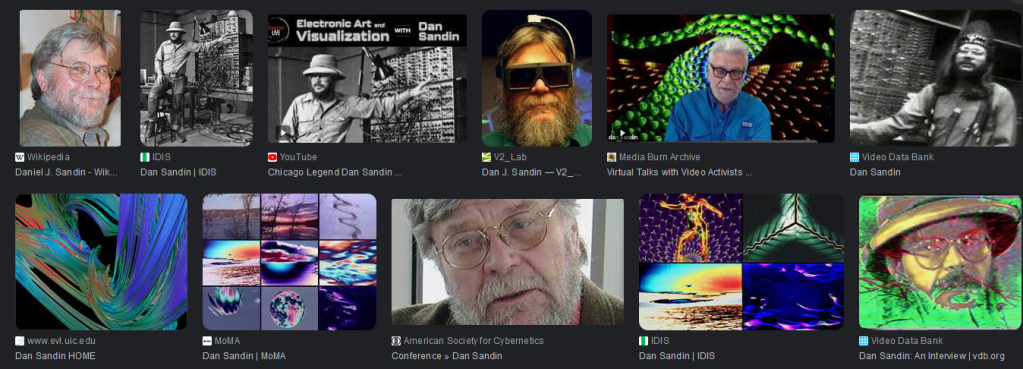
Daniel J. Sandin https://www.evl.uic.edu/dan/
Daniel J. Sandin (born 1942) is an American video and computer graphics artist, designer and researcher. He is a Professor Emeritus of the School of Art & Design at University of Illinois at Chicago, and co-director of the Electronic Visualization Laboratory (EVL) at the University of Illinois at Chicago. He is an internationally recognized pioneer in computer graphics, electronic art and visualization.
spiral5PTL
Live performances, real-time instruments: Spiral 5 PTL (Perhaps The Last) 1979 –Dan Sandin, Tom DeFanti, and Mimi Shevitz Live recording of performance before a small studio audience
Dan Sandin | Spiral5PTL | Processing Chicago 02/04/13
Dan Sandin’s talk on Spiral5PTL at Processing Chicago.
Ant Farm – Media Burn – West Coast Video Art – MOCAtv
“Media Burn” employs performance and spectacle in service of media critique, featuring the explosive collision of two of America’s most potent cultural symbols: the automobile and television. On July 4, 1975, at San Francisco’s Cow Palace, Ant Farm presented what they termed the “ultimate media event.” In this alternative Bicentennial celebration, a “Phantom Dream Car”—a reconstructed 1959 El Dorado Cadillac convertible—was driven through a wall of burning TV sets. The spectacle of the Cadillac crashing through the burning TV sets became a visual manifesto of the early alternative video movement, an emblem of an oppositional and irreverent stance against the political and cultural imperatives promoted by television and the passivity of TV viewing.
Three Transitions (1973) | Peter Campus
Peter Campus – Double Vision [1971]
Performer/Audience/Mirror by Dan Graham (1975)
Recorded at Video Free America in San Francisco, this work is a phenomenological inquiry into the audience/performer relationship and the notion of subjectivity/objectivity. Graham stands in front of a mirrored wall facing a seated audience; he describes the audience’s movements and what they signify. He then turns and describes himself and the audience in the mirror. Graham writes: “Through the use of the mirror the audience is able to instantaneously perceive itself as a public mass (as a unity), offsetting its definition by the performer (‘s discourse). The audience sees itself reflected by the mirror instantly while the performer’s comments are slightly delayed. First, a person in the audience sees himself ‘objectively’ (‘subjectively’) perceived by himself, next he hears himself described ‘objectively’ (‘subjectively’) in terms of the performer’s perception.”
In my opinion, it is a very interesting performance, when I started watching it, I was unsure, but it grew on me over time. Very impressed how that man can be talking like this non-stop. I wonder if he rehearsed it or did he come up with all that on the spot.
Back and Forth (Michael Snow, 1969)
Antoni Muntadas (Barcelona, 1942) is a postconceptual multimedia artist, who resides in New York since 1971. His work often addresses social, political and communications issues through different media: such as photography, video, text and image publications, the Internet, and multi-media installations.
Bruce Nauman-Stampin in the studio 1968
Acconci Vito Centers 1971
Nancy Holt (October 22, 1986)
Nancy Holt discusses work of the last 18 years. She stresses that her work is mainly site-specific, public art. Her work incorporates tunnels, pipes, water and electricity. Holt discusses her landscape and large-scale park designs, emphasizing her interest in drainage and electrical systems. Holt responds to audience comments on collaboration with architects and engineers.
Victor Burgin – Photopath (1967-69)
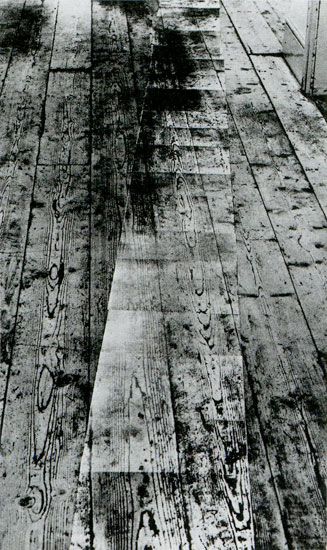
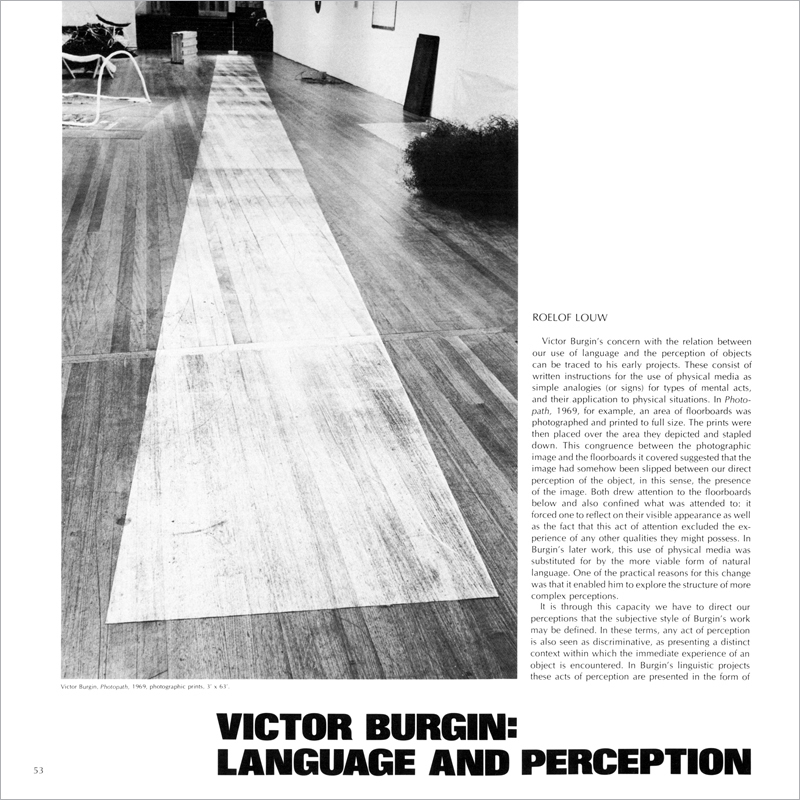
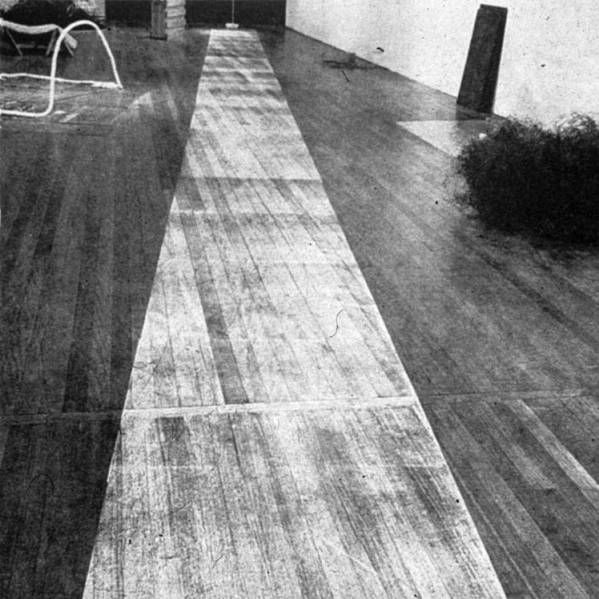

Victor Burgin, installation view of Photopath (1967-69), realized for the exhibition When Attitudes Became Form, Fruitmarket Gallery, Edinburgh, 1985.
In his very short story ‘On Exactitude in Science’, Jorge Luis Borges describes a civilization that desires maps of ever-finer detail. Eventually a map is produced at one-to-one in scale, covering the entire land it represents. The citizens take to living on the map, which slowly decays and dissolves back into its territory.
Most maps, like most photographs, are not made at the scale of their objects. Neither are they co-extensive with them. They are portable miniatures that relay evidence and impressions from one place to another. What use would there be for a photograph the size of the Pyramids, displayed at the site of the pyramids? Victor Burgin’s Photopath is unique: a Borgesian image-object that seems to break every rule of photography, while adhering so strictly to the medium’s oldest aspiration, to substitute itself for the world.
In the spirit of 1960s conceptualism, Photopath is not photographic, strictly speaking. The work itself is a card, bearing a simple set of instructions:
“A path along the floor, of proportions 1×21 units, photographed Photographs printed to actual size of objects and prints attached to the floor so that images are perfectly congruent with their objects.”
Anyone can make a Photopath and each manifestation will be a singular, site-specific instance of the idea. It can be made on any floor and at any size, although the proportions must remain 1×21. Burgin has made the piece several times, notably as part of the exhibition When Attitudes Become Form: Live in Your Head at London’s Institute of Contemporary Art in 1969, and in the rotunda of the Guggenheim Museum, New York, in 1971. In 2011 technicians made a colour version of Photopath for a survey show of conceptual art at The Art Institute of Chicago. It was installed in the Institute’s then-new glass-walled foyer. During the exhibition the new wooden floor was bleached by bright sunlight, and when Photopathcame to be removed it left behind a dark patch, a perfectly congruent shadow of its former self.
Victor Burgin: image and text in changing times
Victor Burgin’s Between stands ‘between’ the two main forms of his practice as an artist and writer. In this presentation, Burgin will look back from 2020 to a book published in the mid-1980s, which in turn looks back to the mid-1970s, describing how his ideas and practices have evolved in response to changing times.
A Line Made by Walking – Richard Long
Ana Mendieta – 2 minutos de arte
Ana Mendieta – A Brief History of Female Artists
JOAN JONES – VERTICAL ROLL 1972
“Boy meets girl” por Eugenia Balcells (1978)
Dara Birnbaum’s ‘Technology/Transformation: Wonder Woman (1978-79)’
Explosive bursts of fire open Technology/Transformation, an incendiary deconstruction of the ideology embedded in television form and pop cultural iconography. Appropriating imagery from the 1970s TV series Wonder Woman, Birnbaum isolates and repeats the moment of the “real” woman’s symbolic transformation into super-hero. Entrapped in her magical metamorphosis by Birnbaum’s stuttering edits, Wonder Woman spins dizzily like a music-box doll. Through radical manipulation of this female Pop icon, she subverts its meaning within the television text. Arresting the flow of images through fragmentation and repetition, Birnbaum condenses the comic-book narrative — Wonder Woman deflects bullets off her bracelets, “cuts” her throat in a hall of mirrors — distilling its essence to allow the subtext to emerge. In a further textual deconstruction, she spells out the words to the song Wonder Woman in Discoland on the screen. The lyrics’ double entendres (“Get us out from under… Wonder Woman”) reveal the sexual source of the superwoman’s supposed empowerment: “Shake thy Wonder Maker.” Writing about the “stutter-step progression of ‘extended moments’ of transformation from Wonder Woman,” Birnbaum states, “The abbreviated narrative — running, spinning, saving a man — allows the underlying theme to surface: psychological transformation versus television product. Real becomes Wonder in order to “do good” (be moral) in an (a) or (im)moral society.”
Pipilotti Rist – I’m Not The Girl Who Misses Much
Rist created I’m Not The Girl Who Misses Much when MTV was at the height of its cultural influence. Here, the artist approaches rock music with the tools of the genre, taking female representations and the repetitive strategies of Pop music to absurd extremes. Images of the artist singing the work’s title (a line adapted from the Beatles’ theme Happiness is a Warm Gun) are played at high and low speed, with jumbled video effects that manage to convey the effect of a procession of images of almost pictorial features. Rist’s manipulation turns her voice into a parody of female hysteria and her body into that of a grotesque dancing doll. He uses obsessive mimesis and exhausts any possible legibility of the words to finally include John Lennon singing the “real” song.
Peter Land “Peter Land d. 5 Maj 1994” (1994)Not Yet Rated
Andy Warhol’s ‘Empire’
The full version of Andy Warhol’s Empire.
Empire is a 1965 American black-and-white silent art film by Andy Warhol. When projected according to Warhol’s specifications, it consists of eight hours and five minutes of slow motion footage of an unchanging view of New York City’s Empire State Building. The film does not have conventional narrative or characters, and largely reduces the experience of cinema to the passing of time. Warhol stated that the purpose of the film was “to see time go by.”
A week after the film was shot, experimental filmmaker Jonas Mekas (who was cinematographer for Empire) speculated in the Village Voice that Warhol’s film would have a profound influence on avant-garde cinema. In 2004, Empire was included in the annual selection of 25 motion pictures added to the National Film Registry by the Library of Congress, who deemed it “culturally, historically, or aesthetically significant”. Empire was filmed at 24 frames per second, and is meant to be seen in slow motion at 16 frames per second, extending its 6+1⁄2-hour length to 8 hours and 5 minutes. The film consists of a stationary view of the Empire State Building lasting the entirety of the running time. The film begins with a blank white screen, a result of the camera being calibrated for nighttime filming. As the sun sets almost imperceptibly, the figure of the building emerges and its details become clearer. As the sun sets further, the building is enveloped in darkness. The building’s floodlights are turned on, illuminating its upper levels and spire. Lights in the windows of other structures go on and off. In the background, a beacon atop the Metropolitan Life Insurance Company tower flashes at intervals corresponding to every 15 minutes in real time (it flashes a single time every 15 minutes and at hour it flashes the time of day). Eventually, the floodlights go dark and the image in the remainder of the film is nearly total darkness. At three points in the film, the reflections of the crew, including Warhol, are seen in the windows of the Rockefeller Foundation office, where the work was filmed, as the office lights were not shut off before the crew started shooting after changing the film magazines.
The initial idea for Empire came from John Palmer, a young filmmaker affiliated with Jonas Mekas. Palmer had been sleeping occasionally on the roof of Mekas’s Film Maker’s Cooperative, which had an impressive view of the tower, only a few blocks away. He told Mekas that he thought an image of the floodlit building would make a good Warhol film, and Mekas passed the idea to Warhol. Around the time Warhol considered the idea, he had completed (in late 1963) his first extended-length film, the 5-hour Sleep, which shows multiple views of a man sleeping; Empire was his second long film. In April 1964, the upper 30 floors of the Empire State Building were floodlighted for the first time in connection with the opening of the New York World’s Fair in Queens. As the only floodlit skyscraper in New York City, the impact of the lighting was dramatic, with one person calling the tower’s illuminated crown “a chandelier suspended in the sky”. The floodlights were essential to Warhol’s concept for the film, as there would be almost nothing to see without them.
For a shooting venue, Warhol made arrangements to use an office belonging to the Rockefeller Foundation on the 41st floor of the Time-Life Building at 51st Street and 6th Avenue. Cinematography took place overnight on July 24 and 25, 1964. Present for filming were Mekas, Warhol, Palmer, Gerard Malanga, Marie Desert (Mekas’ girlfriend), and Henry Romney (of the Rockefeller Foundation). From the window at the northeast corner of 51st Street and 6th Avenue, the camera was pointed southeast toward the Empire State Building at 34th Street and 5th Avenue, taking in the Metropolitan Life Insurance Company tower with its blinking beacon at the corner of Madison Avenue and 24th Street, and the bulkier New York Life Insurance Company building at Madison Avenue and 26th Street.
In contrast to Warhol’s earlier films, which had been shot with a Bolex camera limited to three minutes of shooting time, Empire was filmed on an Auricon camera that allowed for takes of around 33 minutes. In the Rockefeller Foundation office, Mekas framed the shot for Warhol’s approval, and filming commenced at 8:06 pm, about ten minutes before sunset. Mekas’ article about the shooting printed in the Village Voice the next week described a lighthearted night of filmmaking, with Warhol discoursing on the Empire State Building as the most prominent site in New York, visited by celebrities and tourists alike, and various people in the room imploring Warhol to pan the camera. Shooting wrapped at 2:42 a.m. the next day, with 654 feet of film exposed.
Andy Warhol Screen Test 3 Edie Sedgwick
A person’s face is filmed in silence. Emotions. Stillness. So little but so much.
Terry Fox – The Children’s Tapes
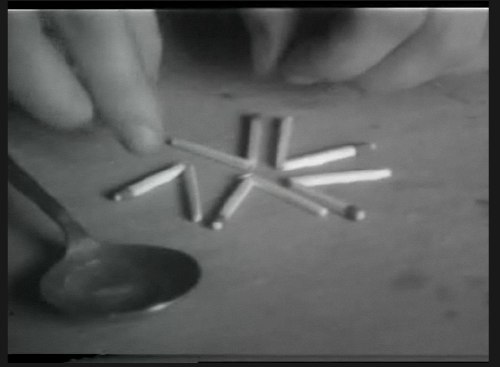
Fischli & Weiss – Equilibrium
24 HOUR PSYCHO
Douglas Gordon
Psycho, 1993 Video installation 24 h Exhibition Modern Art Oxford, February 2016 [Excerpt]
Marina Abramović – Art must be beautiful…
Marina Abramović Lisson Gallery, London 2010
Art must be beautiful, Artist must be beautiful ‘I brush my hair with a metal brush held in my right hand and simultaneously comb my hair with a metal comb held in my left hand. While so doing, I continuously repeat “Art must be beautiful, Artist must be beautiful”, until I have destroyed my hair and face.’ Also: Rhythm 10 & Rhythm 0 Video: Max Reed 28.10.10
LECTURE 10.11.22
Today we learned how to use Adobe Premiere Pro in Spanish, so I didn’t follow, but I remember a little about how to use it from Unit X at MMU. I don’t think I will be able to use it in Spanish, so I will have to find a different editing program.
Martha Rosler – Semiotics of the Kitchen 1975
In this performance, Rosler takes on the role of an apron-clad housewife and parodies the television cooking demonstrations popularized by Julia Child in the 1960s. Standing in a kitchen, surrounded by a refrigerator, table, and stove, she moves through the alphabet from A to Z, assigning a letter to the various tools found in this domestic space. Wielding knives, a nutcracker, and a rolling pin, she warms to her task, her gestures sharply punctuating the rage and frustration of oppressive women’s roles. Rosler has said of this work, “I was concerned with something like the notion of ‘language speaking the subject,’ and with the transformation of the woman herself into a sign in a system of signs that represent a system of food production, a system of harnessed subjectivity.”
CONCEPTING THE PROJECT
IDEAS FOR WRITING DOWN TITLE:
- sign language
- made of matches
- sand
- written on a rolled paper
IDEA FOR TITLE:
What is Pareidolia?
Apophenia and pareidolia
HOW TO WRITE ARTWORK DESCRIPTION:
How To Write The Perfect Artwork Description
When it comes to selling your art, the more information that you provide in your artwork description the better! After all, this is where your customer will turn to learn more about your piece. The best artwork descriptions on Artfinder comprise two sections: one detailing the inspiration behind the piece and another presenting the bare facts.
The inspirational bit
This component of the description will need to refer directly to the artwork at hand. There’s no perfect formula for this, however it does need to be engaging! Remember that it should reflect you and your personality, as well as your enthusiasm for your work.
You may wish to mention the following:
- What inspired you to create the piece?
- What techniques did you use and why?
- What does it mean to you?
- What does it represent in terms of your artistic work as a whole?
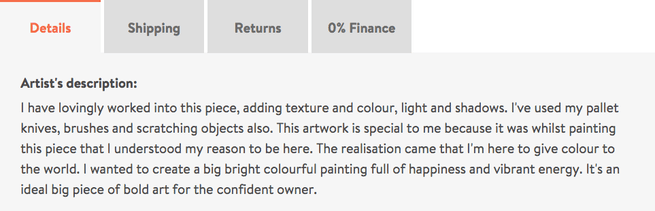
Bear in mind that along with our usual criteria for excellent listings, we look for detailed and inspirational artwork descriptions for our Art of the Day email feature. So if you tick all of the boxes, you are more likely to be selected!
The factual bit
It’s worth spending a little more time on this component to ensure that you have every possible factor that the customer could wish to know. The good news is, though, that you can then copy and paste the same formula into each listing and tweak it to make it relevant to your artwork.
- Materials used – include canvas type, materials used e.g. pastels or pencils
- Dimensions – include these in centimeters and inches for extra clarity
- Packaging – explain your packaging process. Will the work be packed in bubble wrap or rolled? Do you offer to ship artworks both rolled and stretched?
- Delivery – expand on your courier and shipping times
- Anything else to add? Maybe you want to encourage the customer to get in touch with you directly with any questions
SHOOTING PAREIDOLIA
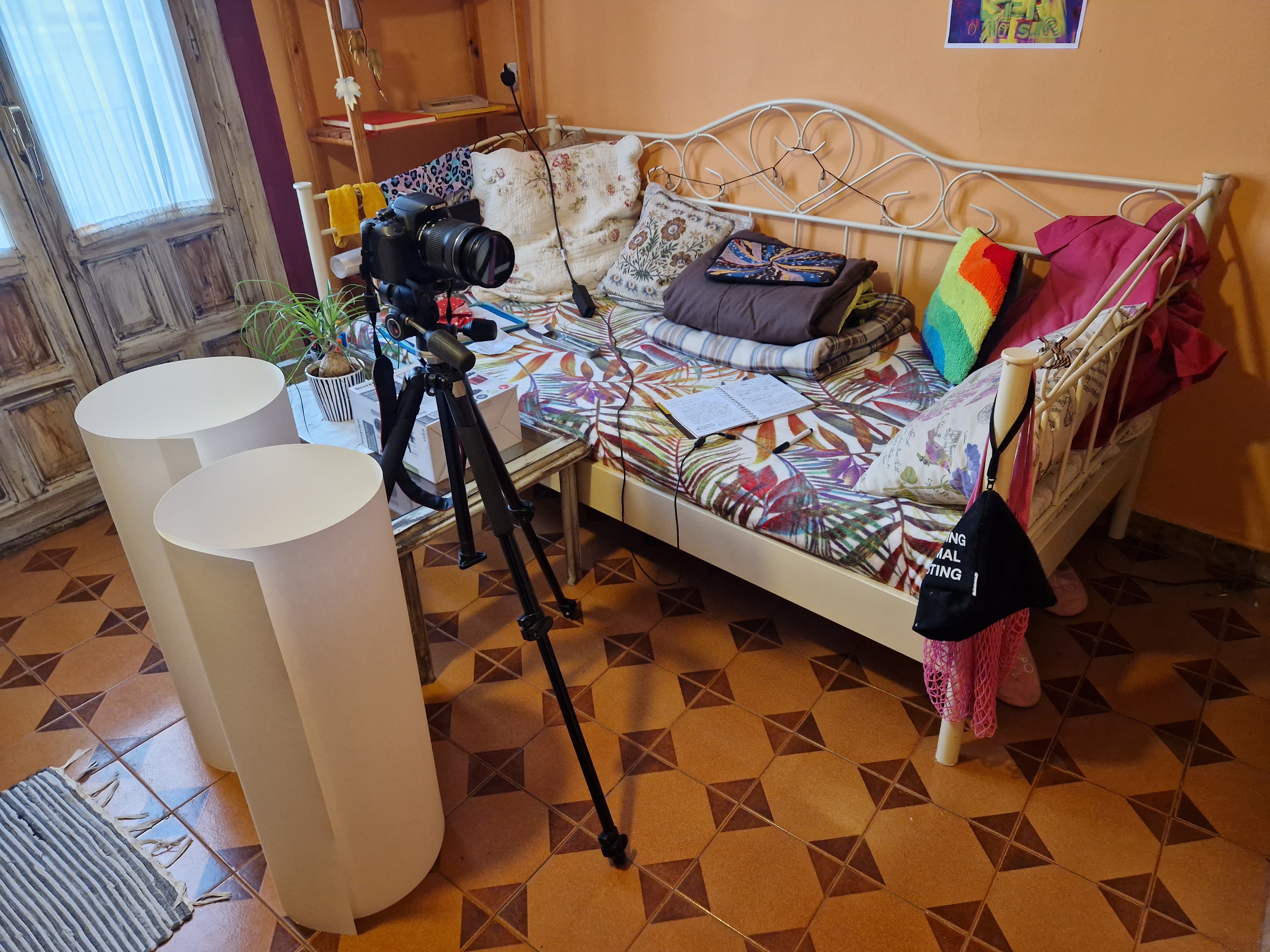
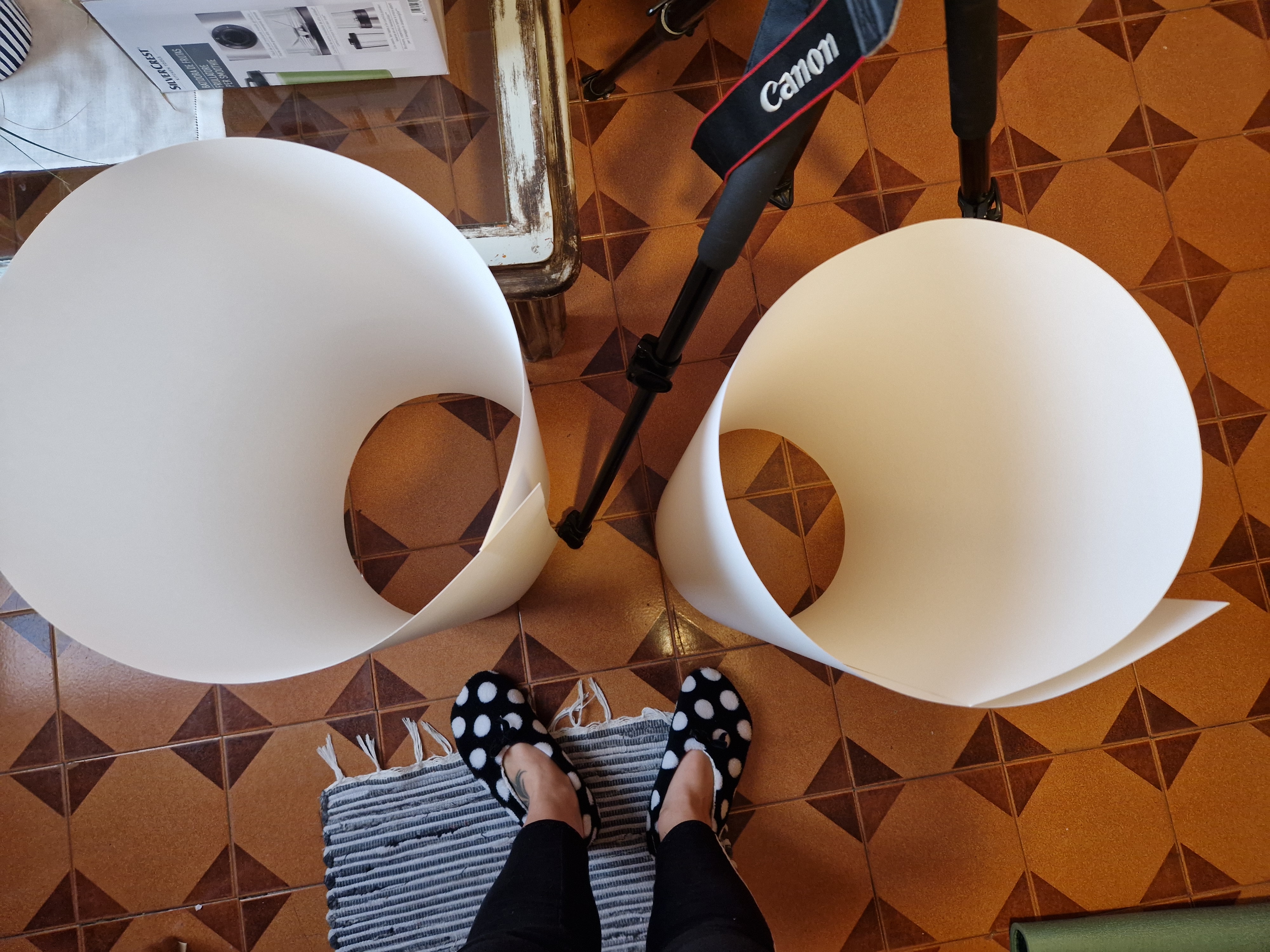
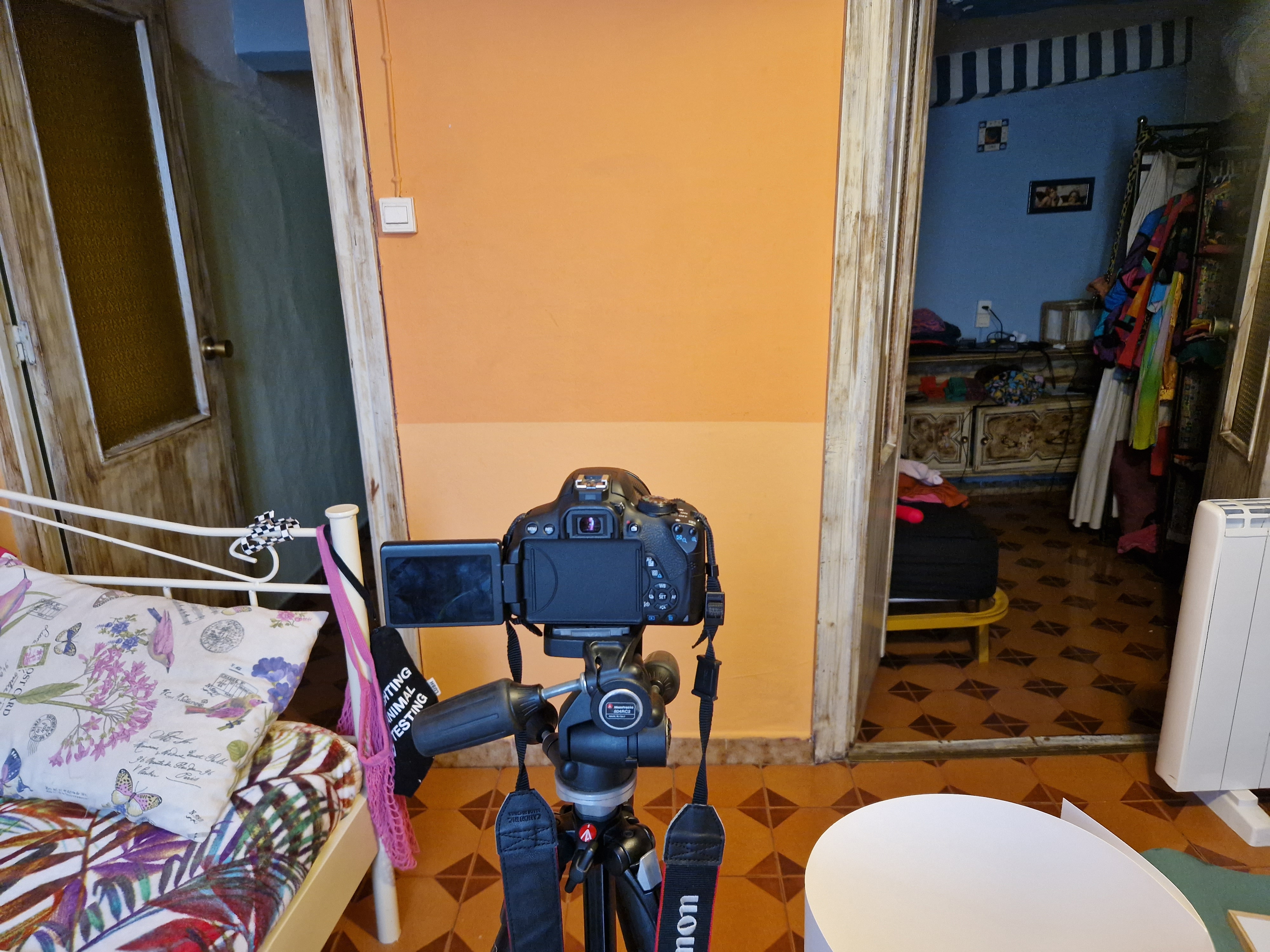
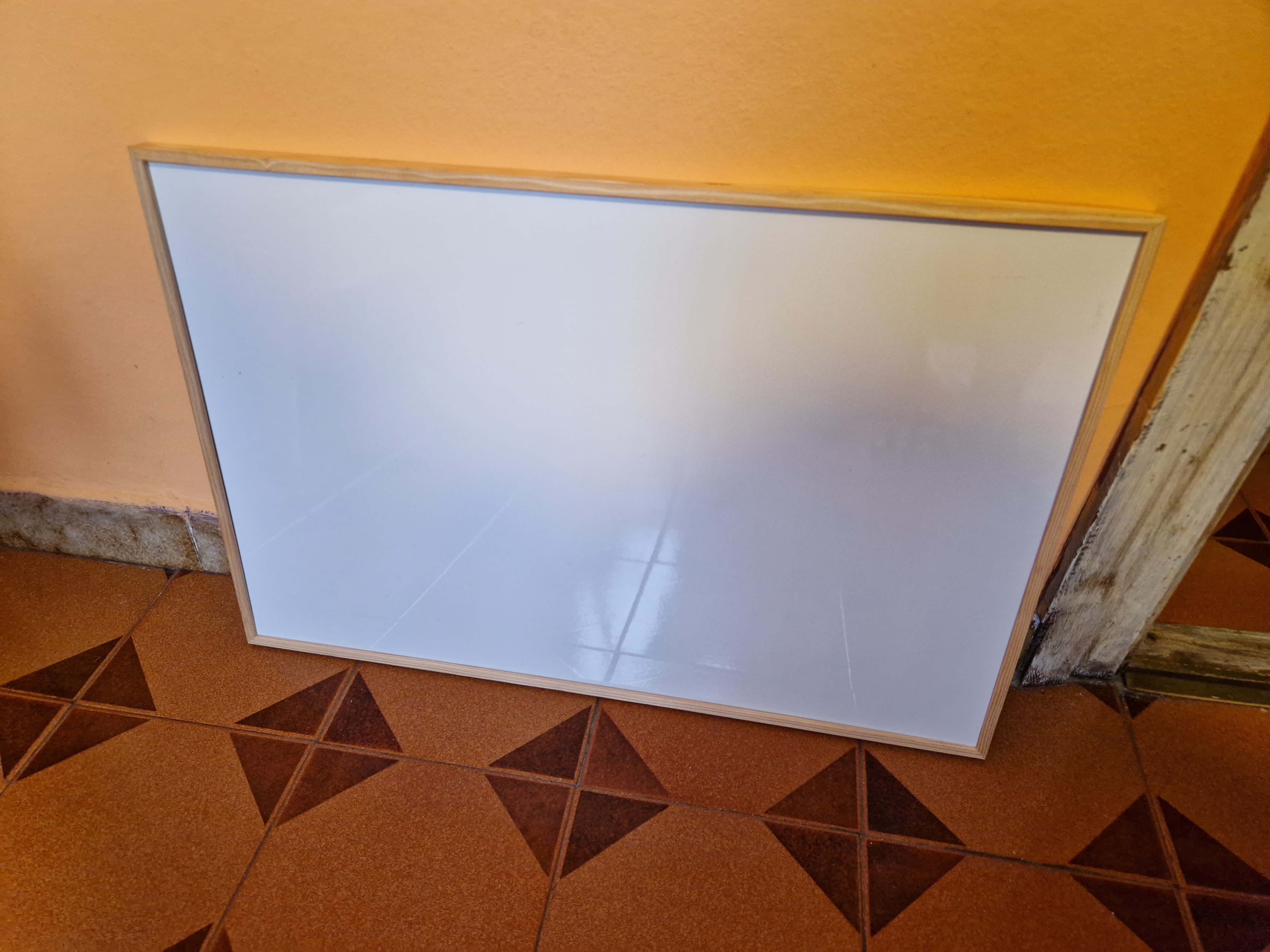
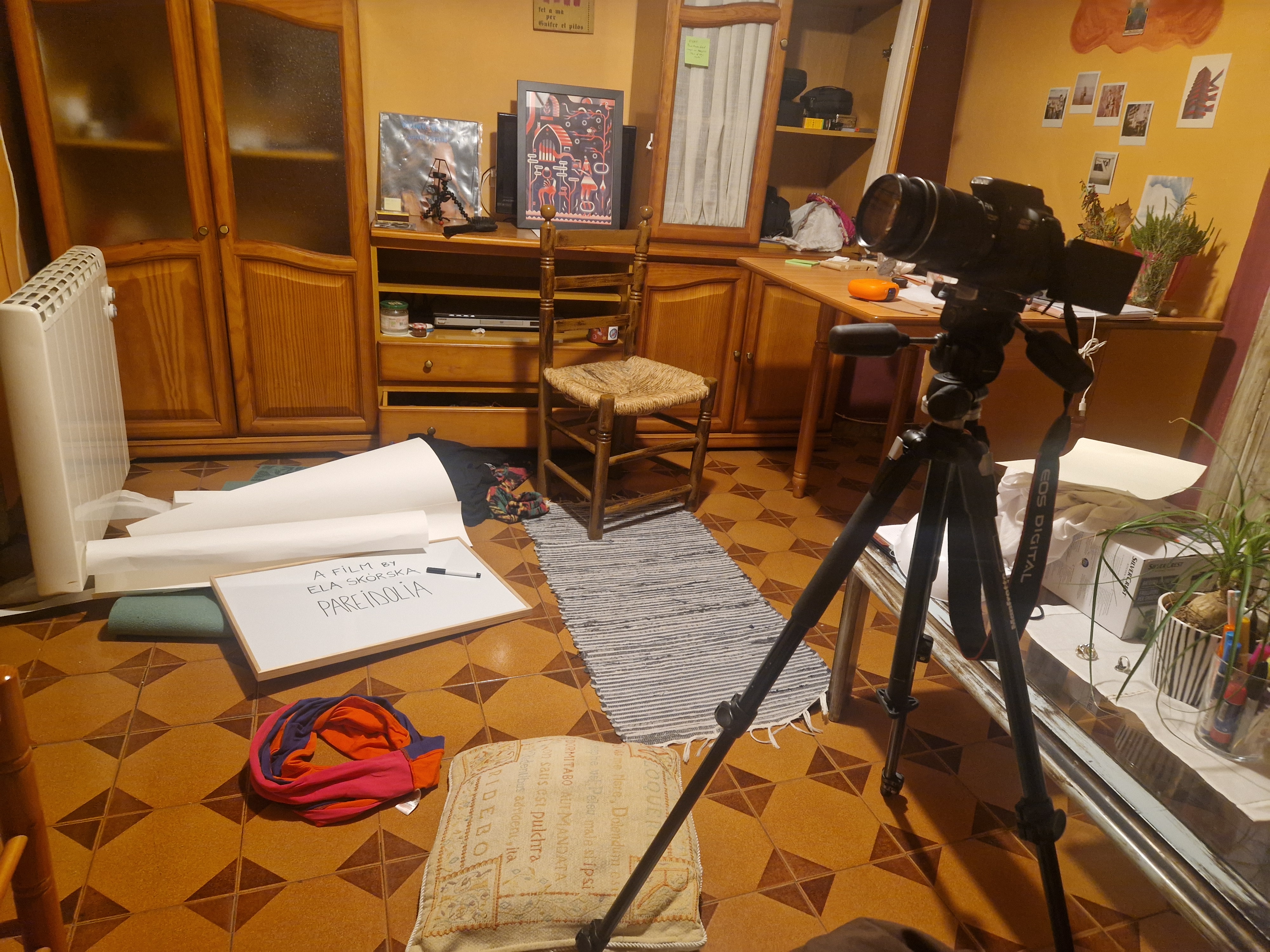
SCREENSHOTS OF THE VIDEO
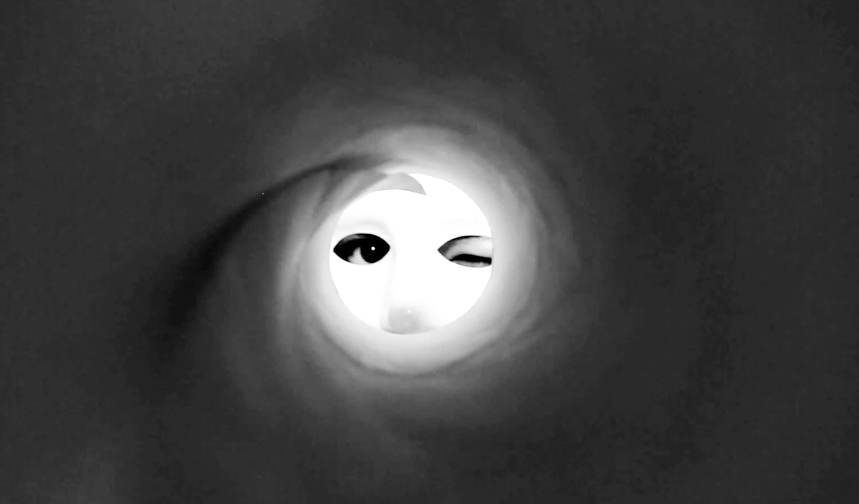

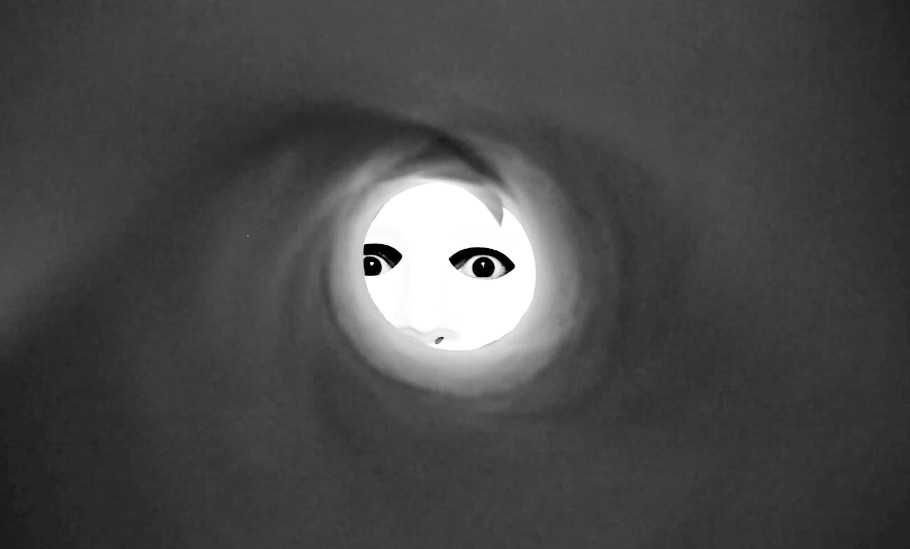
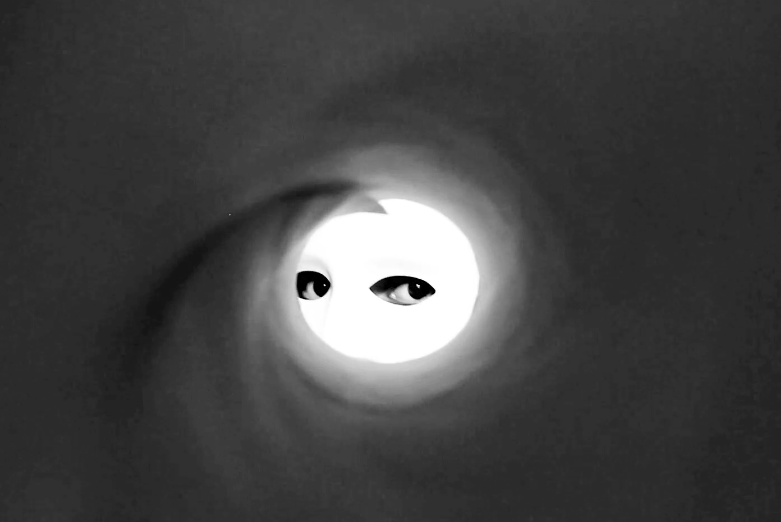
FINAL WORK – PAREIDOLIA
Pareidolia by Ela Skorska (2022)
Elzbieta Skorska
Pareidolia, 2022
DV, black and white, sound, 2’43’’
Single channel
Pareidolia came to me very naturally as an extension and development of my latest
photographic project – ARTificial, where I explored the theme of the truth in photography, concluding that there is no such thing due to the beauty of the human factor and the possibilities of manipulation.
The title – Pareidolia – the tendency to perceive a specific, often meaningful image in a
random or ambiguous visual pattern, perfectly applies to both projects. Each individual’s pareidolia is unique, as is each individual’s perception of art. Perhaps there is a connection here, a connection that I explore in this project.
In my work, I am asking a question: who is looking at who?
Is the camera looking at you, or you are looking at the camera, or is it both?
And what is born of this mutual exchange of seeing?
The inspiration came from a reflection on how both media manipulate reality, but also an acknowledgement that that is one of their main purposes. Certainly, when both
mediums came to life, they were used mostly for documenting and attempting to copy
reality. These days are gone, and when considering the possibilities and creativeness
within both mediums, they are endless, abstract, challenging, and groundbreaking. They are anything and everything.
My reflections and methods as well as simplicity of used materials, were mainly inspired by the works of Nam June Paik, Dan Sandin, Steina and Woody Vasulka, and Terry Fox.
I constructed this work as a single-channel flat sequence video, executed digitally in my
flat, using simple but effective methods of paper, plain mask and no words. I didn’t want
to use any language as I felt the performance would be more universal if only images
and basic sounds – whispers, heartbeat and paper rustling, were used.
Peeping through a lens, we choose the world we see, and we choose the world we
show. And more often than not, we display our deepest subconscious self and decide to
share the theatre of our imagination and dreams with others.
Silence, please, the show is about to start.
REFERENCES
Acconci Vito Centers 1971. Kristoffer ardeña. [Online video] [Accessed on 10/11/22] https://youtu.be/BIZOIoklszI
Ana Mendieta – A Brief History of Female Artists. CamiiW. [Online video] [Accessed on 10/11/22] https://youtu.be/K3dH1inq3tQ
Ana Mendieta – 2 minutos de arte. LS / Galería. [Online video] [Accessed on 10/11/22] https://youtu.be/0zA16FYjc6U
A Line Made by Walking – Richard Long. Educational Videos for Art. [Online video] [Accessed on 20/11/22] https://youtu.be/SlcFTNcH2y8
Andy Warhol’s ‘Empire’. dradny. [Online video] [Accessed on 10/11/22] https://youtu.be/YSDDyzCagMY
Andy Warhol Screen Test 3 Edie Sedgwick. SangareMP. [Online video] [Accessed on 15/11/22] https://youtu.be/hLW_sXv44Uc
Ant Farm – Media Burn – West Coast Video Art – MOCAtv. The Museum of Contemporary Art. [Online video] [Accessed on 10/11/22] https://youtu.be/FXY6ocvaZyE
Apophenia and pareidolia. Science World. [Online video] [Accessed on 11/11/22] https://youtu.be/JyreYdCiThs
Ares Visuals. Antoni Muntadas. [Online] [Accessed on 12/11/22] https://aresvisuals.net/fichas/63_muntadas_antoni/
Artfinder. How To Write The Perfect Artwork Description. [Online] [Accessed on 12/11/22]. https://www.artfinder.com/blog/post/perfect-artwork-description/#/
Back and Forth (Michael Snow, 1969). LB. [Online video] [Accessed on 15/11/22] https://youtu.be/ivryfBTpRxI
Birthday Suit with Scars and Defects – Extrait. Tënk Canada. [Online video] [Accessed on 10/11/22] https://vimeo.com/438996236
“Boy meets girl” por Eugenia Balcells (1978). Guillermo Tizón. [Online video] [Accessed on 15/11/22] https://youtu.be/0VXdIejgHQs
Charlotte Moorman performs with Paik’s ‘TV cello’. Art Gallery of NSW. [Online video] [Accessed on 10/11/22] https://youtu.be/-9lnbIGHzUM
Bruce Nauman-Stampin in the studio 1968. Can Châu. [Online video] [Accessed on 10/11/22] https://youtu.be/YRF5FukKiCo
Dan Sandin | Spiral5PTL | Processing Chicago 02/04/13. evltube. [Online video] [Accessed on 18/11/22] https://youtu.be/wdysHHZZTYA
Dara Birnbaum’s ‘Technology/Transformation: Wonder Woman (1978-79)’. Image Oscillite. [Online video] [Accessed on 16/11/22] https://youtu.be/wJhEgbz9piI
David Campany. Victor Burgin, Photopath, 1967/1969. [Online] [Accessed on 10/11/22] https://davidcampany.com/victor-burgin-photopath-1967-1967/
Fischli & Weiss – Equilibrium. Museo Jumex. [Online video] [Accessed on 12/11/22] https://youtu.be/gzSsFIjaylI
Going Around in Circles. Video Data Bank. [Online video] [Accessed on 12/11/22] https://www.vdb.org/titles/going-around-circles
JOAN JONES – VERTICAL ROLL 1972. Tedoré. [Online video] [Accessed on 12/11/22] https://youtu.be/jpstpzBDJ7s
Marina Abramović – Art must be beautiful… Maxwell Reed. [Online video] [Accessed on 12/11/22] https://youtu.be/XmllstbdN9U
Martha Rosler – Semiotics of the Kitchen 1975. Everything has its first time. [Online video] [Accessed on 12/11/22] https://youtu.be/ZuZympOIGC0
Nam June Paik: Electronic Superhighway. San Francisco Museum of Modern Art. [Online video] [Accessed on 12/11/22] https://youtu.be/tPNkTBwVaAw
Nam June Paik. [Online] [Accessed on 10/11/22]. https://www.paikstudios.com/
Nam June Paik : Zen for TV, 1963 (Executed 1981) at MoMA. Artist in New York City. [Online video] [Accessed on 11/11/22] https://youtu.be/-_EGwhZ64LQ
Nancy Holt (October 22, 1986). SCI-Arc Media Archive. [Online video] [Accessed on 11/11/22] https://youtu.be/Uz4uq89QKaQ
Pareidolia by Ela Skorska (2022). Elzbieta Skorska. [Online video] [Accessed on 21/11/22] https://vimeo.com/manage/videos/795167813
Performer/Audience/Mirror by Dan Graham (1975). fft films. [Online video] [Accessed on 21/11/22] https://youtu.be/5PqNAG9Q33o
Peter Campus – Double Vision [1971]. blacknightie. [Online video] [Accessed on 21/11/22] https://youtu.be/p3V0KkBD8n4
Peter Land “Peter Land d. 5 Maj 1994” (1994). Galleri Nicolai Wallner. [Online video] [Accessed on 20/11/22] https://vimeo.com/310317284
Pipilotti Rist – I’m Not The Girl Who Misses Much. Mito Tomi. [Online video] [Accessed on 23/11/22] https://youtu.be/hjvWXiUp1hI
reverse television.mov. REMEDIA2010. [Online video] [Accessed on 23/11/22] https://youtu.be/4GrIN9m83zw
Richard Serra “Television Delivers People” (1973). KunstSpektrum. [Online video] [Accessed on 19/11/22] https://youtu.be/LvZYwaQlJsg
Spielmann, Y. (2004) ‘Steina and Woody Vasulka, Calligrams 1970’. Foundation Daniel Langlois. [Online] [Accessed on 17/04/22]. https://www.fondation-langlois.org/html/e/page.php?NumPage=474
spiral5PTL. Dan Sandin. [Online video] [Accessed on 23/11/22] https://youtu.be/hw9kY85DkfE
10 Greatest ‘One Shot’ Scenes In Movie History. WhatCulture. [Online video] [Accessed on 19/11/22] https://youtu.be/Vr6x34wIwc8
Three Transitions (1973) | Peter Campus. FilmZ. [Online video] [Accessed on 19/11/22] https://youtu.be/qPQ4LjbI65M
24 HOUR PSYCHO. KunstmuseumWolfsburg. [Online video] [Accessed on 19/11/22] https://youtu.be/a31q2ZQcETw
Victor Burgin: image and text in changing times. MACK. [Online video] [Accessed on 19/11/22] https://youtu.be/GnKMwnYA4K0
Video Data Bank. The Children’s Tapes. [Online] [Accessed on 12/11/22] https://www.vdb.org/titles/childrens-tapes
Video Data Bank. Triangle in Front of Square in Front of Circle in Front of Triangle. [Online] [Accessed on 12/11/22] https://www.vdb.org/titles/triangle-front-square-front-circle-front-triangle
What is Pareidolia?. Grant Wilson. [Online video] [Accessed on 19/11/22] https://youtu.be/PfoPDuQvsTU
Why Nam June Paik’s “TV Buddha” Is So Cool. bennyandthejets. [Online video] [Accessed on 11/11/22] https://youtu.be/F3NWNqH2Ayw
Videoworks: The Videos of Sadie Benning (1989-1998). Internet Archive. [Online video] [Accessed on 11/11/22] https://archive.org/details/BenningVideoworks
Wave. The single shot, the differences of the long take, and its effects in the viewer. . https://wavefilmakers.com/the-single-shot-and-its-effects-in-the-viewer/
Wikipedia. Antoni Muntadas. [Online] [Accessed on 12/11/22] https://en.wikipedia.org/wiki/Antoni_Muntadas
Wikipedia. Nam June Paik. [Online] [Accessed on 12/11/22] https://en.wikipedia.org/wiki/Nam_June_Paik
Wikipedia. Daniel J. Sandin. [Online] [Accessed on 12/11/22]. https://en.wikipedia.org/wiki/Daniel_J._Sandin
Wikipedia. Single-channel video. [Online] [Accessed on 12/11/22] https://en.wikipedia.org/wiki/Single-channel_video
Wikipedia. Steina and Woody Vasulka. [Online] [Accessed on 12/11/22]. https://en.wikipedia.org/wiki/Steina_and_Woody_Vasulka
 Ela Skorska